

Meta Sells $97.5 Billion of Itself to Build a Superintelligence Smart Enough to Explain Where the Money Went
Meta raised its planned stock sales to $97.5 billion to fund AI and "personal superintelligence," letting the chipmakers it pays buy in and collecting $25 billion of it sometime before November 2027. This satirical business dispatch asks whether it is a visionary bet or the most expensive layaway plan in human history, and concludes: yes.

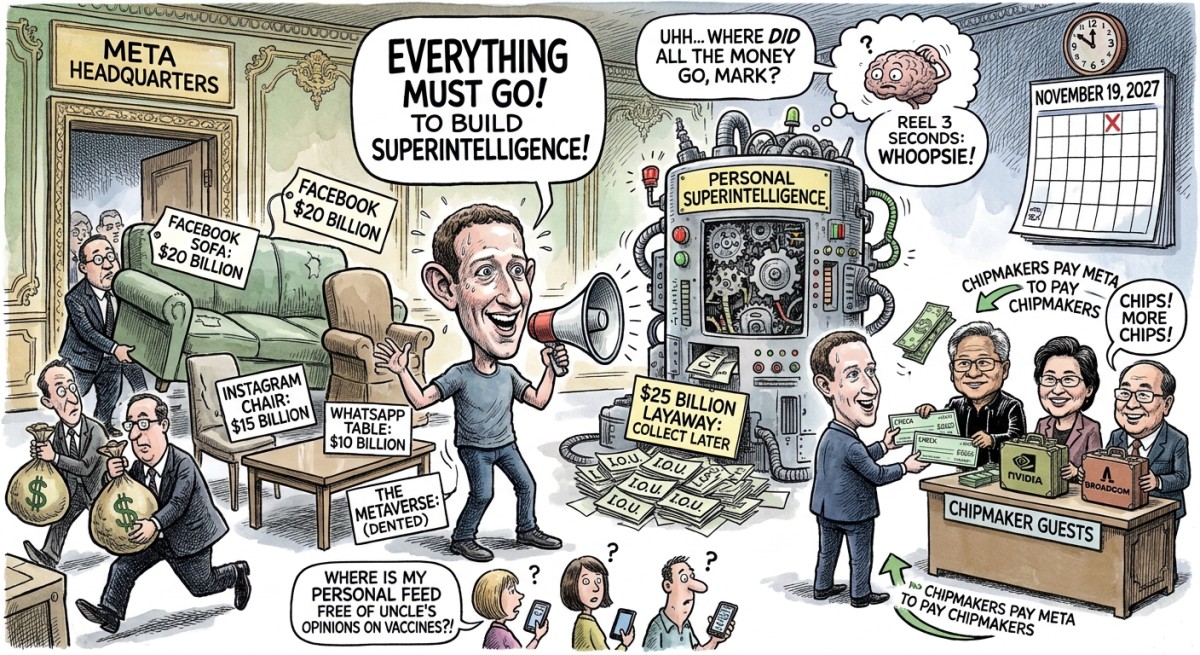
Meta has discovered the oldest trick in the family album: when the money runs low, sell the furniture to the guests. On Tuesday the Facebook parent raised the planned size of its stock offerings to $97.5 billion, its largest ever, all to build what it calls "personal superintelligence." Nobody asked for a personal superintelligence. Most people would settle for a personal feed without their uncle's opinions on vaccines.
The menu is generous. There is $25 billion of common stock at $625 a share, $12.5 billion of preferred stock at $50 a share paying 6.5 percent, and a separate program to sell up to $60 billion more "over time at prevailing market prices," which is what a garage sale sounds like after it hires Goldman Sachs. The par value is $0.000006 a share. It is the only number in the deal that has stayed humble.
The best part is the $25 billion Meta does not actually get. Under forward contracts, the cash arrives on dates the company chooses, on or before November 19, 2027. Investors pay now; Meta collects later. It is layaway for a trillion-dollar company, and the item on hold is the future.
Why the hurry? In the third quarter Meta burned $2.12 billion, its first negative free cash flow in more than a decade. The company that perfected the infinite scroll has finally found a bottom. It expects to spend $135 billion to $145 billion this year and has committed to roughly $825 billion in future spending, a figure so large it has stopped being money and started being weather.
Then the guests arrived with their wallets. Nvidia, AMD and Broadcom showed interest in buying up to $5 billion of the shares, which means the chipmakers will give Meta money so Meta can give the chipmakers money. Reuters noted this adds to worries about "an increasingly circular flow of capital." Economists call it circular. Children call it a merry-go-round. Both know someone eventually throws up.
Analysts remain calm, in the way of analysts. William Blair said it believes "Meta will ultimately produce a profitable AI business," while conceding "the path may not be linear." Neither is a man walking home from a wedding, but he usually gets there, and he rarely issues preferred stock on the way.
Mark Zuckerberg, meanwhile, keeps control, because the new Class C shares arriving in 2027 will not vote. Shareholders may own the house; they just may not touch the thermostat. It is democracy as practiced in a Menlo Park lobby: everyone gets a seat, and one man gets the chair.
Shares closed Monday at $630.56 and slipped about 1 percent on Tuesday, a mild shrug at news that a company wants nearly a hundred billion dollars to build a brain. Wall Street has seen this movie before. It was called the metaverse, and it eventually got legs.
So the furniture is sold, the guests are seated, and part of the check arrives in 2027. If the superintelligence works, its first task is obvious: explaining to Meta where all the money went. If it is truly super, it will answer in a Reel, and nobody will watch past the first three seconds.
Meta's $97.5 Billion Garage Sale: Your Questions, Answered Reluctantly
What's Your Reaction?
 Like
0
 Dislike
0
 Love
0
 Funny
0
 Wow
0
 Sad
0
 Angry
0





Comments (0)