

Study Finds Fast Walkers Live Longer, Confirming the Grim Reaper Mostly Catches People Who Stop to Read Restaurant Menus
A JAMA Network Open study of more than 4,000 British civil servants found that faster walking speed and a snappier step rate were tied to a lower risk of dying from any cause. This satirical health dispatch treats the sidewalk as a getaway route and death as a pedestrian with no sense of urgency and a very bad knee.

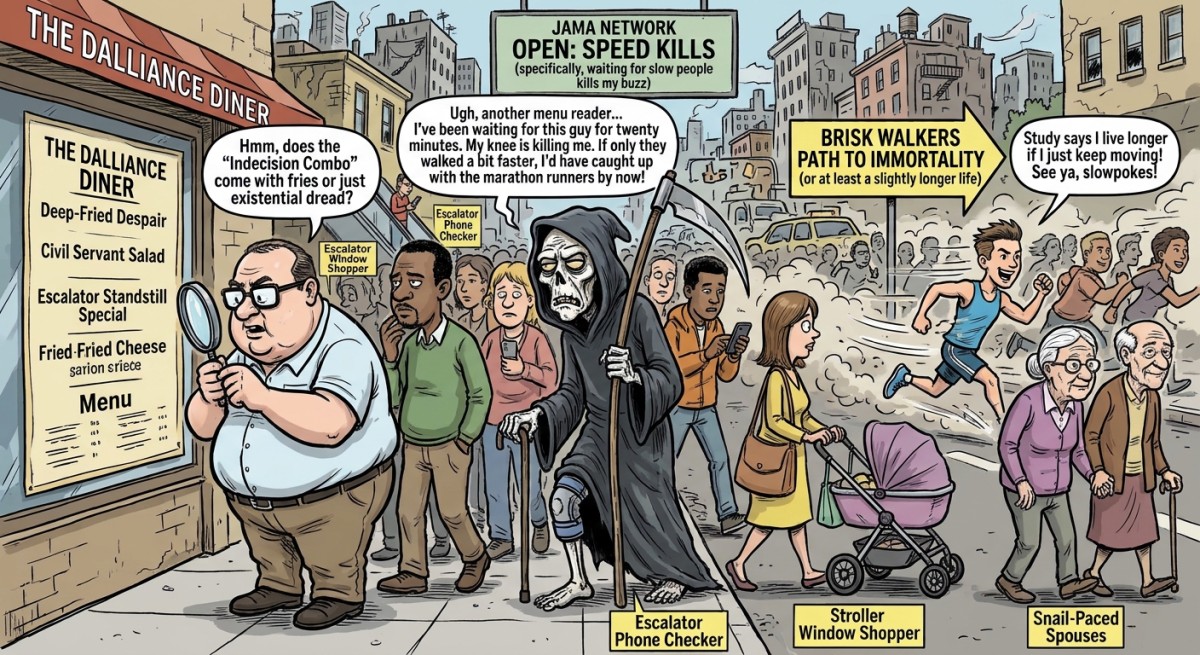
Science has finally answered humanity's oldest question, which turns out to be not "Why are we here?" but "Could you possibly walk a bit faster?" A new study in JAMA Network Open says people who walk briskly have a lower risk of an early death, which means the person dawdling in front of you at the airport was not merely rude. They were dying, slowly, and taking you with them.
The research was led by Rayane Haddadj, a fellow at the Norwegian University of Science and Technology in Trondheim, a city where walking fast is less a fitness choice than a way to avoid freezing to a bus stop. The team studied more than 4,000 British civil servants, the only population on Earth with decades of medical records and no professional reason to hurry anywhere.
These volunteers have been examined every four to five years in a health project begun in the late 1980s, making them the most thoroughly measured bureaucrats since the Domesday Book. In 2012 and 2013, scientists timed their walking speed and strapped on devices to count their steps per minute, which is the first time anyone has asked a civil servant to track output.
The results were blunt. Faster walking speed was linked to a 23% lower risk of death over the study period, and a snappier step rate to a 17% lower risk. The researchers wrote that speed and cadence were "consistently associated with all-cause mortality, even after adjustment for daily step count." Translated from Science: it is not how far you go, it is whether the Reaper has to jog.
This is devastating news for the stroller, the window shopper, and the man who stops dead at the top of an escalator to check his phone. It is wonderful news for New Yorkers, who have been training for immortality for two centuries without a single thank-you. Every person who has ever said "excuse me" in a tone that was not a request is now, technically, a public health advocate.
Dr. Theodore Strange, chair of medicine at Northwell Staten Island University Hospital, explained that a brisk pace suggests you're living "with fewer chronic diseases and that whatever diseases you may have are more well managed." In other words, fast walkers are not outrunning death. They are simply healthy enough to look like they could, which is also how most resumes work.
Strange also offered a safety note: "Probably shorter steps are safer than longer steps in terms of tripping hazards and so on." This is the most medically dignified way anyone has ever said "don't lunge." Science wants you to hurry, but like a toddler carrying soup.
Best of all, he said you don't necessarily need the famous 10,000 daily steps. His advice was to "start where you are," the gentlest instruction ever given to a man currently on a couch. Ten thousand was always more slogan than prescription. Urgency, it turns out, is the real medicine, and no insurer has ever covered it.
So walk like you're late. Walk like your ride is about to cancel. Walk like a British civil servant who just heard someone is handing out free biscuits two departments over. The Grim Reaper is still coming for everyone, of course. He just keeps getting stuck behind the people reading the menu.
Walking Faster: Your Questions, Answered Before You Can Get Away
What's Your Reaction?
 Like
0
 Dislike
0
 Love
0
 Funny
0
 Wow
0
 Sad
0
 Angry
0




Comments (0)