

Study Finds One Extra Year of School Protects Your Brain Fifty Years Later, Finally Answering "When Will I Ever Use This?"
A new PNAS study funded by the NIH found that a 1972 British law forcing teenagers to stay in school until 16 cut dementia diagnoses decades later, even for people at high genetic risk. This satirical health dispatch treats the longest detention in history as the most effective medicine nobody wanted to take.

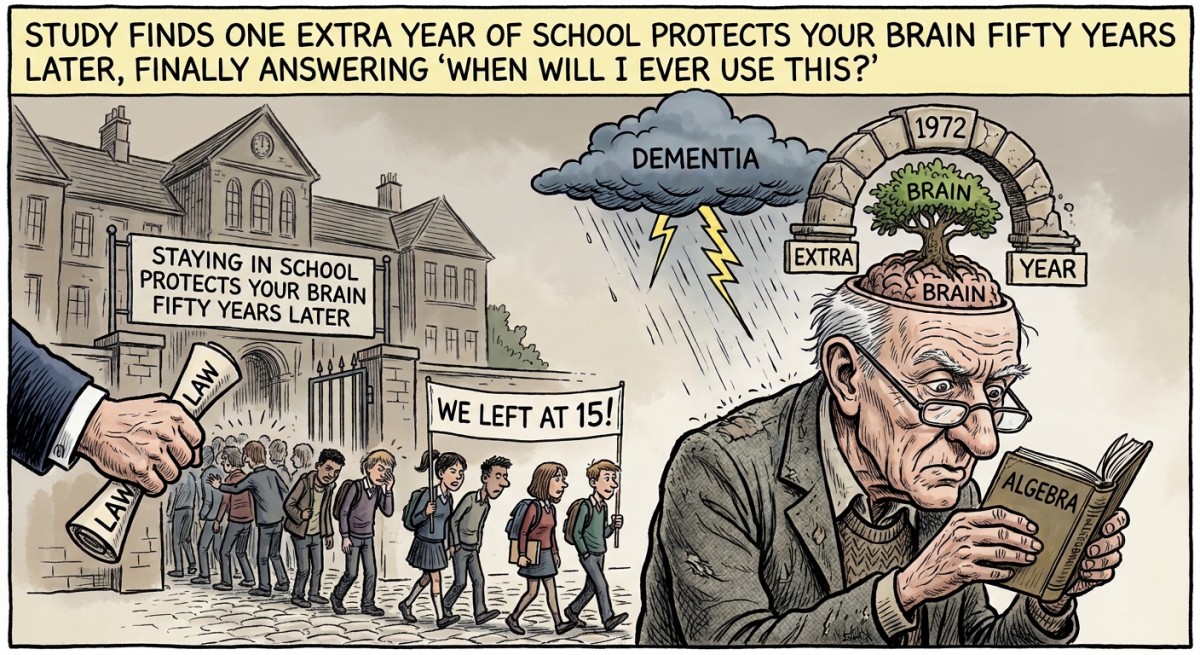
Every teenager in history has asked the same question from the back row of a maths class: "When will I ever use this?" On Friday, science finally answered. At about 65, and mostly to keep remembering where you parked.
A study published October 23 in the Proceedings of the National Academy of Sciences, funded by the National Institutes of Health, found that a 1972 British law forcing teenagers to stay in school one extra year, from 15 to 16, reduced dementia diagnoses decades later. The extra year was never meant as inspiration. It was a sentence. It turns out a sentence can also be a vaccine.
The law caught everyone born on or after September 1, 1957. Those born a few days earlier could still walk out at 15. That handed researchers at USC, the University of Wisconsin–Madison and the University of Michigan a perfect experiment: Britons separated by nothing but a birthday and a headmaster's paperwork. Somewhere in 1972, a boy born on August 31 left school cheering. Fifty years later, science has sent him a follow-up form.
The reform raised the share of students staying until 16 by 14 percentage points. Researchers then followed more than 100,000 people in the UK Biobank through age 65, using hospital records, death registries and self-reported histories. That is the longest detention ever supervised, and none of the pupils knew they were still in it.
"We have known for a long time that people with more education are less likely to develop dementia, but it has been difficult to know whether education itself is responsible," said lead author Silvia Barcellos, a health economist. Correlation is what scientists call it when the rich kids win again. Causation is when the government makes everyone sit through the same double chemistry and the effect still shows up.
The most striking finding: the protection held even for people at the highest genetic risk. "Genes help shape disease risk, but they do not necessarily determine the outcome," said coauthor Leandro Carvalho. Your DNA writes the forecast. Year 11, apparently, brings an umbrella.
NIA director Richard Hodes said the results show "changes such as additional schooling can offset inherited vulnerability." Every parent who ever said "you'll thank me later" has just been issued a peer-reviewed receipt. Later has arrived. It is 65 and carrying a citation.
The researchers were careful. "The message here is less about the specific numbers," Barcellos said, which may be the first time an economist has asked anyone to look away from the numbers. That is how you know they are excited. The extra year was also linked to higher household income and fewer strokes and heart attacks. One more year of algebra: bad for your Tuesdays, excellent for your arteries.
Nobody yet knows exactly why it works. Better jobs, perhaps. More money. More stimulating work. Or perhaps the brain simply remembers being made to memorise the periodic table and resolves never to be that bored again.
The back row finally has its answer. When will you ever use this? In about fifty years. You will not remember the quadratic formula. You will remember your grandchildren's names, which, frankly, was always the better deal.
Your Questions About Staying in School, Answered (Eventually)
What's Your Reaction?
 Like
0
 Dislike
0
 Love
0
 Funny
0
 Wow
0
 Sad
0
 Angry
0





Comments (0)