

Brighton's West Pier, Closed Since 1975, Finally Takes the Hint as Storm Austen Shows It the Door
Part of Brighton's derelict West Pier, closed to the public since 1975 and declared beyond repair after the 2003 fires, fell into the sea on Friday as Storm Austen battered southern England with 84mph gusts, power cuts and cancelled trains. This satirical weather dispatch treats the collapse as a very long goodbye, the sea as a repeat offender, and Storm Boelo as the next bailiff in the queue.

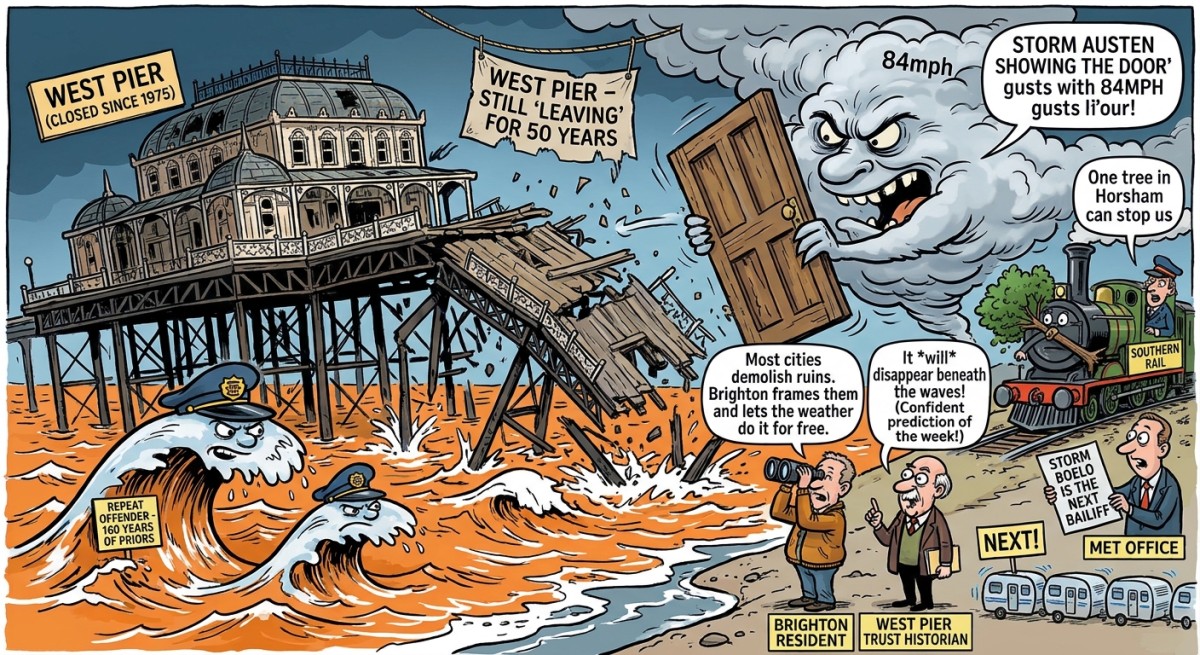
Britain's first named storm of the season arrived on Friday with the manners of a bailiff. It knocked on Jersey at 84mph, rearranged the railways with trees, and then went to Brighton to collect on a debt the West Pier has owed since 1975.
A section of the pier fell into the sea. This is news the way a retired man losing more hair is news: technically an event, mostly a continuation. The pier closed to the public half a century ago, lost major sections in 2002, survived two fires in 2003 and was declared beyond repair by English Heritage. It has been leaving for longer than most marriages last. Storm Austen merely held the door.
Simon Haffenden, who lives opposite, caught it on video. He saw a "big wave come along and literally hit the pier." That is the sea's entire business model, and in 160 years it has never once diversified. "You heard the bang of the wave and then... there was a huge crash," he said, which is also how every British home renovation is described to the neighbours.
He was moved. "It's so iconic," he said. "It's such a beauty." Then, with admirable honesty: "It sounds funny to say, but it is such a unique thing to have on the seafront that most other cities don't." He is right. Most cities demolish their ruins. Brighton frames them, sells the postcards and lets the weather do the demolition for free.
Another neighbour, Stephen Royle, said he was "shocked by the amount of pier that's ended up in the sea." Every engineer who has ever built a pier shares the shock, because the only amount of pier meant to end up in the sea is the legs.
The West Pier Trust's honorary historian, Professor Fred Gray, delivered the finest eulogy a pile of Victorian iron has ever received. "All ruins are alive and ever-changing, and this is true of the West Pier," he said. Then came the forecast: "We don't know when the pier will eventually disappear beneath the waves, but disappear it will." It was the most confident prediction made in Britain all week, and it came from a historian, not the Met Office.
He added: "That so much still remains is a tribute to the Victorian designers and engineers who built the pier." The Victorians built things to outlast their own reputations. Modern Britain builds rail timetables that cannot outlast one tree in Horsham.
Elsewhere, more than 19,000 homes lost power, ferries to France were cancelled and families were evacuated from a holiday park in Perranporth. Hannah Dawson-Turk said "the night before last, it sounded like our caravan was going to be ripped apart." In fairness, every caravan in Britain is sold with that sound as a standard feature.
Nor is the weekend free. Met Office Chief Forecaster Dan Suri said: "Conditions will eventually improve briefly tonight before Storm Boelo moves in from the west." "Eventually," "improve" and "briefly" in one sentence is not a forecast. It is a hostage negotiation. Boelo's amber warning covers much of Scotland, with gusts of up to 80mph in exposed coastal spots, which in Scotland is simply called the coast.
Only this morning, Britain was told that warm weather had stopped people buying coats. The weather read the report and took it personally.
The West Pier has been leaving since 1975. Austen held the door. On Saturday, Boelo arrives to ask why it is still standing in the doorway.
West Pier Collapse: Your Questions, Answered Before the Next Storm
What's Your Reaction?
 Like
0
 Dislike
0
 Love
0
 Funny
0
 Wow
0
 Sad
0
 Angry
0



Comments (0)