

Cassowary Couple Ends Adelaide Zoo's 34-Year Drought on the First Date, Lays a Neon-Green Egg and Hands Dad 50 Days of Unpaid Paternity Leave
Adelaide Zoo's southern cassowaries Martina, 10, and Jeffrey, 13, produced the zoo's first cassowary eggs in 34 years after being paired in August, and the eggs are fluorescent green. This satirical science dispatch treats the romance, the privacy screen and the father's 50-day incubation shift as the most efficient courtship in the animal kingdom.

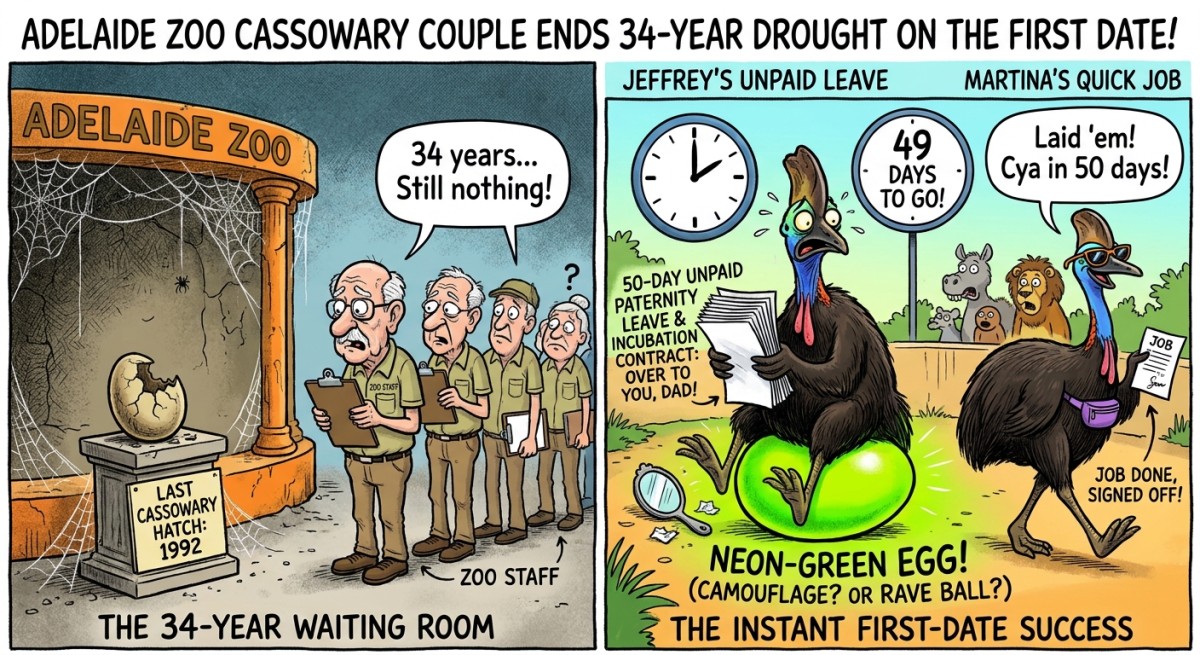
For 34 years, Adelaide Zoo waited for a cassowary egg. Six chicks hatched in 1992, and then nothing, a silence long enough to outlast the fax machine, the floppy disk and several prime ministers. The drought has now ended, and it ended the way the best droughts do: with something absurdly, radioactively green.
The mother is Martina, 10. The father is Jeffrey, 13. They met in mid-August through what the zoo calls a managed breeding program, which is a dating app where the matchmaker carries a bucket of fruit and a clipboard.
Before the introduction, keepers watched for "a low rumble or boom call" and whether the two "were more tolerant of eating near each other." In other words, the zoo ran a background check on whether Jeffrey could survive dinner. For a cassowary, that is a serious question. This is a bird with a dagger on each foot. Tolerating someone near your plate is basically a proposal.
Staff removed parts of the shade cloth between them and put their food side by side at the fence line. Humans call this a supervised first date. Cassowaries call it a hostage negotiation with snacks.
Then the big day. "Jeffrey approached Martina cautiously at first, then started preening himself before going over and preening Martina," said Erin, the zoo's team supervisor for birds. Jeffrey checked his own feathers before touching hers. Every man in a nightclub bathroom mirror has done the same thing, with far worse results.
"They actually mated on the first day that we paired them together," Erin added. Thirty-four years of waiting, solved in one afternoon. Somewhere, a human couple six years into "seeing where it goes" felt personally attacked.
The couple then picked a nest near the front of their habitat, and keepers added shade cloth "to give the pair extra privacy." Only a zoo would build a glass-walled home for a famous bird and then act surprised it wants curtains.
And the egg. "The egg is actually fluorescent green," Erin said. The color comes from pigment in the shell and camouflages it in the rainforest. In a zoo enclosure, it camouflages it as a highlighter someone dropped. A second egg has since joined it. Clutches can run three to five, so Martina may still be clearing her inbox.
Now the best part. Once laying is done, the male does the incubating, roughly 50 days of it, and if chicks hatch, he raises them. Martina laid the eggs and handed over the project. Jeffrey, who only last month was preening himself for the date, now owns the deadline, the night shift and the school run.
The zoo is cautious. "It's not guaranteed that the egg is fertile," Erin said. Which makes this the most human thing that has happened at Adelaide Zoo in decades: a whirlwind romance, a nursery painted in a color nobody asked for, and nobody sure yet whether anyone is actually coming.
Still, the egg is here. Thirty-four years of patience produced one glowing green orb and one very busy dad. Jeffrey preened himself before the date. He will not have time to preen again until 2027.
Cassowary Egg Questions Nobody at the Zoo Wanted to Answer
What's Your Reaction?
 Like
0
 Dislike
0
 Love
0
 Funny
0
 Wow
0
 Sad
0
 Angry
0




Comments (0)