

Swedish Private Equity Pays A$9.3 Billion for Australia's Garbage, Then Spells the Company's Name Wrong
Cleanaway Waste Management agreed to be bought by Swedish private equity group EQT in a deal valuing the Australian rubbish collector at about A$9.3 billion including debt, sending its shares up nearly 20%. This satirical business dispatch follows the premium, the bins, the two-hundredths-of-a-cent ticking fee and the missing letter "a".

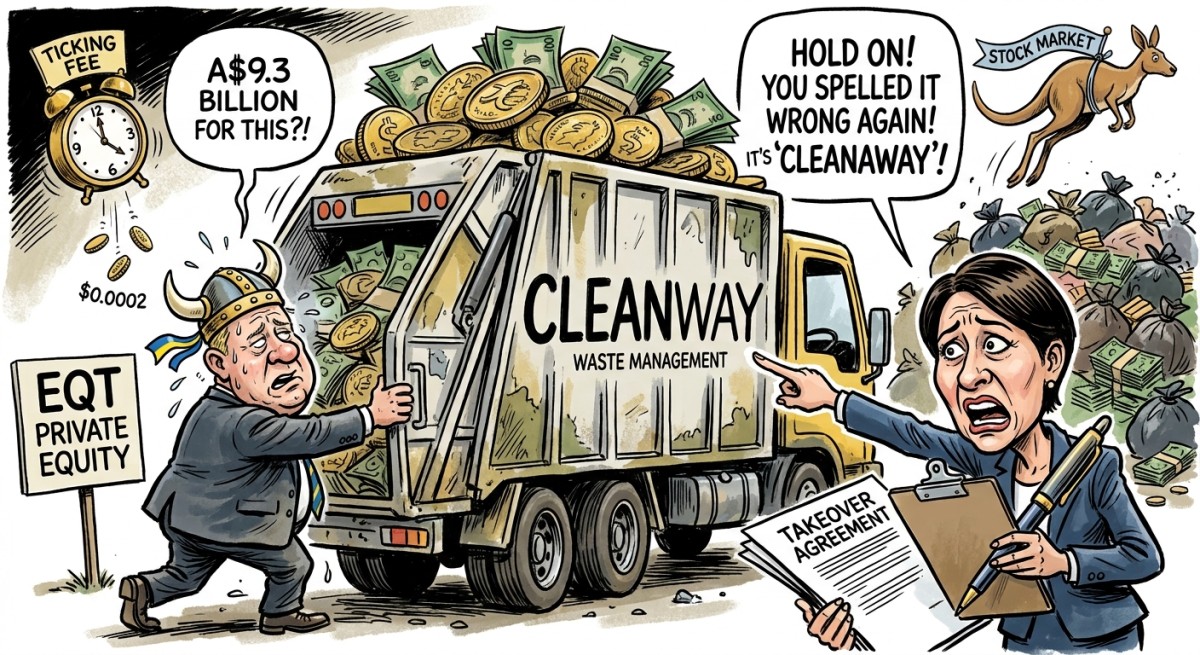
There is an old saying that one man's trash is another man's treasure. On Monday, Sweden finally put a number on it: about A$9.3 billion.
Cleanaway Waste Management, the Melbourne-based company that collects, sorts and buries everything Australians would rather not think about, said it had agreed to be bought by Swedish private equity group EQT in a deal valuing it at about A$9.3 billion ($6.5 billion), including debt. Shareholders will receive A$3.095 in cash per share. It is the first time anyone has been paid a premium to take out the rubbish. Normally you have to wheel the bin to the curb yourself.
The market reacted the way a raccoon reacts to an unlatched lid. Cleanaway shares rose nearly 20% to A$2.960, on track for their best day since October 2011. For fourteen years, investors held a stock that, professionally speaking, smelled. On Monday it finally smelled like money.
The price is a 32.1% premium to the A$2.37 close on August 12, the last trading day before the approach went public. In private equity, a premium is what you pay for the privilege of later telling a company it has too many people. In waste management, that conversation comes with gloves.
EQT is no tourist in the garbage business. It already owns Urbaser, ReWorld, Encyclis and Arcwood, and calls itself one of the world's most active investors in waste management, a sentence no Swedish mother ever expected to repeat at dinner. Stockholm is assembling a global rubbish empire the way IKEA assembles a bookshelf: flat-packed, Scandinavian, and with one piece left over that nobody can explain.
The finest joke is in the footnotes. If the takeover is not implemented by May 31, 2027, shareholders earn a "ticking fee" of $0.0002 per share per day. That is two hundredths of a cent. An investor with 10,000 shares would collect two dollars a day for EQT's lateness, less than a library fine and much less than what the council charges when your bin misses Thursday.
Then came the love letter. "Cleanaway has built an exceptional national platform providing services to Australians every day," said EQT Infrastructure managing director Sam Franklin. A sentence later, the same statement promised "to support Cleanway's management team." That typo is not ours. It is theirs. They agreed to pay A$9.3 billion and still lost the second "a". Presumably it was recycled.
Cleanaway chair Samantha Hogg said the board weighed the offer against "the opportunities ahead of us under Blueprint 2030 2.0" and decided the scheme "delivers strong and certain cash value to shareholders." Blueprint 2030 2.0 is a sequel to a plan for a year that has not happened yet. Hollywood learned long ago that certain cash beats an uncertain sequel. The rubbish industry has now caught up.
The deal still needs shareholders, the Federal Court of Australia and the regulators, with completion expected by the end of March 2027. In the meantime, Cleanaway says shareholders "are not required to take any action at this stage," which has also been the official position of every Australian teenager on bin night since the invention of the wheelie bin.
So the treasure has been priced, the premium paid, and the ticking fee set to tick at two hundredths of a cent. One man's trash is another man's treasure. In Australia, it is now a Swede's, at A$3.095 a share, spelled however he likes.
Garbage Takeover FAQ: What Australia Wants to Know
What's Your Reaction?
 Like
0
 Dislike
0
 Love
0
 Funny
0
 Wow
0
 Sad
0
 Angry
0

Comments (0)