

Albania's Prime Minister Keeps Putting Out Cushions for Dialogue, and Protesters Keep Returning Them as Smoke
Edi Rama placed cushions around a "dialogue table" outside his Tirana office as an invitation to protesting students, and opposition supporters set them on fire. This satirical world news dispatch follows the prime minister's furniture-based diplomacy from chairs to pillows to a water cannon.

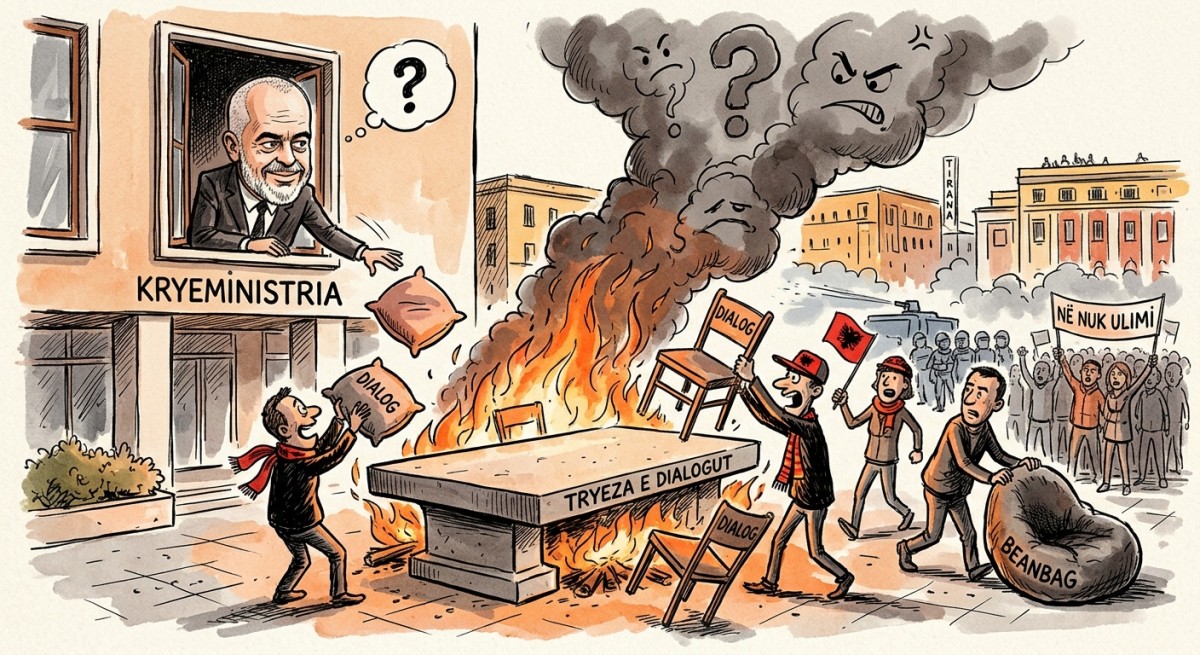
Diplomacy has tried many instruments over the centuries: the treaty, the summit, the hotline. On Saturday in Tirana it tried the throw pillow, and the throw pillow lost.
Prime Minister Edi Rama had placed cushions around a stone table outside his office, a "dialogue table" offered as a symbolic invitation to students who have been protesting for twelve days and want him to resign. Supporters of the opposition Democratic Party gathered for about an hour and a half, picked up the cushions and set them on fire in the square. It is the first known case of a negotiation being declined by arson of the upholstery.
This was not the government's first attempt at furniture-based statecraft. On October 20, Rama set out chairs marked "Dialogue" and invited students to talk "unconditionally." On October 21, protesters threw the chairs away and burned one. When the chairs failed, the government did not rethink the message. It softened the seating. Somewhere in the cabinet there is an adviser whose plan for Monday is a beanbag.
Rama has now sought dialogue for four days in a row and received only rejection, which makes him the only head of government in Europe being ghosted in person. Most leaders get left on read. He gets left on fire.
The man is a painter by training, and it shows. Other politicians announce a policy. Rama stages an installation. "Dialogue, With Cushions" was meant to be a work about openness. The audience reviewed it with a lighter, which in a gallery would count as engagement with the piece.
Opposition leader Sali Berisha, who had called supporters in from across the country, described Rama as a "narco-dictator" using "barbaric violence" against students. This is the core weakness of the soft-furnishings strategy. It is hard to sell a cozy sit-down when the other side has already printed your nickname.
Rama, for his part, promised an answer. "Within a matter of hours or days, we will present our overall reflection on what a significant portion of society is trying to convey," he said. "Hours or days" is the government version of a courier's delivery window. Society has been conveying it for twelve days. It has conveyed it in chairs. It has conveyed it in pillows. The memo is now mostly ash.
He also warned that "just as the urban terror was intense, concentrated, and prolonged, so too will the response from the state be prolonged and persistent." It is a rare government that offers a cushion and a water cannon in the same afternoon, and Saturday delivered both: riot units and a water cannon were deployed near the Ministry of Education, where students had called their own protest. Nothing says "let's talk" like a vehicle whose only vocabulary is pressure.
The lesson for governments everywhere is simple. When the public wants your resignation, it is not asking for better lumbar support. Dialogue is not a seating chart, and no crisis has ever been upholstered away.
Still, credit persistence. Rama has gone from chairs to cushions. On the current escalation curve, next week brings a sofa, and by November a full showroom with a banner reading "Let's Talk." The protesters, judging by their consistency, will bring the matches. Albania may not get a dialogue out of this, but it is on track to become the first country whose political crisis is measured in fabric.
The stone table survived, because stone does not burn. That leaves exactly one seat in Tirana the protesters have not managed to set alight, and it is the one Rama is still sitting in. They are, by every account, working on it.
Rama's Dialogue Furniture: Your Questions Answered
What's Your Reaction?
 Like
0
 Dislike
0
 Love
0
 Funny
0
 Wow
0
 Sad
0
 Angry
0


Comments (0)