

Scientists Discover Tiny Snakes That Roll Four Times Faster Than They Slither, Instantly Making Every Other Snake Look Like It Took the Stairs
A Current Biology study filmed dwarf reedsnakes in Borneo rolling like wheels at up to 3.69 metres per second, about four times their slithering speed, while keeping their heads perfectly level. This satirical science dispatch treats the world's first self-propelled hula hoop as a transport revolution, a dashcam miracle and a quiet humiliation for the rest of the reptile kingdom.

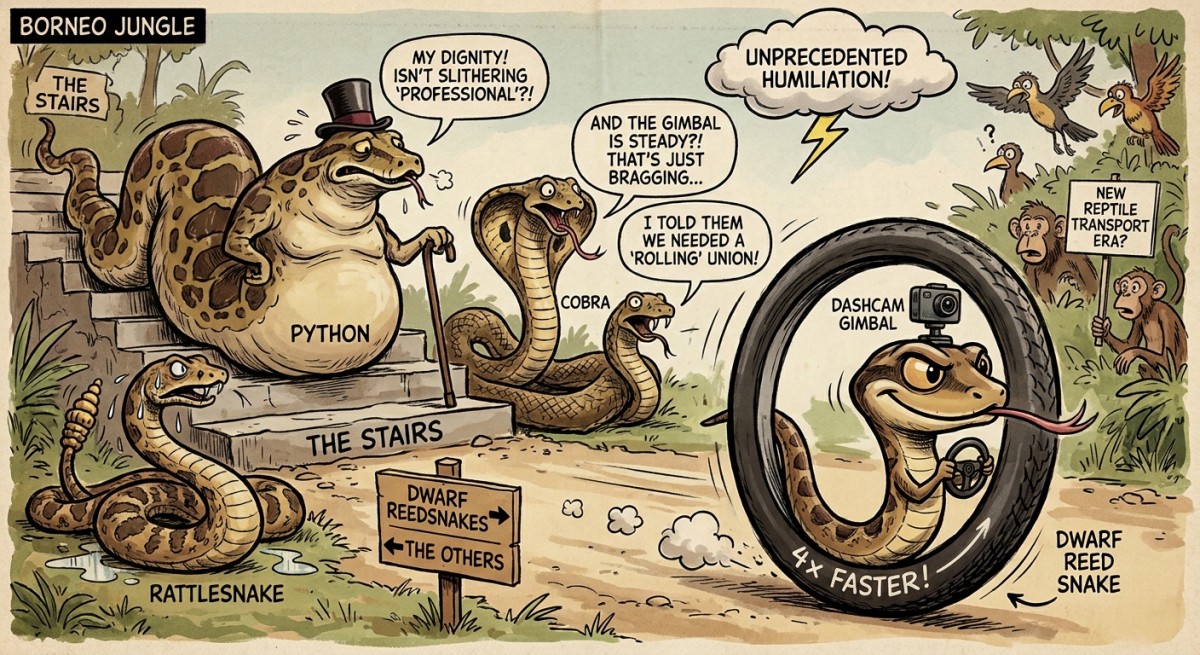
For roughly a hundred million years, the snake has had one job: lie down, then move while still lying down. It was a career built on low expectations. Then scientists went to Borneo and found a family of small snakes that looked at slithering and said, respectfully, no.
According to a study published in Current Biology, dwarf reedsnakes of the genus Pseudorabdion escape danger by rolling across the ground like a wheel. Not tumbling. Not falling down a hill with confidence. Rolling, on purpose, as a lifestyle.
The numbers are humiliating for everyone else. Researchers clocked the snakes at peak speeds of 1.72 to 3.69 metres per second, about four times faster than their own slithering. That is up to 8.3 miles per hour, which is faster than most people jog in January and every person jogs in February. A snake that slithers is a predator. A snake that rolls is a delivery service.
The team, led by Yosuke Kojima and Ibuki Fukuyama, filmed eleven P. saravacense, one P. collaris and one P. longiceps, then compared them with six ordinary reed snakes. None of the ordinary reed snakes rolled. They simply watched, the way the kid with the regular bike watches the kid with the electric one.
Rolling has a problem, of course, and the problem is the head. If your whole body spins, your eyes spin with it, and steering becomes a matter of prayer. The dwarf reedsnake solved this by rolling the back half of its body like a tire while keeping its head upright and facing forward. It is a wheel with a dashcam. Somewhere a gimbal manufacturer is quietly updating its résumé.
The researchers describe each cycle as a roll, followed by a "stroke," in which an arched loop of body swings down past the head and hits the ground, alternating left and right. Translated from biology into English: the snake does cartwheels, but with paperwork. Even in its fastest moments, the head bobs and pauses like a pigeon checking its reflection, which the paper politely compares to "avian head bobbing." Evolution, it turns out, has only so many ideas and it reuses them like a sitcom.
They also ran the snakes down a racetrack just 20 centimetres wide, and the snakes stayed on it. Twenty centimetres. Most drivers cannot manage that on a three-lane highway with a GPS, a spouse and a reversing camera.
And how does a high-speed rolling escape end? According to the study, the snakes "frequently terminated rolling by diving underneath nearby objects." That is not a defence mechanism. That is a teenager hearing the car in the driveway.
The authors conclude that "behavioral innovation can circumvent deep morphological constraints and expand the capacities of animals." That is the most inspiring sentence ever written about a reptile. It means you do not need legs. You do not need wheels. You need a plan, a narrow track and somewhere to hide afterwards.
The rest of the snake kingdom has been put on notice. The python is still big. The cobra is still dramatic. The rattlesnake still has its little maraca. But none of them can leave a room at 8 miles an hour without lifting a finger, mostly because none of them have fingers.
The dwarf reedsnake has proved that you can be small, legless and permanently horizontal, and still arrive first. It simply refused to take the slow lane. It took the wheel.
Rolling Snakes: Your Urgent Questions, Answered Sideways
What's Your Reaction?
 Like
0
 Dislike
0
 Love
0
 Funny
0
 Wow
0
 Sad
0
 Angry
0






Comments (0)