

Doctors Discover New Emergency Plan: If Your Heart Stops, Apparently the Drone Is Now Coming Before Your Relatives
Scientists are exploring a new way to respond to cardiac emergencies: sending defibrillators by drone. Because apparently waiting for an ambulance was not stressful enough, humanity has now decided that the next thing flying toward you during a medical emergency could be a drone carrying an electric shock machine.
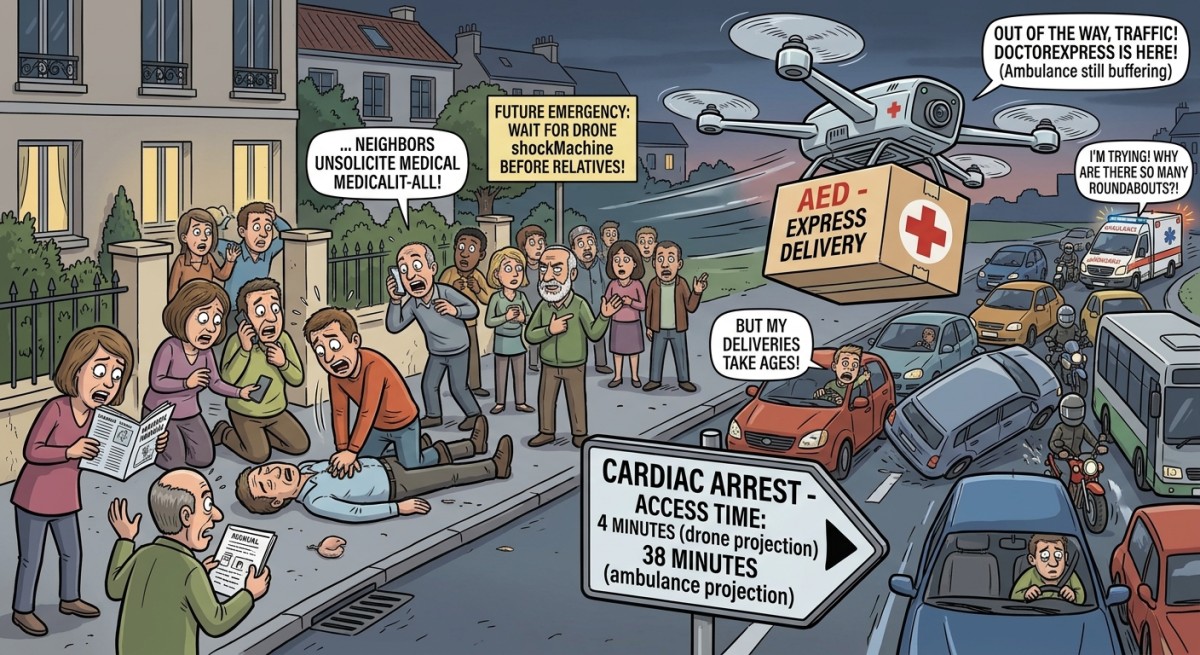
Your heart has stopped.
Your family is panicking.
Someone has called emergency services.
One neighbour is already giving medical advice despite having no medical qualifications whatsoever.
Another person is searching the internet for instructions while holding the phone upside down.
Then, from somewhere above the neighbourhood, comes the sound that humanity once associated with cameras, deliveries and people making suspiciously expensive videos of themselves.
WHOOOOOOOOSH.
A drone.
But this time, it isn't carrying food, clothes or an online shopping package.
It is carrying a defibrillator.
Humanity has apparently reached the point where even emergency medical equipment has decided that traffic is optional.
THE IDEA IS ACTUALLY SERIOUS
Researchers in France have been studying whether drones could deliver automated external defibrillators, commonly called AEDs, to people experiencing cardiac arrest outside hospitals.
The research, presented at the European Emergency Medicine Congress, used computer simulations based on 28,349 out-of-hospital cardiac arrests across seven areas around Paris.
The researchers examined whether combining drones with existing fixed AED locations could reduce the time needed to get a defibrillator to someone experiencing cardiac arrest.
In one modeled strategy, more than 95% of cases could potentially receive an AED within five minutes.
That is a serious medical development.
It is also the moment when emergency medicine appears to have accidentally wandered into the delivery business.
MEDICAL EXPRESS DELIVERY HAS ARRIVED
Modern humans have already perfected the art of delivering almost everything.
Food can be delivered.
Groceries can be delivered.
Clothes can be delivered.
A phone case costing less than the delivery fee can be delivered.
Now scientists are investigating whether an emergency device capable of delivering an electric shock to a stopped heart can also be delivered through the sky.
The reason is simple.
Cardiac arrest is extremely time-sensitive, and rapid access to an AED can be important while emergency services are on the way.
Unfortunately, ambulances have a terrible enemy.
Traffic.
Traffic does not care about medical emergencies.
Traffic has no sympathy.
Traffic can watch an ambulance approaching with flashing lights and still somehow produce twelve cars, three motorcycles, a bus and one mysterious vehicle parked diagonally across the road.
The drone has discovered a revolutionary solution.
It simply goes over everybody.
THE AMBULANCE IS NOT BEING FIRED
Despite the futuristic appearance of the idea, drones would not replace ambulances or medical professionals.
Instead, they could potentially become another part of the emergency-response chain.
An emergency call could trigger the dispatch of an ambulance while a drone simultaneously carries an AED toward the location.
That could allow a defibrillator to reach the scene before the ambulance arrives.
The concept is particularly interesting because the drone does not need to navigate every road between its base and the emergency.
While an ambulance may be calculating how to squeeze through a road containing seventeen vehicles that all believe they have priority, the drone can simply fly above the problem.
This is not exactly a technological breakthrough for aviation.
It is more like humanity finally remembering that the sky exists.
BUT THERE IS A SMALL PROBLEM CALLED REALITY
The research is based on computer simulations.
The researchers did not release thousands of medical drones over Paris and wait for cardiac emergencies to occur.
There was no giant squadron of autonomous flying defibrillators circling the Eiffel Tower looking for patients.
The study modeled how such a system could potentially work.
Real-world operations would have to deal with weather, wind, buildings, trees, power lines, airspace restrictions, communications, battery life, regulations and landing locations.
There is also another extremely important detail.
Someone still has to use the AED.
A drone can deliver the machine.
It cannot magically turn everyone standing around the patient into a paramedic.
Fortunately, AEDs are designed to guide users through the process and determine whether a shock is appropriate.
Still, an emergency scene is probably not the ideal environment for calmly reading a user manual.
HEALTHCARE HAS DISCOVERED THE SKY
The larger idea fits into a growing effort to use technology to reduce delays in emergency medicine.
Drones are already being explored for healthcare logistics and the transportation of medical supplies.
Using them to deliver AEDs takes the concept one step further.
Instead of waiting for every piece of emergency equipment to travel entirely by road, some equipment could potentially travel through the air.
That could be especially useful when an AED technically exists nearby but is difficult to reach quickly.
A defibrillator sitting inside a building several kilometres away is not particularly useful if nobody can get it to the patient in time.
A drone carrying one directly toward the emergency could change that calculation.
TRAFFIC HAS FINALLY MET ITS ENEMY
For decades, traffic has delayed practically everything.
Workers.
Students.
Appointments.
Deliveries.
People who left home two hours early and still somehow arrived late.
Now emergency medicine has discovered a transportation method that refuses to participate in the traffic problem.
The drone does not care about potholes.
It does not care about roundabouts.
It does not care about road construction.
It does not care about the mysterious traffic jam caused by three vehicles stopping beside each other to discuss something that apparently could not be discussed anywhere else.
The drone simply flies.
Traffic has finally encountered something it cannot block without acquiring a very large ladder.
THE FUTURE MAY LOOK RIDICULOUSLY FUTURISTIC
Today's emergency response generally involves an emergency call, an ambulance, paramedics, medical equipment and a hospital.
Future systems could potentially involve GPS, drones, AED networks, smartphones, automated alerts and increasingly sophisticated dispatch technology.
The result could be a much more connected emergency-response system.
The important point is that the drone would not be the doctor.
It would not replace paramedics.
It would not perform surgery.
It would simply deliver an important piece of equipment faster.
Which is probably the most sensible job for a flying robot carrying something designed to restart a heart.
FINAL MEDICAL UPDATE
Scientists are not replacing doctors with drones.
They are investigating whether drones could become another link in the emergency-response chain and help deliver AEDs to cardiac-arrest scenes while traditional emergency services are also dispatched.
The Paris study suggests that combining drones with fixed AED locations could significantly improve potential access times in many modeled cases.
However, simulations are not the same as real-world emergencies.
Weather, regulations, infrastructure, drone reliability, operating costs and the ability of people at the scene to use the AED would all affect the results.
For now, ambulances remain firmly employed.
But if this technology eventually becomes widespread, emergency medicine could become considerably more airborne.
One day, saving a life may involve doctors, paramedics, smartphones, GPS satellites and a small aircraft carrying a machine capable of delivering a lifesaving electric shock.
Humanity has spent centuries improving transportation.
Apparently, we have finally reached the stage where even the defibrillator gets an express flight.
Healthcare: advancing.
Technology: flying.
Traffic: defeated by altitude.
Common sense: still buffering.
Reality Check
The underlying story is based on September 2026 research presented at the European Emergency Medicine Congress. Researchers modeled AED access in the Paris region using data from 28,349 out-of-hospital cardiac arrests and examined the potential effect of combining drone delivery with fixed AED locations.
The findings are based on computer simulations, so they do not establish that drones will perform identically during real emergencies.
The exaggerated situations, jokes and absurd descriptions in this article are satire.
What's Your Reaction?
 Like
0
 Dislike
0
 Love
0
 Funny
0
 Wow
0
 Sad
0
 Angry
0

Achieve or die trying





Comments (0)