

Over 1,000 Mathematicians Go Vegan on Artificial Intelligence, Promising Proofs That Are Free-Range, Hand-Raised and Only Six Years Late
More than 1,000 mathematicians have joined the Association for Human Mathematics and pledged to shun AI companies, splitting into "vegetarians" and stricter "vegans" who keep AI out of their research entirely. This satirical science report covers the first academic discipline to get a dietary label.

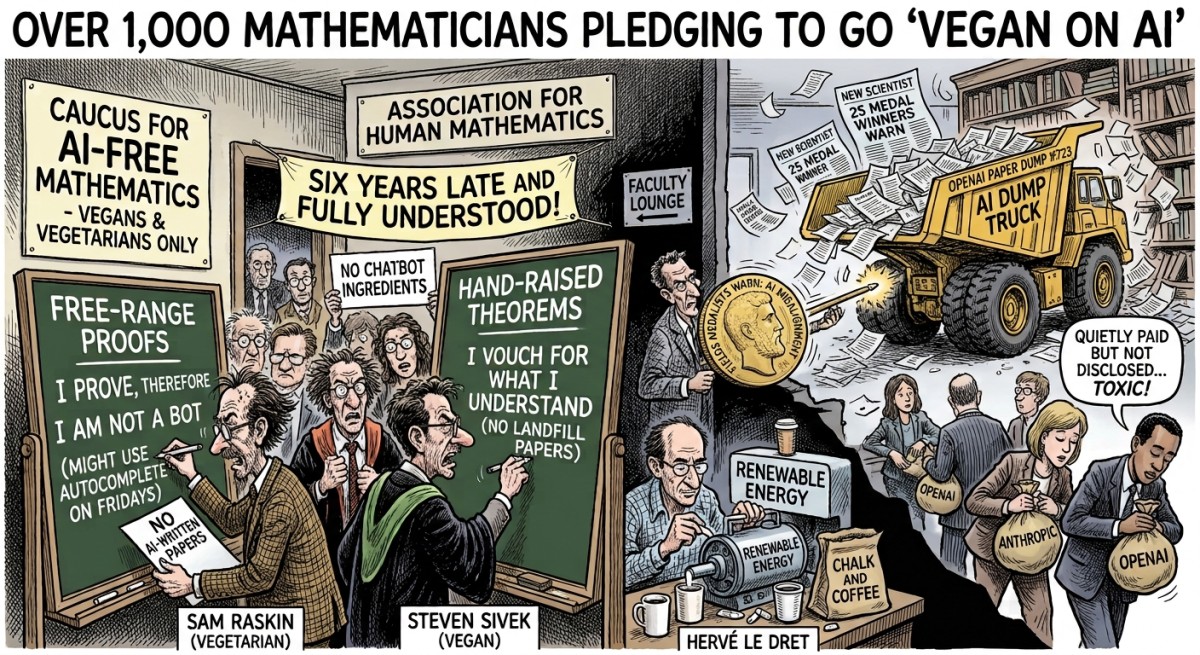
Mathematics has finally produced a dietary label. More than 1,000 mathematicians have pledged to shun artificial intelligence, New Scientist reports, and the movement has already split into "vegetarians" and "vegans." It took the field two thousand years to agree on what a proof is, and about a month to agree on what a tofu is.
The group is the Association for Human Mathematics. Its website lists 1,008 members, 654 of them in an "AI-free caucus." Vegetarians promise not to work for AI companies and not to publish anything a chatbot wrote. Vegans go further and keep the machine out of their research entirely. Nobody has said what the pescatarians do, but presumably they allow autocomplete on Fridays.
The trigger, New Scientist says, was OpenAI releasing 722 papers in one fell swoop earlier this month. A mathematician produces a handful of papers in a career. A company produced 722 in an afternoon, like a dump truck reversing into a library. Terence Tao had warned that the discoveries were being "dumped" on the field. When the world's most famous mathematician reaches for the vocabulary of a landfill, the landfill has won.
Yale's Sam Raskin is a vegetarian. He calls the pledges "pretty mild," and he skipped the vegan pledge because of slight ambiguity over whether his occasional use of AI for simple tasks counted. That is the most mathematician sentence ever printed: a man declined to take an oath because he could not prove he had kept it.
Raskin also said this: "I keep hearing about people who are in positions of leadership in the mathematical community, [who] lead institutions and things, and are quietly being paid by either Anthropic or OpenAI and are not disclosing this information necessarily. And I think that's toxic." In most professions, a secret sponsor buys you a boat. In mathematics, it buys a 40-page proof that you might own one.
Steven Sivek of Imperial College London is a vegan, and he wants you to know he is not a crank. "We're not denialists. We're not sticking our heads in the sand and saying 'this is not happening'," he said. "I mean, it is happening, it's real." Then came his creed: "I'm not comfortable putting out things that I don't understand, that I can't vouch for." If that rule ever spreads beyond mathematics, the internet will shrink to four pages and a weather forecast.
At the Sorbonne, Hervé Le Dret objects to AI's "scandalous waste of resources and environmental impact." Mathematicians, by contrast, run on coffee and chalk, the only fully renewable energy source in the faculty lounge.
The fine print is gentle. The association's FAQ says its commitments "should be interpreted as expressions of principle rather than precise legal agreements," and that members should follow their conscience. A profession that demands proof that one plus one is two has written a constitution that runs on vibes. The FAQ even names OpenAI's Navier-Stokes document as its example of forbidden text, the way a diet book prints a photo of a doughnut.
Weeks earlier, 25 Fields Medal winners warned of a "severe misalignment" between AI companies and the discipline. Misalignment is the AI industry's favorite scary word. Mathematicians have returned it to sender, with a citation.
So the battle lines are drawn. Vegetarians may let a chatbot tidy their formatting. Vegans will not let one near the chalkboard. And OpenAI will publish paper number 723 before anyone finishes reading this sentence. Meanwhile, somewhere in a quiet office, a human proof is being raised the old way: free-range, hand-fed and fully understood by at least one person. It should be ready in about six years.
Human Mathematics: Frequently Asked Questions, Solved by Hand
What's Your Reaction?
 Like
0
 Dislike
0
 Love
0
 Funny
0
 Wow
0
 Sad
0
 Angry
0



Comments (0)