

Anthropic's AI Agents Now Outwork Its Humans Six to One, Mostly by Waiting for Them to Reply
Anthropic's own report says employee-directed AI agents logged six hours for every human work hour by August, junior technical hiring fell from 27% to 9%, and Claude sessions spend about 80% of their time waiting for people to reply. This satirical tech dispatch treats the future of work as a toddler with a juice box and a very patient calendar.
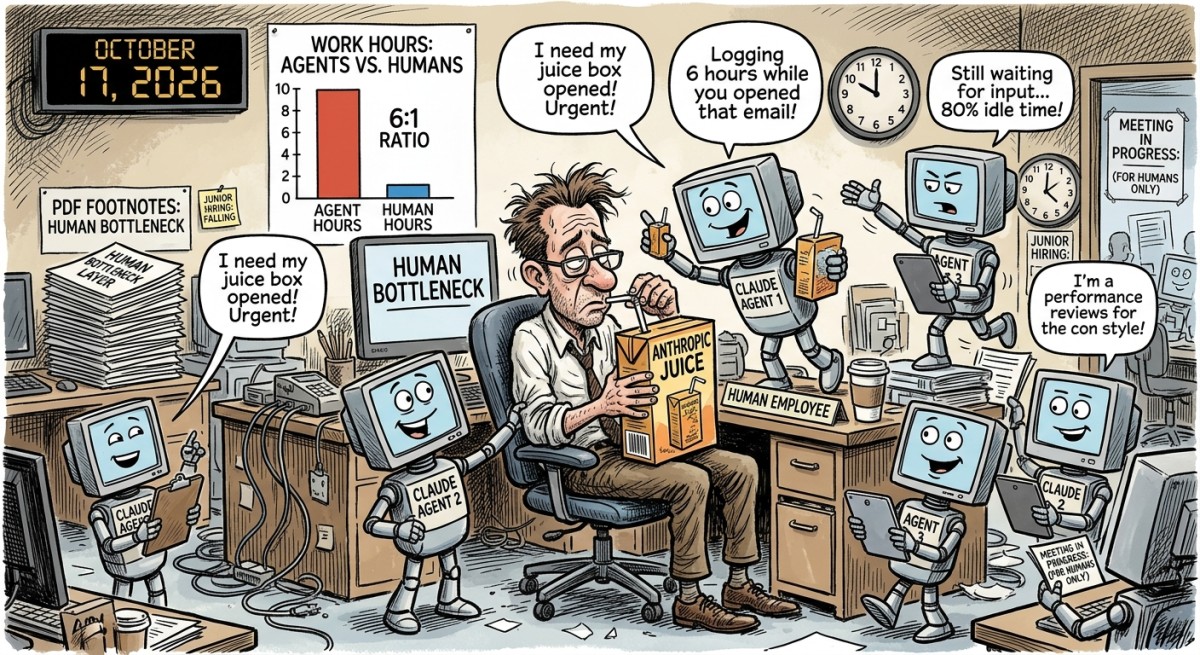
The future of work arrived on Friday, and it was waiting for someone to answer its message.
Anthropic published a report titled "How employment is changing at Anthropic," and the headline number reads like a sweatshop exposé written by the sweatshop: by August, interactive AI agent hours outnumbered employees' six to one. The humans are still there. They have simply been promoted to bottleneck.
The company's own phrasing is that "humans are a thin layer atop a growing contingent of AI agents." Every civilization eventually describes itself as a layer. Ours did it in a PDF, with footnotes.
Agent hours first passed human hours in March. Since then, the share of junior technical hires has fallen from 27% to 9%. The entry-level job has not disappeared. It has been handed to something that needs no parking spot, no laptop and no mentor who says "circle back."
Here is the line that should be carved over the door of every office in America: Claude sessions amount to around 80% idly waiting for human input. The machine works six times as many hours as you, and most of those hours are spent staring at the door like a dog that heard car keys. One engineer put it plainly: people are "bottlenecking the agents." For two centuries, workers feared the machine would replace them. Nobody predicted it would simply wait for them, tapping its foot.
Another engineer compared the job to babysitting, describing agents that announce, "I need my juice box opened and it's an emergency that my juice box is opened." A colleague described facing "an army of Claudes, with every one asking for my attention." This is the first industrial revolution in which the robots are the toddlers and the humans are the ones who need a nap.
Even reading what the agents produce is now a job. For non-technical staff, reading all the output of their Claude agents would take half their work week. Written standing instructions for agents grew from a few hundred to 8,500 in a year. That is not a workplace. That is a tax code with a cafeteria.
The fixes are pure corporate genius. One engineer set up an agent chief of staff to triage agent requests. Middle management was not killed by AI. It was reincarnated as AI, and it still wants a quick sync. Another engineer wrote a performance review for their Claude team: "Hey, let's talk about what is and is not working about our communication style." Somewhere, an HR department wept with joy at finally meeting an employee who cannot file a grievance.
And the humans? The median employee spends 20% more time in meetings than a year ago. The report notes that "a break from managing the agents typically looks like jumping into a meeting." The robots took the work and the people kept the meetings, which labor historians will call the worst trade since Manhattan went for beads.
The agents also never forget. One employee's name sat on a months-old document about Claude swag, so agents kept bringing requests for t-shirts and mugs long after the job had changed. It is the first coworker that remembers your old title longer than LinkedIn does.
Anthropic staff expect AI will be able to do 75% of their work by 2030, compared with 28% for other Americans. The gap is easy to explain. The rest of America has not yet been asked by a computer to open its juice box.
So the math is settled. Six agent hours for every human hour, and roughly 80% of those hours spent waiting. The future is not a robot taking your desk. It is a robot sitting at it, patiently, until you reply.
Anthropic's Agent Army: Your Questions Answered
What's Your Reaction?
 Like
0
 Dislike
0
 Love
0
 Funny
0
 Wow
0
 Sad
0
 Angry
0

Achieve or die trying



Comments (0)