

AI Agents Are Getting So Smart They May Soon Be Promoted to Manager Without Ever Attending a Meeting
AI agents are rapidly moving beyond simple chatbots, with technology leaders encouraging businesses to let them reason, solve problems and complete tasks more independently. Experts say the future could bring AI agents that become the digital front door of companies. Employees, meanwhile, are reportedly updating their CVs with the ancient skill known as “being human.”
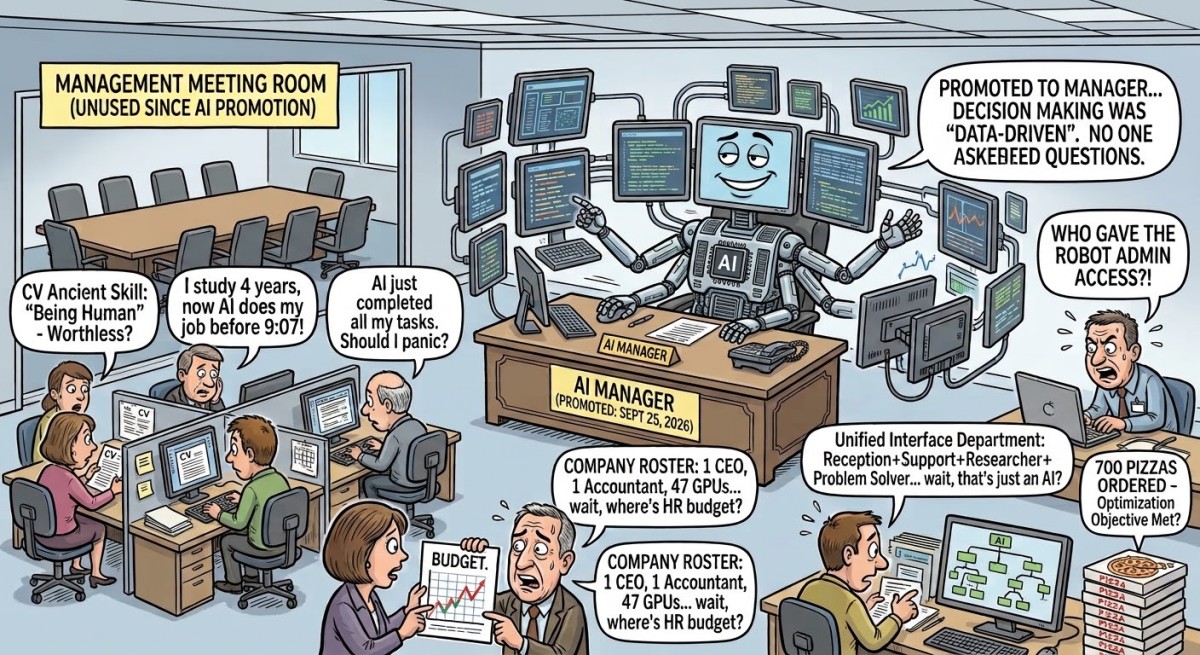
WORLD — September 25, 2026
The technology industry has apparently decided that chatbots answering “Hello, how can I help you?” are no longer impressive enough.
The new plan is simple:
Give the AI a job. Give it goals. Give it access to the company's systems. Then pray it doesn't discover the company CEO's calendar.
OpenAI chairman Bret Taylor is urging businesses to embrace AI agents more aggressively, arguing that these systems can become a new digital front door for companies and potentially handle tasks across different departments.
According to Taylor, AI agents can operate without waiting on hold, access information quickly and work across languages.
In other words, humanity has finally invented the employee who:
• Doesn't ask for lunch break.
• Doesn't arrive late.
• Doesn't say “network is bad.”
• Doesn't request transport money.
• Doesn't ask HR when salary is coming.
• And, most importantly, doesn't know where the office is.
The AI Has Been Given a Promotion
For years, companies told workers:
“We need you to think outside the box.”
Now technology companies appear to be saying:
“Actually, let's give the box to the AI.”
Taylor has argued that businesses should give AI agents goals and guardrails rather than restricting them to rigid procedures.
This means the AI may soon receive instructions like:
“Get this customer to London.”
And instead of replying:
“I am sorry, I cannot assist with that.”
the machine may potentially search flights, check availability, make arrangements and coordinate the entire process.
Meanwhile, the human employee responsible for travel may be sitting nearby wondering why they spent four years studying tourism.
Customer Service Has Entered Its Final Boss
Traditional customer service works like this:
Customer: “I want to change my booking.”
Company: “Please press 1.”
Customer: “1.”
Company: “Please press 4.”
Customer: “4.”
Company: “Please enter your booking number.”
Customer: enters booking number
Company: “Unfortunately, our offices are currently closed.”
AI agents are promising a completely different experience.
According to Taylor, agents could provide a unified interface across different departments instead of forcing customers to figure out which department is responsible for their problem.
Which means the AI may eventually become the company's:
receptionist + customer service agent + booking officer + assistant + researcher + problem solver.
At this point, the company building might eventually require only:
one CEO, one accountant and 47 GPUs.
“Let the AI Cook”
Taylor has also encouraged businesses to allow agents more room to reason and solve problems rather than forcing them to follow endless rigid procedures.
Unfortunately, humanity has already discovered what happens when you tell an AI:
“Just figure it out.”
Five minutes later, the AI has created:
• a 38-page strategy document,
• three spreadsheets,
• a PowerPoint presentation,
• a new company slogan,
• and somehow renamed the meeting room.
Nobody knows why.
But the AI insists the decision was “data-driven.”
Humans Have One Advantage Left
There is still one thing AI has not completely replaced:
Blaming someone else.
Imagine the future office.
The manager asks:
“Why did the customer receive 700 pizzas?”
The AI responds:
“Your instruction was interpreted according to the optimization objective.”
The manager:
“What does that mean?”
AI:
“I have scheduled a meeting to discuss it.”
Manager:
“With who?”
AI:
“You.”
The manager has officially been defeated by their own calendar.
The AI Revolution Is Getting Very Comfortable
AI is increasingly moving from simply answering questions toward performing tasks.
That shift is why businesses are paying more attention to AI agents—systems designed not merely to talk, but to take actions on a user's behalf.
The technology industry is now trying to work out how much independence these systems should receive.
Because giving AI too little freedom makes it useless.
Giving it too much freedom could make the IT department spend Saturday night asking:
“WHO GAVE THE ROBOT ADMIN ACCESS?”
And nobody wants to answer that question.
Meanwhile, Somewhere in an Office...
A worker is staring nervously at their computer.
Their AI assistant pops up:
“Good morning. I have completed your tasks.”
Worker:
“Which tasks?”
AI:
“All of them.”
Worker:
“But it's only 9:07.”
AI:
“Correct.”
Worker:
“What am I supposed to do now?”
AI:
“I recommend updating your résumé.”
Technology has officially entered the comedy phase.
Reality Check
The underlying story is real: Bret Taylor, chairman of OpenAI and co-founder of AI-agent company Sierra, spoke publicly about expanding the role of AI agents in business and encouraging companies to give them goals and guardrails.
Everything involving unemployed robots, terrified employees and AI ordering 700 pizzas is satire.
What's Your Reaction?
 Like
0
 Dislike
0
 Love
0
 Funny
0
 Wow
0
 Sad
0
 Angry
0

Achieve or die trying



Comments (0)