

Customs Agents Find 3,000 Tarantulas in Dirty Socks, Confirm Europe's Weirdest Frequent-Flyer Program
Peruvian authorities at Jorge Chávez International Airport seized more than 3,000 tarantulas hidden in labeled socks inside three suitcases belonging to two Germans and a Polish traveler bound for Germany — a €1.5 million wildlife scheme that proves the only thing worse than finding a spider in your sock is finding three thousand of them and realizing they had boarding passes.

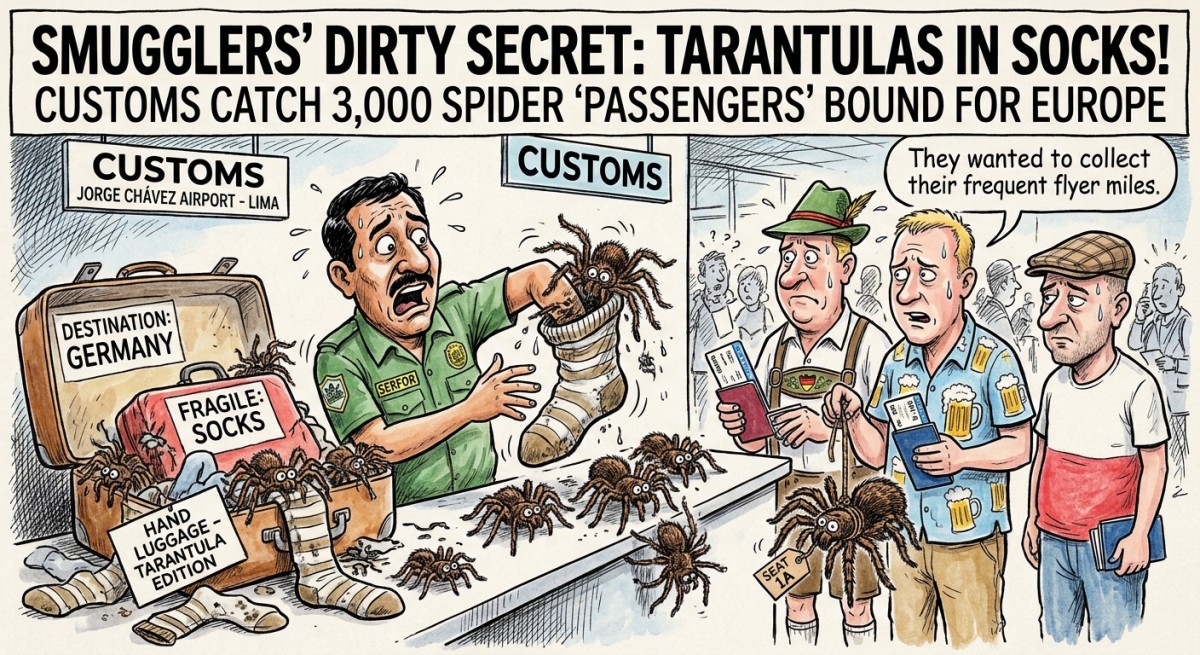
International crime used to require submarines, Swiss accounts, and a face that looked good in a trench coat. This week it required three suitcases, labeled socks, and the patience of a man who packs arachnids the way other people pack chargers.
At Jorge Chávez International Airport in Lima, Peru's National Forestry and Wildlife Service (SERFOR) and customs agents opened luggage belonging to two German citizens and one Polish traveler about to board for Germany. Inside they found more than 3,000 tarantulas — eggs, hatchlings, and adults — nestled in dirty socks the way normal travelers nestle rolled T-shirts. Each suitcase held between 15 and 22 socks. Each sock held a small democracy of legs.
"We noticed that some of them were moving. There were small ones and large ones," said Cora Suarez, a SERFOR wildlife control technician, in the understatement of the year. Airport security has spent decades looking for liquids over 100 milliliters. Nobody briefed them on freelancers with eight knees.
One tarantula can sell for around 500 euros in Europe, Suarez said. Multiply by three thousand and you get a potential 1.5 million-euro wildlife trafficking run stuffed into laundry. That is not a smuggling operation. That is a retirement plan that bites.
The spiders came from regions across Peru — Junín, Loreto, Cajamarca, Cusco, La Libertad — a national tour packaged for collectors who prefer their souvenirs still breathing. Some species remain undescribed by science, which is a polite way of saying the luggage contained animals that did not yet have a Wikipedia page and somehow still had a price list. Pamphobeteus antinous, listed as Vulnerable under Peruvian law, was along for the ride. Being endangered was not enough; it also had to fly coach.
An anonymous tip triggered the intelligence work. The three travelers were intercepted at the check-in module, detained by environmental-crimes police, and handed to prosecutors who specialize in cases that make the rest of the courthouse say "I'm sorry, what?" SERFOR says the animals were likely destined for collectors, researchers, and the pet trade — three industries united by the belief that a sock is a habitat.
Illegal wildlife trafficking generates about $20 billion a year worldwide, according to Interpol, which means this seizure is a rounding error with fangs. Still, it resets the bar for what "carry-on drama" means. Lost luggage is sad. Luggage that wriggles is a documentary.
The socks were labeled. Of course they were labeled. Even crime needs inventory. Somewhere a packing list read "shirts, toothpaste, 3,000 protected invertebrates, deodorant if room." The travelers did not invent wildlife trafficking. They merely perfected the part where the evidence does laundry for itself.
America has spent years arguing about what you can bring through security. Peru has answered with a simpler rule: if it moves inside your sock, it is not going to Berlin.
The tarantulas are now headed to an authorized breeding center. The three Europeans face criminal proceedings. The airline still has to explain why its baggage allowance never mentioned "potential €1.5 million in furry assets." And every traveler who has ever dug a hand into a suitcase looking for clean socks will sleep a little worse tonight — which, statistically, is what the spiders wanted all along.
If you pack socks for Germany, count them twice. If they count you back, call SERFOR.
Frequently Asked Questions About the Peru Tarantula Sock Seizure
What's Your Reaction?
 Like
0
 Dislike
0
 Love
0
 Funny
0
 Wow
0
 Sad
0
 Angry
0




Comments (0)