

Man Solves Four Rubik's Cubes While Running a Mile, Proving Multitasking Is Just Panic With Better Timing
Guinness confirmed that British speedcuber George Scholey ran a puzzle-cube mile in 5:09.25 at Toronto's Central Tech, solving four Rubik's cubes between wind, laps, and the quiet horror of never getting inspection time. Humanity's longest-running plastic toy just became cardio equipment, and the previous record is filing for emotional leave.

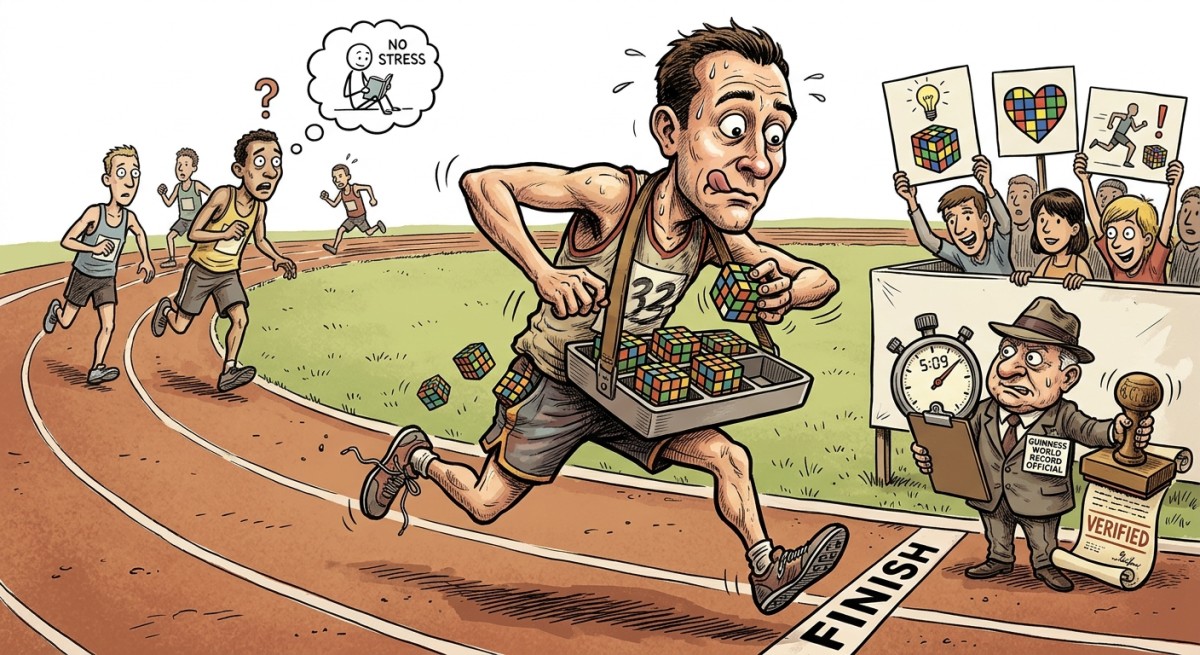
The mile used to be about lungs, legs, and the ancient belief that finishing first meant you had anything figured out. George Scholey has upgraded the event: four Rubik's cubes, no inspection time, and a finish line that arrives before your dignity can file a complaint.
On October 12, 2026, at Central Tech high school in Toronto, the British speedcuber and Red Bull–Rubik's ambassador completed the fastest puzzle-cube mile in Guinness World Records history: 5 minutes and 9.25 seconds. The format is cruel in the way only a committee can invent. Solve a covered cube. Sprint a 400-meter lap. Repeat until four cubes and a full mile are done, including an extra 9.344 meters on the last lap so the distance cannot cheat. The clock never stops. Neither does the cube's quiet contempt.
Guinness published the confirmation on November 6, 2026, which is how bureaucracy celebrates: late, stamped, and somehow still impressive. Scholey beat Jake Hanson's previous mark of 5:22.75 by 13.5 seconds, which in track terms is an eternity and in cube terms is roughly one argument with a sticky corner.
At the horn, he lifted the cover, solved the first cube in nine seconds, and ran the opening lap in 67. Round two: 10.5 seconds of twisting, another 67-second lap, and the growing suspicion that oxygen and algorithm were sharing a lease. Round three delivered his best solve—8.5 seconds—then a 70-second lap, because the body always collects interest. Final cube: 9.5 seconds. Final stretch: 68 seconds, longer by design, louder by friends. He finished “absolutely buzzing,” which is athlete for “my hands still think they are late for something.”
This is his fourth multitasking Guinness title. He once solved 500 cubes on a skateboard. He once solved 6,931 in 24 hours while friends hand-fed him like a very specific zoo exhibit. At the 2024 London Marathon he solved 520 mid-run before Spain's Toti Moragas Pardell edged that marathon mark to 561. Scholey does not quit. He just finds a new way to make colored plastic and cardiovascular shame share a résumé.
Training took seven weeks of sprinting harder and cubing faster, including a 3.86-second solve and a 4:50 relay mile that suggested the attempt was possible and the lifestyle was not. Pacers ran ahead on different laps. Spectators yelled. Cubes stayed covered until each solve began, denying the 15-second inspection speedcubers treat as a constitutional right. He averaged about nine seconds per solve and roughly 67 seconds per lap—the rare athlete whose warm-up includes both hamstrings and corner orientation.
Humanity spent decades treating the Rubik's Cube as a coffee-table accusation. Scholey turned it into interval training. Toronto got wind, a track, and proof that multitasking is real if you redefine it as “doing two hard things badly enough to still win.” Hanson can keep the silver. The rest of us can keep our cubes in drawers, where they belong, unsolved and judging quietly.
Four cubes. One mile. Five-oh-nine. The plastic finally ran out of excuses before the runner did.
George Scholey's Cube Mile, Explained Like a Midlife Crisis With Better Footwork
What's Your Reaction?
 Like
0
 Dislike
0
 Love
0
 Funny
0
 Wow
0
 Sad
0
 Angry
0




Comments (0)