

World Series Discovers Its Most Exciting Athletes Are Five Sausages, One of Whom Is Wearing a Sombrero Against His Will
Milwaukee's Famous Racing Sausages waited 33 years to reach the World Series, won the hearts of America, and then lost their TV slot to $400,000 commercials. A very serious sports report on five foam athletes, one cursed sombrero, and the only race in baseball where the hot dog is a competitor instead of a snack.

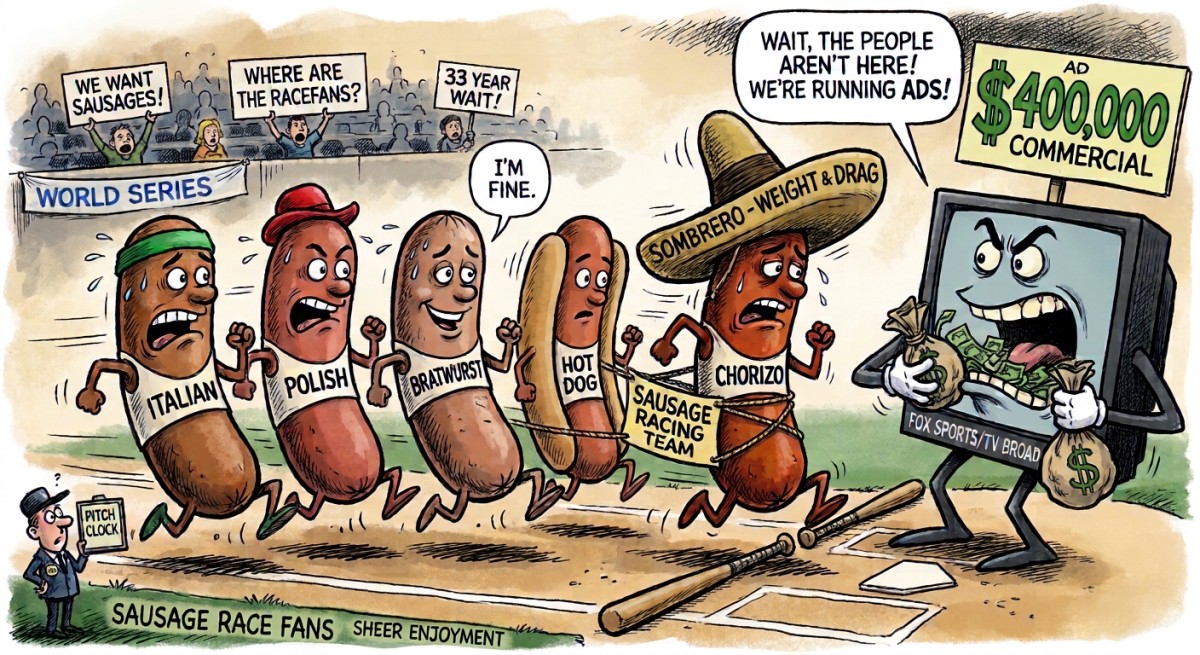
The World Series has pitchers who throw 100 miles an hour and hitters who earn more than small nations. This week, America fell in love with five people dressed as sausages.
Milwaukee's Famous Racing Sausages, a Brewers sixth-inning tradition since 1993, finally ran in the Fall Classic on Friday after a wait of 33 years. That is longer than most careers, most marriages and every sausage that has ever existed. Guido, the Italian sausage, won Game 1. The Polish sausage won Game 2. The bratwurst says it is fine, which is exactly what a bratwurst would say.
The Washington Post has now declared the sausages breakout stars of the World Series, a sentence never once written about a middle reliever. Steven Radmer, a Milwaukee photojournalist who used to race inside one of the costumes, revealed the sport's hidden class system: "Nobody wanted to be Chorizo." The Chorizo wears a wide-brimmed sombrero that adds weight and flaps in the wind, costing speed and, in Radmer's words, making turns "a bit spicy." Every office has a Chorizo. Most of them just don't get the hat.
The original Bratwurst was built in 1993 by graphic designer Michael Dillon out of foam rubber, contact cement and spray paint. He practiced in it once. Then he won. Modern athletes have nutritionists, sleep coaches and biomechanics labs. Dillon had glue, paint and the unshakable confidence of a man already inside a bratwurst.
Then came the scandal. Fox Sports, broadcasting the series, skipped the races and ran commercials instead. Chicago columnist Paul Sullivan, who calls himself "a proud member of the fraternity of Racing Sausages," noted that ad rates reportedly run around $400,000 for 30 seconds, and the race takes about 30 seconds. He then asked the question no network executive is equipped to answer: "But what's more important — loads of money or the sheer enjoyment of the American people?" Fox replied the way networks reply to everything: after a short break.
It is a uniquely American dilemma. Millions of viewers were denied a footrace between processed meats so they could watch an advertisement that may well have been for processed meats.
Fox did feature the sausages in pregame videos and let them entertain David Ortiz, Derek Jeter and Alex Rodriguez in the outfield studio. So three of the greatest hitters of a generation got a private audience with the sausages, and the rest of the nation got the experience of hearing about a party from someone who was invited.
Baseball spent years installing a pitch clock to make its games faster. The sausages have been finishing in 30 seconds since 1993. Nobody asked them to be efficient. They simply read the room, and the room was hungry.
Whatever happens against the Tampa Bay Rays, Milwaukee has already proven something the league's analytics departments never could: the most watchable athlete after a 33-year wait can be a hot dog with legs.
Somewhere in a tunnel under American Family Field, a sombrero is waiting. Fame has finally arrived for the Racing Sausages. It is heavy, it flaps in the wind, and, as every Chorizo knows, it makes the turns a bit spicy.
Racing Sausages FAQ: Everything You Were Too Hungry to Ask
What's Your Reaction?
 Like
0
 Dislike
0
 Love
0
 Funny
0
 Wow
0
 Sad
0
 Angry
0



Comments (0)