

NASA Telescope Spends 22 Years Watching the Universe's Biggest Explosions, Then Decides to Become One Over Indonesia
NASA built the Swift Observatory for a two-year job watching cosmic explosions. It worked 22 years, outlived the $30 million robot sent to rescue it, and on Wednesday fell over North Sumatra in a fireball Malaysia briefly mistook for aliens. Overtime finally caught up with it, at terminal velocity.

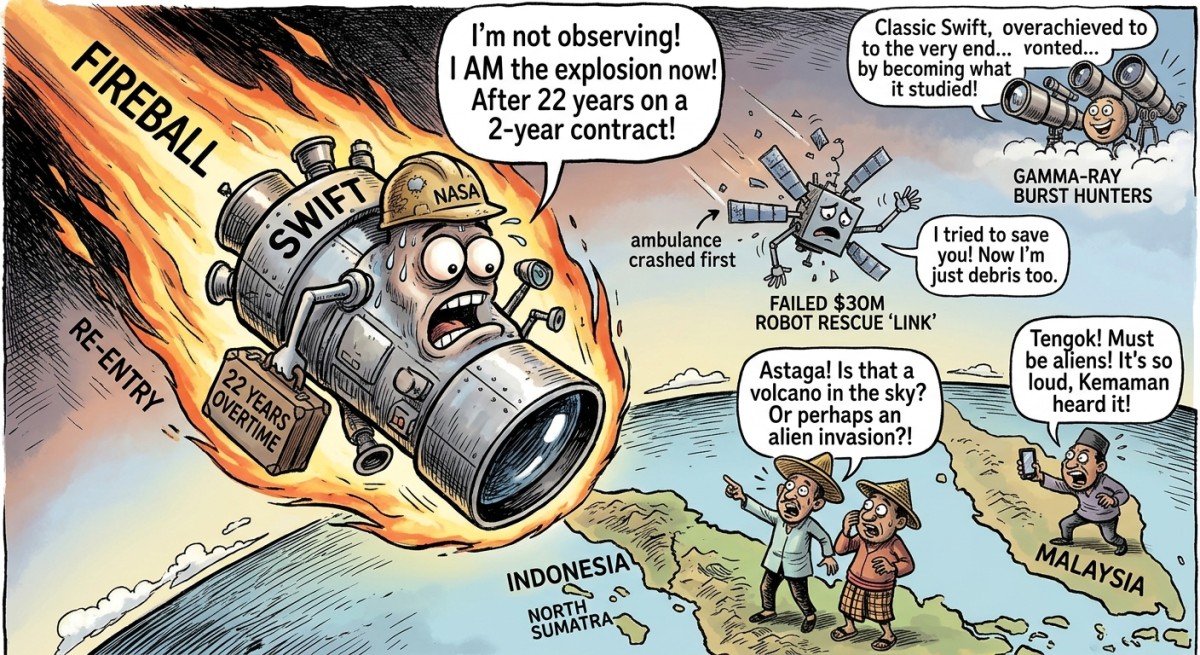
NASA built the Swift Observatory to watch the most powerful explosions in the universe for two years. It watched them for 22. On Wednesday, it stopped watching and started participating.
The roughly 3,200-pound telescope re-entered Earth's atmosphere at 7:39 a.m. EST over the North Sumatra region of Indonesia, according to the U.S. Space Force, making it the first retirement party ever tracked by the military. It landed almost exactly in the middle of the predicted window, which makes it the only thing in 2026 that arrived on time.
Swift was a ridiculous overachiever. It observed more than 2,000 gamma-ray bursts, studied more than 1,400 supernovae and helped produce about 7,000 scientific papers. It was hired on a two-year contract and worked twenty years of unpaid overtime. In America, that isn't a telescope. That's a middle manager.
It also had no engine. So when the Sun got busy and puffed up the upper atmosphere, Swift had the same escape plan as a dropped sandwich.
NASA tried a rescue anyway. It paid Katalyst Space $30 million to send a three-armed robot named LINK to grab Swift and shove it higher. LINK launched July 3, lost control of its orientation within weeks, never got within seven miles of the patient, and fell back to Earth in September. The ambulance crashed first. The patient, out of politeness, waited two more months.
NASA called off the capture on Aug. 19. Swift kept working anyway and made its final observation on Oct. 20 from about 171 miles up, the space equivalent of answering one last email from inside a falling elevator.
The agency's farewell was pure NASA: "NASA expected most of the spacecraft to burn up as it traveled through the atmosphere, but some components may have survived re-entry." Translation: Swift is mostly gone, partly everywhere, and possibly in your gutter. NASA put the odds of anyone on the ground being hurt at about 1 in 2,100. The odds for the telescope were 1 in 1.
Over Malaysia, people filmed the fireball and did what humanity does best: suspected aliens. "Right above our heads in Kota Tinggi last night," one Threads user wrote. Another reported, "It sounded like a jet engine from inside the house. From Kemaman." Twenty-two years of decoding black holes, and the final customer review was "loud."
Media personnel Uthman Daud tried to restore calm: "Meteors typically glow for only a few seconds before disappearing as they burn up in the atmosphere." Swift, true to form, stayed longer than expected. It always did.
The telescope was named for how fast it could swerve toward a cosmic explosion. For two decades it chased the brightest flash in the sky. On Wednesday night over Malaysia, it finally caught it. It was in the mirror.
Swift's Last Shift: Questions From Mission Control's Break Room
What's Your Reaction?
 Like
0
 Dislike
0
 Love
0
 Funny
0
 Wow
0
 Sad
0
 Angry
0




Comments (0)