

Atlanta Reopens Soft Power With Two Pandas Who Negotiate Exclusively by Chewing
Zoo Atlanta unveiled Ping Ping and Fu Shuang on Friday in the renovated Arthur M. Blank Panda Grove, ending a two-year panda drought that left the Southeast emotionally underfed and gift-shop-adjacent. The pair arrived from China on a 10-year loan, survived a 16-hour flight, and now occupy a $6 million habitat with better water features than some starter homes. Atlanta finally has black-and-white diplomats who answer every briefing with bamboo.

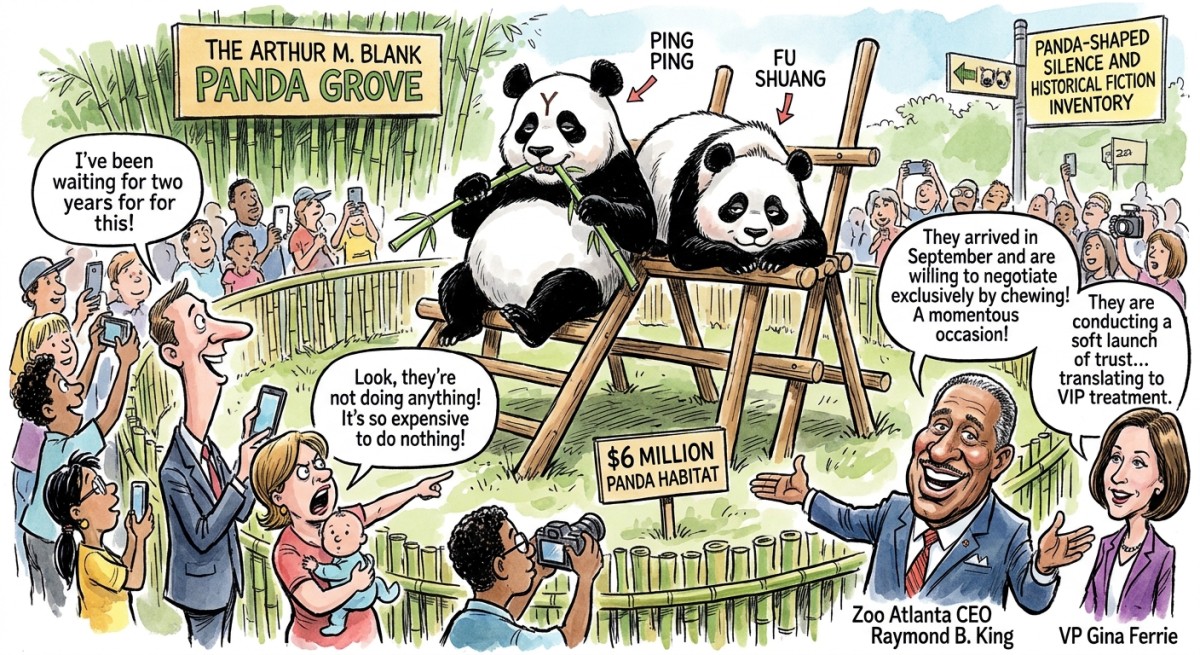
Diplomacy used to involve treaties, translators, and people who smiled for cameras while privately calculating. Zoo Atlanta has streamlined the model: two giant pandas, one renovated grove, and a city that waited two years for something soft, expensive, and unwilling to explain itself.
On Friday, November 6, 2026, Ping Ping, a male, and Fu Shuang, a female, made their public debut in the renovated Arthur M. Blank Panda Grove. The previous four pandas had returned to China, leaving Atlanta with a panda-shaped silence and gift-shop inventory that suddenly looked like historical fiction. The new pair arrived from China in September on a 10-year loan with the China Wildlife Conservation Association. Both were born in 2020 at the Chengdu Research Base. Both are six. Both endured a 16-hour journey that would make a coach-class human invent a religion and a panda invent a nap.
The habitat cost $6 million, funded by the Robert W. Woodruff Foundation, which is how Atlanta says “we are serious about climbing structures.” The Grove now includes expanded dayrooms, climbing structures, pools, water features, and sculpture—amenities suggesting the pandas accepted a soft opening, not a cage. Zoo Atlanta remains one of only three U.S. zoos with giant pandas and the only one in the Southeast, a monopoly on black-and-white charisma that Florida will somehow still try to claim.
A ceremony began around 8 a.m. The public arrived around 10:30 a.m., early for brunch and late for pandas who have already decided the morning belongs to bamboo. CEO Raymond B. King called it “a momentous occasion in Zoo Atlanta history” and said the zoo was “overjoyed to introduce Ping Ping and Fu Shuang and the all-new Arthur M. Blank Panda Grove to our community, City of Atlanta, State of Georgia, and beyond.” “Beyond” is CEO for “tourists who will photograph the bamboo more carefully than their own relatives.”
VP Gina Ferrie offered the useful briefing: “It took them a little while to get used to the new environment, new people, new animal care staff.” Translation: the pandas conducted a soft launch of trust, the way any VIP does when the hotel is new and the staff keep smiling too hard. Their diet is bamboo, biscuits, and apples—the diplomatic tasting menu of creatures who refuse to pretend salad is optional.
The Panda Care Team issued identification tips that read like a gentle police sketch. “Fu Shuang has a round face with a ridge of fur between her ears that frames her face. Ping Ping is noticeably larger than Fu Shuang and has a ‘Y’ down the bridge of his nose.” She arrives framed; he arrives labeled. Fashion has rarely been this helpful outdoors.
Arthur Blank has backed the zoo’s panda program since Lun Lun and Yang Yang arrived in 1999, which means Atlanta’s panda era has outlasted several football seasons, several phone generations, and several adults pretending they came “just for the kids.” The Grove now bears his name, the Woodruff money, China’s loan terms, and two six-year-olds who treat debut like royalty treats a ribbon cutting: briefly, carefully, and with snacks.
Atlanta waited two years. China sent Ping Ping and Fu Shuang. Georgia has the Grove, the biscuits, and two diplomats who negotiate exclusively by chewing. The treaties are edible. The applause is optional. The nap is nonnegotiable.
Zoo Atlanta's New Pandas, Explained Like a Soft Launch With Better Sna
What's Your Reaction?
 Like
1
 Dislike
0
 Love
0
 Funny
0
 Wow
0
 Sad
0
 Angry
0





Comments (0)