

Man Spends Years Teaching a Computer to Be a Candle, Finally Invents the Only Candle That Needs a Charger
Arduboy creator Kevin Bates has released a $149 Digital Candle that runs a tiny neural network trained on footage of a real flame, producing a flicker that never repeats across 144 amber LEDs. Humanity spent 400,000 years mastering fire. Silicon Valley has now mastered the part where you plug it into the wall.

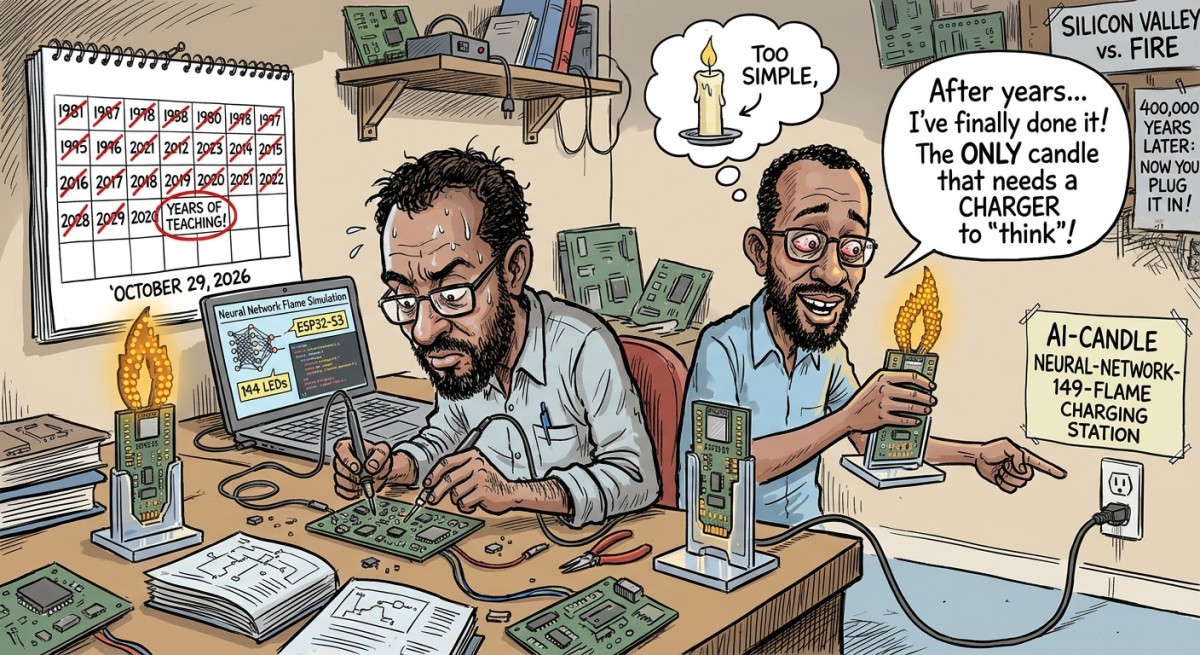
For roughly 400,000 years, the candle had one job and no software updates. On Thursday, that ended. Kevin Bates, creator of the Arduboy handheld, released the Digital Candle, a $149 device that runs artificial intelligence to do what a 99-cent stick of wax does while you are not looking.
The company calls it "The world's first AI-powered candle." It is also the world's first candle with a USB-C port, which is a sentence that should have stayed in a fever dream.
The specifications read like a dating profile for a lamp. It is 10 inches tall. It has 144 amber LEDs in a 9-by-16 grid. It runs on an ESP32-S3 chip with Wi-Fi and Bluetooth, which means your candle is now better connected than your uncle.
The brain is a neural network with 3,545 parameters, trained on phone footage of one real candle burning in a dark room. Somewhere out there is the most important candle in the history of computing, and it never got paid. It did the work, the model got the credit, and the wax went in the bin. Welcome to the creative industries.
The product page states the philosophy plainly: "It thinks." Most candles do not think. That is their charm. A candle that thinks is one bad mood away from a candle that judges your apartment.
The flame never repeats and is unique to each unit, derived from the chip's factory hardware address. Every candle has its own personality. You are no longer lighting a candle. You are adopting one.
The candles can even talk to each other on a private network to synchronize their flicker, though the feature is off by default. Wise. Nobody needs a group chat of candles deciding the vibe without them.
Bates says the idea came from a hotel in Singapore. "Walking past a hotel, I saw dozens of candles floating in the air. Up close, they were circuit boards." Most people see circuit boards pretending to be candles and think, how charming. Bates thought, I can make that harder.
He also writes that the work is "co-authored by a ghost in the machine." Fair. Every candle ever made has eventually been co-authored by a ghost. This is the first one with a GitHub page.
The Verge noted that it "doesn't quite provide the same ambiance as the real thing, even if it's much safer." That is the entire history of technology in one review: worse, safer, and $148 more expensive.
The slogan is "The candle, danger removed." Also removed: the smell, the romance, and the battery, which is not included. You may now experience a blackout with a candle that also goes out in a blackout.
To be fair, it is open source. You can reprogram it into a clock, a notification screen, or Conway's Game of Life. That is a candle that tells the time, tells you about your emails, and simulates life itself, which is a lot of ambition for something whose ancestors were happy at a birthday party.
So the future has arrived, and it flickers at 30 frames per second. Blow on it all you want. It will not go out. It will just ask you to update.
The AI Candle: Questions Nobody Asked a Candle Before
What's Your Reaction?
 Like
0
 Dislike
0
 Love
0
 Funny
0
 Wow
0
 Sad
0
 Angry
0






Comments (0)