

China and North Korea Finally Open the Bridge They Finished in 2014, Ending the Longest "Almost There" in Engineering History
China and North Korea officially opened the New Yalu River Bridge between Dandong and Sinuiju on Thursday, October 15, 2026, twelve years after the 3-kilometre span was completed. This satirical politics dispatch treats the world's most patient bridge as a long engagement, a delivery chute and a diplomatic friendship conducted mostly by video link.
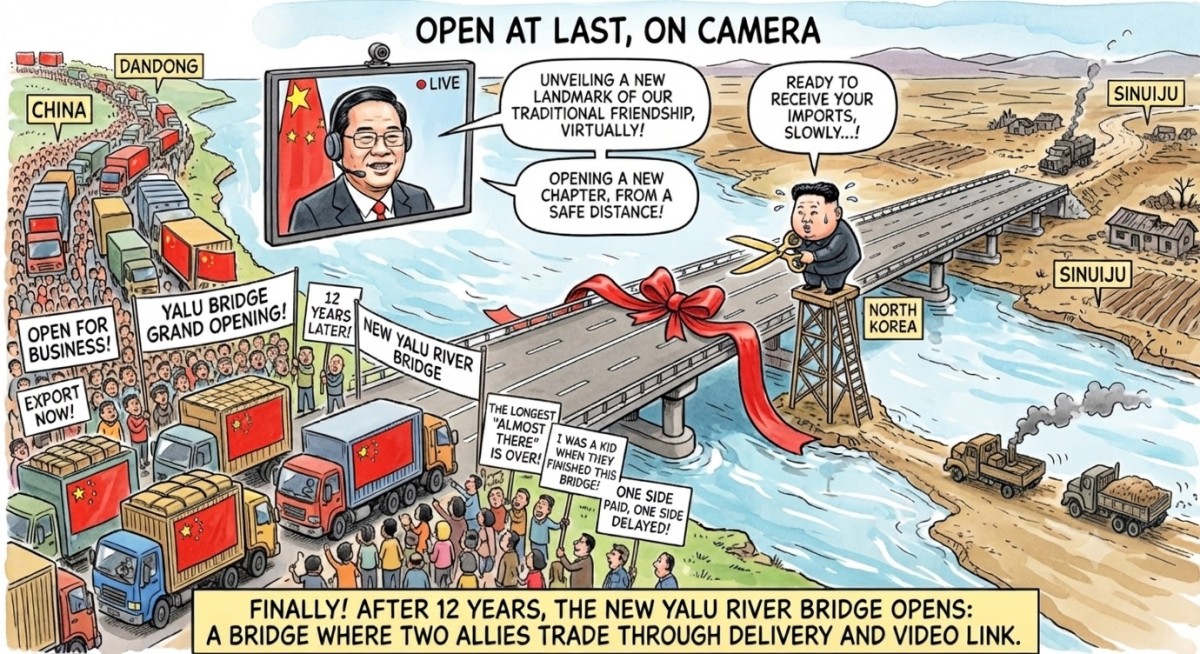
On Thursday, China and North Korea opened a bridge. This would be ordinary news if the bridge had not been finished in 2014. At that point it is not a construction project. It is a long engagement with concrete.
The New Yalu River Bridge runs 3,026 metres from Dandong, China, to Sinuiju, North Korea. It has four lanes and room underneath for 3,000-tonne ships. For twelve years it also had the cleanest accident record in Asia, because nothing can crash on a bridge nobody is allowed to drive on.
The two countries agreed to build it in 2010. China paid for the whole thing. North Korea's job was the connecting road and the customs post at its own end, and North Korea, after careful reflection, did not do it. It may be the only infrastructure project in history where one side built a bridge and the other side built suspense.
So for a decade the bridge simply stood over the river, like a man holding a door for someone who stopped walking toward it in the Obama administration.
The reasons included sanctions, COVID-19 and a frosty patch in relations. Leif-Eric Easley of Ewha University put it with academic tact: "the long delay, including North Korea's pandemic self-isolation and domestic socioeconomic crackdowns, shows what a difficult partner Pyongyang can be for Beijing." In plainer English: some friends reply within the hour, and one replies in 2026.
Observers expected the opening on October 6, the 77th anniversary of diplomatic ties. It did not happen. After twelve years, missing a deadline by nine days is how North Korea says it's early.
Then, at last, the ceremony. Chinese Premier Li Qiang called the bridge a "new landmark symbolising the traditional friendship between China and North Korea" and said the two countries were "opening a new chapter." He said it by video. Beijing finally had a road into North Korea and still chose the internet. It remains the safest way to cross.
Trucks flying Chinese flags rolled across, which tells you who the bridge is really for. Last year's $2.7 billion in trade was mostly Chinese exports to North Korea. A two-way bridge between them is less a street than a delivery chute with lane markings.
The bridge it replaces was built between 1937 and 1943 under Imperial Japan's occupation, and its road can take only trucks of up to 20 tonnes, one direction at a time. For eighty years, two allies traded across a one-lane hand-me-down from an empire they both resent. Nothing says eternal friendship like sharing a driveway with your old landlord's ghost.
Nobody should expect a traffic jam. Professor Kang Jun-young told the BBC a sudden jump in trade is "unlikely," because "Pyongyang is also wary of a sudden flood of Chinese imports." Only North Korea could open a gateway and then worry that someone might walk through it. Gradually is the one speed this bridge already knows.
Mao Zedong once described the alliance as "as close as lips and teeth." It is a perfect metaphor. Lips and teeth are very close. Every so often, one bites the other.
Last month North Korea also opened its first road bridge with Russia, and its premier attended that ceremony by video too. In this corner of the world, bridges now open the way meetings do: on camera, with nobody in the room. Its foreign policy is no longer isolation. It is remote attendance.
The engagement is over and the marriage has begun. Like many marriages, one side paid for everything, and the other side is still deciding when to show up.
Your Questions About the Bridge That Waited 12 Years, Answered
What's Your Reaction?
 Like
0
 Dislike
0
 Love
0
 Funny
0
 Wow
0
 Sad
0
 Angry
0

Achieve or die trying




Comments (0)