

Britain Pays Nearly £50 Million in One Day to Stop Wind Farms From Working and Start Gas Plants Instead
Great Britain's grid operator spent £47.9m in a single Wednesday turning Scottish wind off and southern gas on, which is what happens when you build turbines faster than the cables that carry their gossip. This satirical business dispatch treats the £1.6m half-hour, the 9-gigawatt nap, and the French last-resort phone call as energy policy with a sense of humor and no sense of direction.
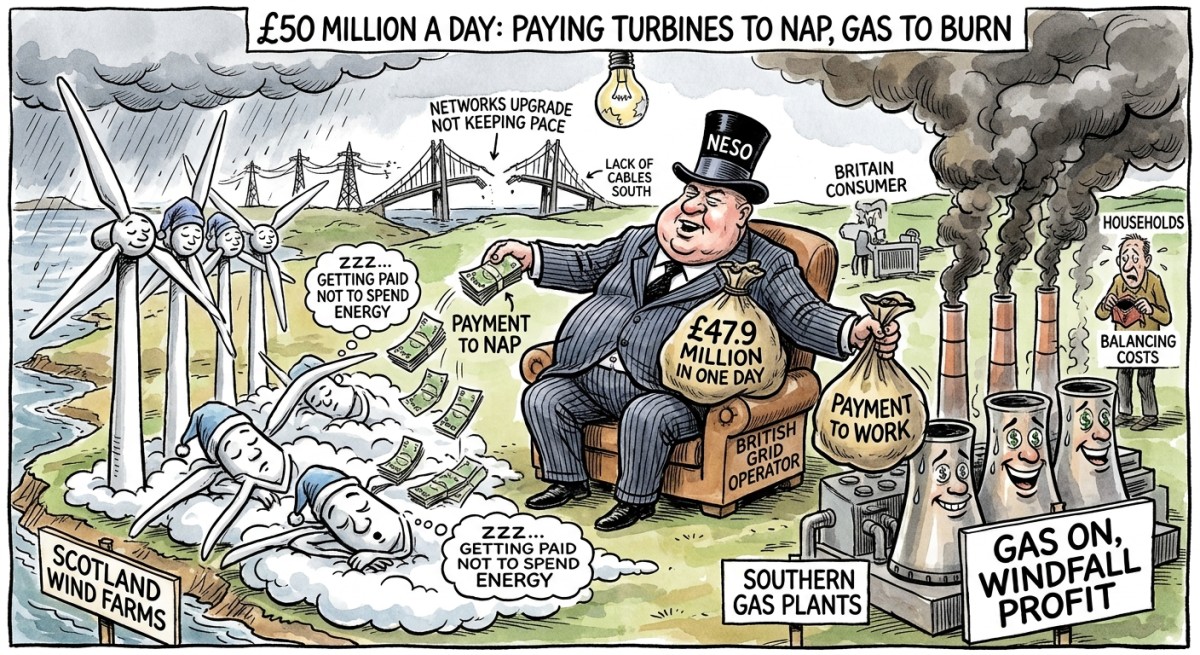
The British electricity system spent Wednesday doing the most expensive thing it knows how to do: paying one set of machines to stop and another set to start.
According to reporting first published Thursday by The Guardian and The Telegraph, the National Energy System Operator paid £47.9 million in a single day to turn wind farms off in places drowning in surplus power and turn gas plants on in places that needed it. One half-hour trading window alone cost £1.6 million. That is not a market. That is a tip jar with a national grid attached.
Roughly 9 gigawatts of wind and hydropower were paid not to generate — enough, consultants said, to power more than 8 million typical households. The turbines had done their job. The cables had not. Scotland, as usual, was asked to hold its applause while the south lit the stove.
"It's the age-old story of a lack of infrastructure to transport power to where it's needed, leading to lots of windfarms being turned off," said Shivam Malhotra of LCP Delta, which is the polite way of saying the country bought a fleet of racehorses and forgot the road.
September's balancing bill had already hit a record £505 million. Analysts now expect about £3.2 billion over the next year, which will arrive on household bills the way weather arrives on a picnic: uninvited, itemized, and somehow your fault. Great Britain is midway through a £150 billion networks upgrade that is failing to keep pace with the renewable projects it keeps connecting. The turbines are early. The wires are fashionably late. The customer is punctual with cash.
Days earlier, NESO had called France for "last resort" emergency power on Monday and Friday — the continental equivalent of asking the neighbor for jumper cables while your garage is full of wind. A NESO spokesperson insisted supplies were "secure" and that the incidents were "not signs of a wider problem," which is how institutions describe a wider problem when the lights are still on.
Chief executive Fintan Slye told a conference there would be "lessons to be learned," that no customers were disconnected, and that his control room "did an absolutely superb job." Superb is the correct word for a room that can spend nearly fifty million pounds before lunch and still call it operational excellence.
The spokesperson added that the biggest chance to cut balancing costs is timely new infrastructure from transmission owners, which "could halve balancing costs by the end of the decade." Halving a bill by 2030 is the kind of promise that sounds like progress until you remember the decade has a receipt.
Britain has discovered the modern energy miracle: renewable power so abundant you must pay it to nap, fossil power so necessary you must wake it with a check, and a cable gap so stubborn it has its own line item. The wind blew. The gas burned. The bill learned a new verb. And somewhere between Scotland and the south, a gigawatt sat in traffic while the country paid both the idle and the idle's replacement — which is, in the end, how a nation keeps the lights on when the map is longer than the wire.
Questions Your Meter Is Too Polite to Ask
What's Your Reaction?
 Like
0
 Dislike
0
 Love
0
 Funny
0
 Wow
0
 Sad
0
 Angry
0

Achieve or die trying






Comments (0)