

An Electric Comb Named After a Rapunzel Movie Grows Hair on Nearly Every Shaved Mouse, Beats Rogaine, and Leaves Human Scalps Until Someone Books a Trial
On Tuesday, Gizmodo and the New York Post took up a Nature Communications paper in which a team led by researchers at Beihang University in China described Detangle, a comb-shaped device they named after the animated film Tangled, and reported that it grew hair over nearly 100 percent of the shaved backs of mice with experimentally induced pattern hair loss. The comb, which looks like an ordinary hair tool, has height-differentiated teeth embedded with electrodes and compartments for therapeutic molecules. Drawn across the skin, it delivers tiny pulses of electricity while the teeth gently lift the surface, generating an electric field the authors say reaches about nine times deeper into hair-follicle regions than a conventional topical application. Loaded with a VEGFA-encoding plasmid, which encourages new blood vessels around follicles, and an siRNA aimed at SRD5A2, which helps suppress the hormone dihydrotestosterone, the comb was used on the mice once every three days for 28 days.

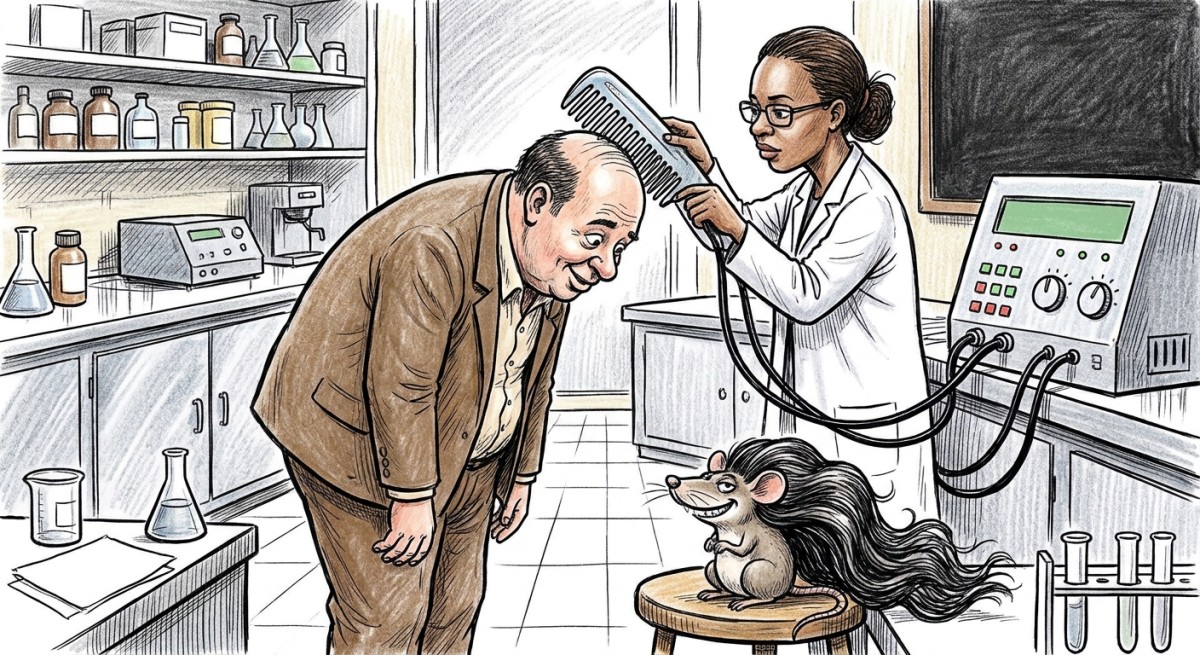
The hair-loss briefing for Tuesday did not lead with a new shampoo. It led with an electric comb, a Rapunzel movie, and a laboratory mouse that has already finished the appointment the rest of us are still trying to book. On Tuesday, Gizmodo and the New York Post took up a paper published this month in Nature Communications, in which a team led by researchers at Beihang University in China described a comb-shaped device named Detangle and reported that it grew hair over nearly 100 percent of the shaved backs of mice with experimentally induced pattern hair loss. The comb was used once every three days for 28 days. Minoxidil, the active ingredient in Rogaine, produced about 70 percent regrowth over the same stretch. The device also outperformed finasteride, which is the formal way of telling two drugstore staples that a grooming tool has just taken their chairs. If hair loss is going to be treated with something already in the bathroom, congratulations: the bathroom has been waiting for the electricity to catch up, and the mouse has left with the coat.
The official record of the invention is almost disappointingly complete, which is how you know a journal has printed the methods. "Here, we report 'Detangle' (a name inspired by the animated film 'Tangled'), a comb-shaped device engineered for AGA treatment," the authors wrote, using the abbreviation for androgenetic alopecia, the most common form of pattern baldness. The name is the most honest part of the filing. A laboratory that has spent years trying to put hair back on a scalp has looked at a cartoon about a girl in a tower, noticed the braid, and decided the product should introduce itself accordingly. First author Feng Liu and corresponding author Lingqian Chang, with colleagues at Beihang and partners including City University of Hong Kong, then described a tool that looks like an ordinary comb until you inspect the teeth. Some are height-differentiated electrodes. Others contain compartments for therapeutic molecules. Drawn across the skin, the comb delivers tiny pulses of electricity while the uneven teeth gently lift the surface. The lift was not requested. The follicles, in the mouse data, did not file a complaint.
The delivery schedule is narrower than a foam's morning routine and much more ambitious about depth. The authors say the resulting electric field reaches about nine times deeper into hair-follicle regions than a conventional external application, which is a polite way of admitting that most of a topical treatment has been having a pleasant afternoon on the surface and never going downstairs. Into that deeper neighborhood Detangle escorts two molecules. One is a VEGFA-encoding plasmid, which encourages new blood vessels around the follicles and, with them, a better blood supply. The other is an siRNA aimed at SRD5A2, which helps reduce production of dihydrotestosterone, the hormone that can shrink a follicle until the hair coming out of it is too modest to be counted. "Safe and efficient delivery remains the key to the treatment outcome of AGA," the team wrote. Gizmodo, in its Tuesday write-up, listed the usual grievances against minoxidil: messy gels and creams, pills that may grow hair in places nobody asked to landscape, and the people who simply do not respond. A comb that lifts, pulses, and walks the medicine in is the laboratory's answer to a bottle that has been knocking on the front door and leaving a note.
The scoreboard arrived after the mice had already completed the course. Used once every three days for 28 days, Detangle produced hair over nearly the entire shaved area. Minoxidil, applied as the conventional comparison, reached about 70 percent. Finasteride finished behind the comb as well. Further tests found more hair follicles, improved blood flow to the treated skin, and no noticeable harm, which is the result a dermatology paper puts in the window when it would like to be invited back. "These results demonstrate that electrostimulation via the Detangle system promotes hair growth and follicle regeneration in a safe and effective manner," the authors wrote. The New York Post, repeating the 100-versus-70 comparison on Tuesday afternoon, also noted that the tool produced new blood vessels around the follicles. A mouse that has been shaved, dosed into a laboratory version of pattern hair loss, and then combed nine times in a month is now the only patient in the building with a completed before-and-after. The control groups, working with the two treatments a human being can already buy, were left to explain a partial finish.
The human contribution, so far, is to read the paper and remain uncombed. Detangle has not been tested on people. That single sentence is doing more work than any electrode on the handle. Androgenetic alopecia, the authors write, affects more than 1.5 billion people. The New York Post, translating the condition into an American cabinet, said some 50 million men and 30 million women experience some form of pattern hair loss during their lifetime, and that minoxidil and finasteride are still the only two treatments approved by the Food and Drug Administration. The researchers are hopeful the system could eventually offer another option, and they close, with a straight face, by saying it "proves safe and effective for deep tissue delivery in dermatology." Optimism is not a clinical trial. A volunteer with a receding hairline has not yet been enrolled, combed on the every-third-day schedule, and compared with a bottle. Until that appointment is booked, the only scalps with a published result belong to animals who did not ask to be in a Rapunzel sequel and still managed to steal the ending.
Until dermatology invents a quieter way to announce that a comb has outscored a foam, the honest takeaway is narrower and funnier. A laboratory can now report that an electric comb named after a movie about a very long braid grew hair over nearly every shaved mouse back it was asked to treat, reached about nine times deeper than a topical application, and left minoxidil to discuss a 70 percent grade. The paper is in Nature Communications. The mice have finished the course. Human heads have not been invited. Further details, the field says, will have to wait for a trial, which is the first time a comb has ever needed a waiting list of more than a billion names. The bathroom cabinet just learned it may have been holding the wrong tool. The briefing, for the moment, is holding a parting in place.
Questions Still Waiting at the Reception Desk After the Mice Left With a Full Coat
What's Your Reaction?
 Like
0
 Dislike
0
 Love
0
 Funny
0
 Wow
0
 Sad
0
 Angry
0




Comments (0)