

Two Saddled Horses Board a Detroit Bus on the Wheelchair Ramp, Exit Out the Other Door, and Leave the City Until Thursday to Decide Whether They Qualified as Lap Animals
On Tuesday, the City of Detroit confirmed that a viral video of two saddled horses boarding a Detroit Department of Transportation bus is real, that the department has located the driver, and that the rest of the investigation will have to wait until Thursday, November 12. The footage, filmed Saturday on Seven Mile Road near Strasburg Street by Ellessia Drew and posted to Facebook, shows two people leading the horses onto a city bus through one door and promptly back out through another. CBS News Detroit, which authenticated the video through metadata and ruled out an artificial-intelligence fake, reported that a rider appeared to be talking to someone on the bus before the animals trotted aboard, and that the driver lowered the wheelchair ramp to get them on. "They tried to pull the horses on there. They wouldn't get on there at first because when he put the horses on there, I guess they got crazy because you saw how the bus was moving a little bit," Drew told the station. City rules

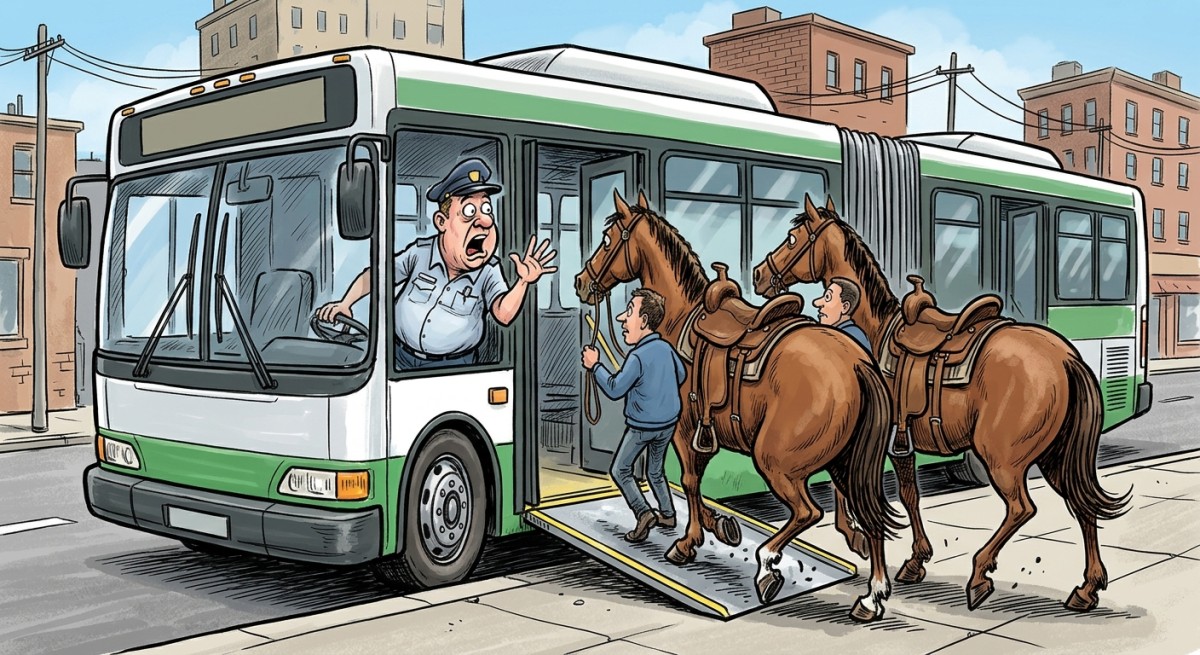
The municipal blotter for Tuesday did not lead with a mastermind. It led with two saddled horses, a wheelchair ramp, and a city spokeswoman prepared to confirm that the internet, for once, had not invented the livestock. On Tuesday, the City of Detroit told the Detroit Free Press that a viral video of two people boarding a Detroit Department of Transportation bus with horses in tow is real, that DDOT has located the bus driver, and that the rest of the investigation will not have further details until Thursday, November 12. The footage, shot Saturday on Seven Mile Road near Strasburg Street by Ellessia Drew and posted to Facebook, shows a pair of saddled horses being led on through one entrance and promptly back out through another. If public transit is going to make a house call, congratulations: the passengers arrived already wearing the seats, and the trip was over before anyone could ask for a transfer.
The official record of the boarding is almost disappointingly complete, which is how you know someone had a phone and a red light. Drew told CBS News Detroit she was driving on Seven Mile, turned down Strasburg Street, and found riders who were not waiting in the usual way. On camera, a horse rider appeared to be talking to someone on the bus, after which the animals trotted aboard. The driver, in a gesture the ramp was not consulted about, lowered the wheelchair lift to get them on. "They tried to pull the horses on there. They wouldn't get on there at first because when he put the horses on there, I guess they got crazy because you saw how the bus was moving a little bit," Drew said. The hesitation was the most reasonable part of the commute. The bus moved a little bit. The horses, after some persuasion, got on anyway. CBS authenticated the clip through metadata and ruled out an artificial-intelligence fake, which is presently the most American way to prove that a horse has used mass transit.
The rulebook, which did not board with them, is narrower than the aisle. Service animals are allowed on Detroit buses, but the city's transportation FAQ limits that courtesy to guide or signal dogs, or to animals trained to help someone with a disability, and requires them to be under control "at all times." DDOT's website is even less poetic: the only animals allowed on board are service animals, and they must sit in the passenger's lap or on the floor. CBS noted that these horses took up the entire aisle, and that it was unclear whether they were service animals. A saddle is many things. It is not a lap. It is also not the floor. It is a piece of equipment that announces, before the farebox can object, that the rider intended to commute in the original sense of the word. The control clause will have a longer meeting. A bus that is "moving a little bit" while horses are being pulled aboard is not the brochure photograph of an animal under control at all times.
The city's contribution arrived after the clip had already finished its own investigation. Alexis Ware, deputy director of media relations for the mayor's office, put the matter in the official dialect: "It is a real video." "DDOT has located the bus driver." As of Monday night, CBS News Detroit said it had reached out to the department twice and had not heard back. By Tuesday, the mayor's office was ready to authenticate a bus ride the weekend had already filmed, and to schedule the remaining answers for Thursday. Locating the driver is the one part of the roster that was supposed to be easy. The horses have not been announced as found, cited, or booked, and no charges have been made public. The investigation now has a calendar appointment, which is how a transit agency says it would like two business days to decide whether a horse is a guide dog.
The exit was the most efficient part of the route. The horses, having used a ramp built for a wheelchair and an aisle built for people, left through the other door almost as soon as they had arrived. It is the shortest recorded use of a Detroit bus this week, and possibly the only one in which the passengers brought their own upholstery and still declined to stay for a stop. No citation has been reported. No fare has been discussed. The rear door did the work usually reserved for a missed connection, and the animals returned to the street as if the bus had been a slightly larger stall with worse hay. Daytime traffic has hosted a lot of unusual boardings. Few of them have required a wheelchair ramp, a metadata lab, and a Thursday status hearing to establish that the livestock was, in fact, livestock.
Until municipal transit invents a quieter way to process a saddled commute, the honest takeaway is narrower and funnier. A city can now confirm that two horses used a wheelchair ramp, occupied an entire aisle they were never going to sit in, and left through the rear door before anyone could ask whether they had paid, transferred, or qualified as lap animals. The video is real. The driver has been located. The horses have not left a forwarding stop. Further details, the city says, on Thursday, November 12, which is the first weekday a wheelchair ramp has ever needed to clear its calendar. The opening doors just learned how to take a hoof print. The blotter, for the moment, is holding the back door open.
Questions Still Holding the Rear Door After the Horses Used the Front
What's Your Reaction?
 Like
0
 Dislike
0
 Love
0
 Funny
0
 Wow
0
 Sad
0
 Angry
0


Comments (0)