

Billionaire Publishes Peer-Reviewed Paper Blaming Gravity for Aging; Gravity Declines to Comment, Keeps Pulling
Zomato founder Deepinder Goyal has published a peer-reviewed paper suggesting gravity may be quietly aging our brains by making the heart pump blood uphill all day. A liver doctor says it "proves nothing," and gravity, as usual, refuses to back down.

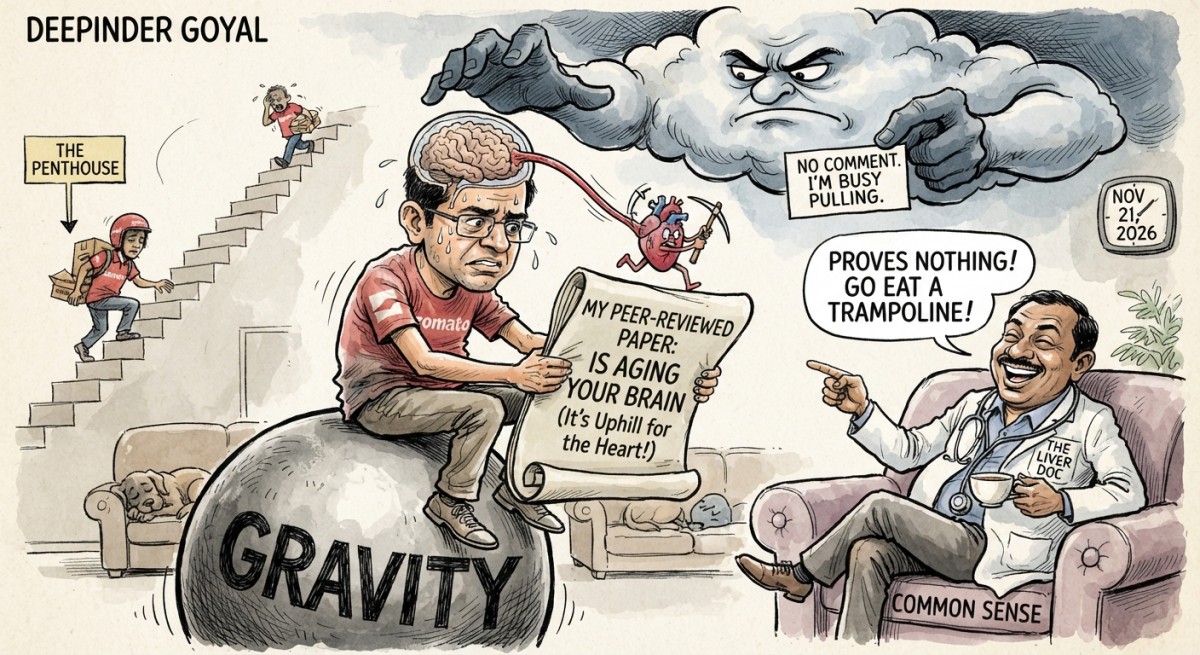
For thousands of years, humanity blamed aging on time, stress and teenagers. This week, Deepinder Goyal, the founder of the Indian food-delivery giant Zomato, finally named the real culprit: gravity, the one force on Earth that has never once been asked to sign a waiver.
His paper, "Gravitational Stress, Cerebral Blood Flow, and Aging: A Hypothesis," has been published in Ageing Research Reviews. The argument is simple. We spend most of our waking lives upright, with the brain above the heart, so the heart spends decades pumping blood uphill, like a delivery rider whose customer lives on the top floor of a building with no elevator and a one-star attitude.
Over the years, the theory goes, the brainstem and hypothalamus may get a little less blood than they ordered. These are the regions that run sleep, hormones, metabolism and body temperature, so when they get tired, every other organ files a complaint. It is the first scientific paper to suggest your brain is aging because it insisted on living in the penthouse.
Goyal, to his credit, has been careful. "What it does not say: that gravity is the sole cause of aging, how big the effect is, or that anyone should try an intervention," he wrote. So that is roughly 17,500 words, about 240 citations, more than 12 months of work, and the official medical advice is: carry on standing. It is the most expensive "no comment" in the history of publishing.
"Peer review checked that the argument is strong enough to publish; only experiments can prove whether it is true or false," he added. This is the academic equivalent of a restaurant review that says the menu was beautifully laminated.
Not everyone liked the order. Dr Cyriac Abby Philips, a Kochi hepatologist who posts as The Liver Doc, said the paper reflects "the lowest level of evidence in medical science" and "proves nothing." When a liver specialist comes after your brain paper, the organs have clearly started a group chat.
Philips pointed out that zero gravity in space also brings muscle loss, bone loss and enlarged brain ventricles. So gravity ages you, and no gravity also ages you, which leaves the only safe place in the universe somewhere in the middle, such as a trampoline. He added that if being upright drove aging, mice and dogs would far outlive humans. Dogs, who have spent thousands of years lying on the couch, could not be reached for comment, because they were lying on the couch.
He also flagged a conflict of interest, claiming co-author Satchin Panda is listed as a paid scientific consultant to Temple, Goyal's brain-blood-flow wearable company, in a separate preprint, a link he said the journal paper does not disclose. Nothing sells a forehead gadget quite like the news that your forehead is under attack from an entire planet.
Goyal says experiments are underway and welcomes collaborators, "including work aimed at disproving it." Gravity has generously volunteered. It has been running the control group for about 4.5 billion years and has never missed a day.
Until results arrive, the public faces a terrible choice: stand up and age your brain, or lie down and age your career. Doctors continue to recommend exercise, sleep and a good diet, which is deeply suspicious, because all three were invented before anyone had a wearable to sell.
As for gravity, it has issued no statement, hired no lawyer and posted no rebuttal on X. It simply did what it has always done when a billionaire tries to rise above it: waited patiently for him to come back down.
Gravity vs. Your Brain: Your Questions
What's Your Reaction?
 Like
0
 Dislike
0
 Love
0
 Funny
0
 Wow
0
 Sad
0
 Angry
0




Comments (0)