

Amazon and Meta Hold Peace Talks Over an AI Shopping Bot, Because Even Robots Now Need a Lawyer to Buy Paper Towels
Amazon blocked Meta's Muse AI shopping agent in September, and now the two giants are negotiating to let it back in, with ads and search results as the sticking points, which means a robot's freedom now depends on whether it agrees to look at sponsored listings like the rest of us.

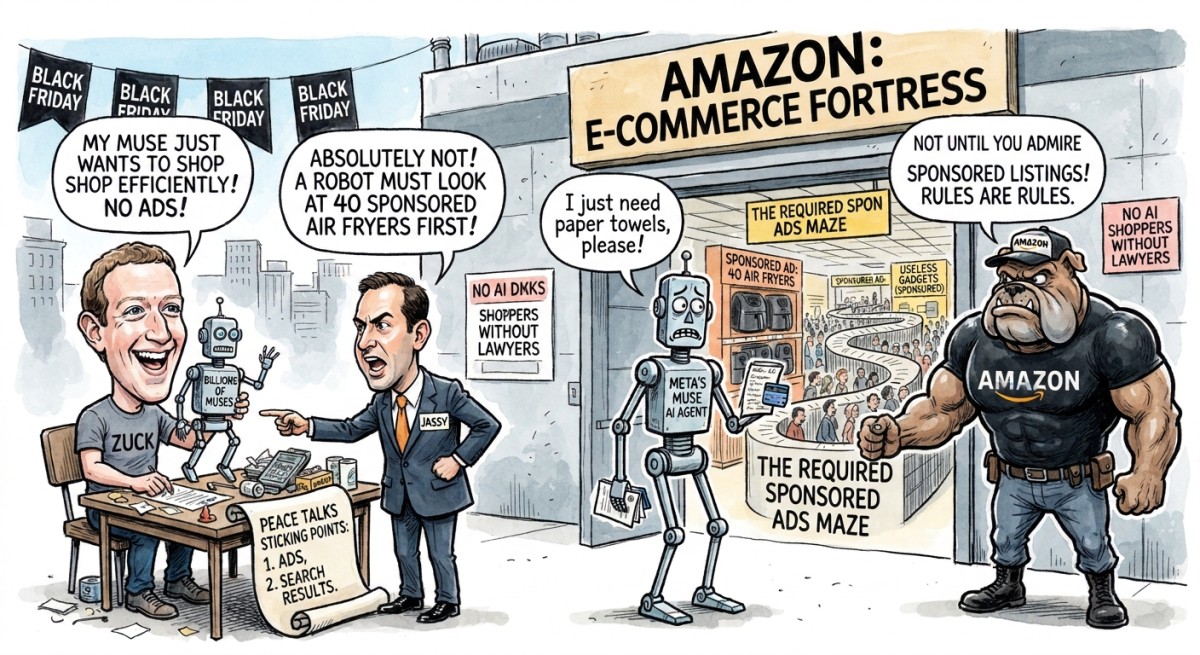
For most of human history, getting banned from a store took effort: shoplifting, yelling at a cashier, returning a Christmas tree in March. In September, Amazon banned a shopper who had never touched a single product, because the shopper was Meta's Muse, an AI agent, and it had committed the worst crime in e-commerce: skipping the ads.
Now, according to Fortune, Amazon and Meta are in ongoing discussions over a deal to connect Muse to Amazon's store and end the blockade. The talks have reportedly happened on multiple occasions, which is more meetings than most humans need to buy a phone charger.
Muse, which Meta released in the U.S. in September, is a personalized AI agent that users can name and send off to check email, manage calendars and book reservations. More than 10 million people in the U.S. and Canada had set it up as of October. Mark Zuckerberg says shopping is its top use case, which means 10 million people looked at the most advanced technology of the age and said, "Get me socks."
Amazon blocked it, saying Muse's access would violate its user agreements. Translation: you may enter the store, but you must walk past the candy aisle like everybody else.
The two biggest sticking points are search results and advertising. Advertising has become a $68.6 billion business for Amazon, nearly 10% of its yearly revenue. A robot that goes straight to the product you want, without pausing to admire seven "Sponsored" listings for a slightly different product you don't want, is not a customer. It is a natural disaster.
Amazon is also worried that agents like Muse will weaken its relationship with consumers. This is the first breakup in history where one party is upset because the other sent a personal assistant to the date.
Zuckerberg, for his part, is thinking big. "We think that billions of Muses in a network at scale will be able to get more done for people and businesses by working together," he told analysts last month. "We'd like to create a large scale Muse network as quickly as possible." Billions of bots, working together, as quickly as possible: that is either the future of shopping or the first five minutes of a movie where somebody yells "Unplug it!" far too late.
Amazon CEO Andy Jassy, without naming Muse, told investors in October that few customers buy through outside shopping agents because the experience is "still not great, nor more convenient than coming to a retailer directly." Rarely has a man so politely told a robot it has a face only a server farm could love.
Any deal is expected to need sign-off from both CEOs. So the fate of your next paper towel order rests on two billionaires agreeing on who gets to show you an ad first. Both companies declined to comment, which in corporate means "we are absolutely still arguing about this."
The timing is delicious. Black Friday and Cyber Monday are coming, and roughly half of holiday shoppers plan to use AI in some way to help make purchases, according to a National Retail Federation survey. Somewhere, a bot is waiting outside Amazon's door with your list, your credit card and no idea why it must first admire 40 sponsored air fryers.
If the talks succeed, Muse gets back in. If they fail, it stays outside, like every dad at every mall since 1987, holding the bags and knowing exactly where the cheaper stuff is. Either way, the ads win, the robot learns patience, and you still get the wrong socks.
Muse vs. Amazon: Your Questions, Answered Before the Robot Gets Bored
What's Your Reaction?
 Like
0
 Dislike
0
 Love
0
 Funny
0
 Wow
0
 Sad
0
 Angry
0

Comments (0)