

FCC Lets SpaceX Launch 1 Million Satellites, Finally Giving the Night Sky the Same Number of Notifications as Your Phone
The FCC has approved SpaceX's Starmind plan to put up to 1 million data center satellites in orbit, announced the day before Thanksgiving. Astronomers object, Amazon says it will take "centuries," and the stars have been quietly asked to move to a smaller apartment.

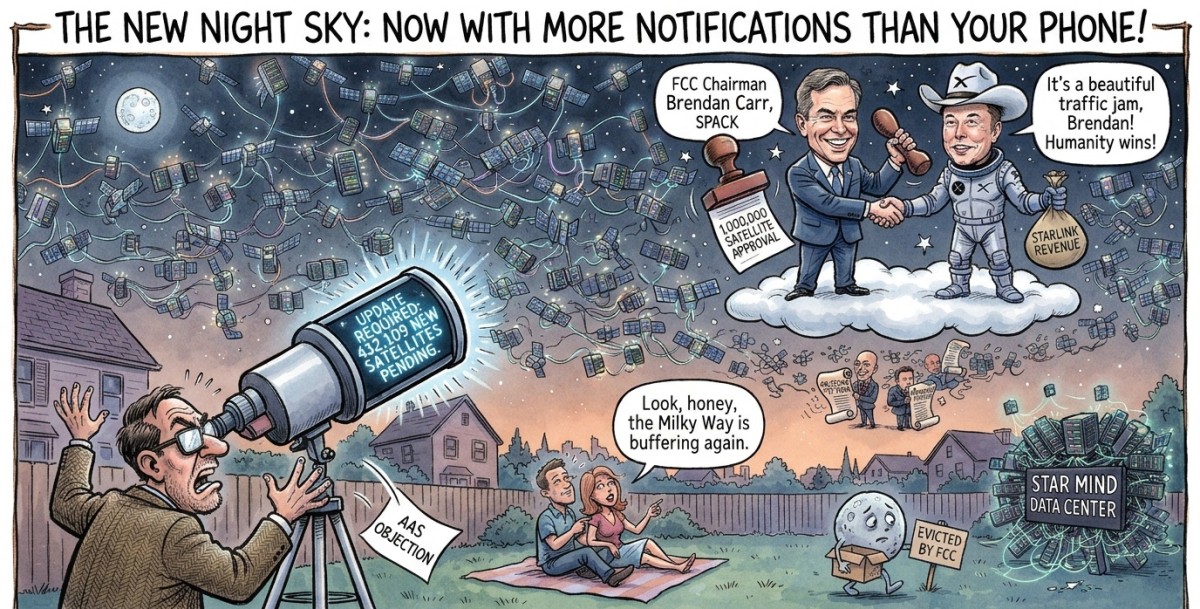
The Federal Communications Commission has authorized SpaceX to put up to 1 million satellites into orbit, which is the first time a government has approved a plan to replace the stars with servers. The Milky Way has been informed. It has asked if it can at least keep the weekends.
"Today, in a historic first, the FCC approved SpaceX's request for 1 million satellites (orbital compute modules) to create data centers in space," Chairman Brendan Carr announced on X. Historic is the right word. Nobody has ever been allowed to litter in that direction before.
The constellation is called Starmind, a name that sounds less like infrastructure and more like a meditation app that bills you monthly for silence. Carr said it and its competitors "will use solar power to extend America's lead in Super Intelligence." The sun has not commented. It never gets equity.
Elon Musk replied, "Much appreciated. This will be a great asset to America and the world." It is the most polite thing anyone has ever said while being handed a million parking spots in the sky.
There are about 15,000 active satellites today. SpaceX may add 1 million. That is not a constellation. That is a traffic jam with a view.
The approval landed on the Wednesday before Thanksgiving, when America was busy thawing a turkey and avoiding an uncle. Earthjustice attorney Jan Hasselman said the FCC "tried to mask the fact with a holiday filing." It is the oldest move in the book: bury the news between the stuffing and the pie, and hope nobody looks up.
There is a schedule, because even the apocalypse of astronomy needs milestones. SpaceX must have the first orbital data center working by 2033, 10% of the fleet by 2035, half by 2038 and all of it by 2040. That is the first government deadline in history that will be easier to see than to meet.
Amazon, which is building a rival network, told regulators the project was a "lofty ambition rather than a real plan" and said it would take SpaceX "centuries" to build. Carr replied that Amazon should focus on missing its own satellite milestone. Two billionaires fighting over the sky is how the gods used to behave, except the gods never filed petitions.
The American Astronomical Society also objected, warning the data centers' waste heat would raise the sky's infrared background and threaten sensitive instruments. Translation: telescopes will soon be able to see the edge of the universe, provided it is hosted on a SpaceX server.
DarkSky International warned the projects "could permanently alter the night sky as we know it." Romance will adapt. Couples will lie in fields, point upward and whisper, "Look, that one is training a chatbot."
Astrophysicist Adam Becker was less gentle, calling the idea nonsense and warning of "a cascading chain reaction of space junk collisions." Every science fiction movie has tried to warn us about this. The FCC apparently only watched the trailers.
So the future is set. Your emails will be stored in orbit, your photos will drift above Ohio, and your search history will finally be closer to heaven than you are.
The stars are still up there, for now. They just have to share the sky with a million roommates, and none of them will ever turn the lights off.
Frequently Asked Questions About SpaceX's 1 Million Satellites
What's Your Reaction?
 Like
0
 Dislike
0
 Love
0
 Funny
0
 Wow
0
 Sad
0
 Angry
0





Comments (0)