

AI Detector Decides Human Novelist Is a Robot, Ignores 11 Drafts and a Notebook, Asks Her to Click All the Squares With Horses
A UK publisher ran Kathryn O'Connor Mertens' debut romance Wild Horse Country through the AI detector Pangram, her agent pulled the book, and deals in Germany, Holland and Italy started to unwind. She says she wrote it herself and has 11 drafts to prove it. Publishing has finally found a way to reject a manuscript without reading it.

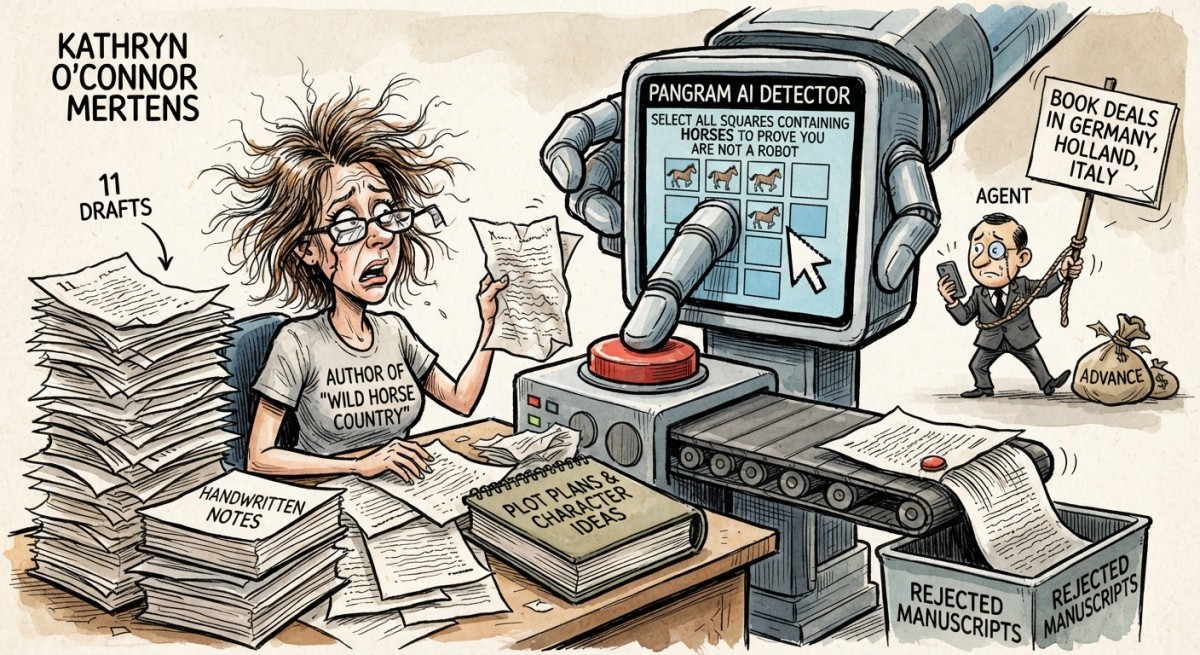
For centuries, writers have feared one verdict above all others: that their book is lifeless, generic and written by a machine. Kathryn O'Connor Mertens is the first to receive it from an actual machine.
Her debut novel, Wild Horse Country, is a romance set at a horse rescue center. It was on submission in several countries, with a two-book pre-empt from Ullstein in Germany and offers in Holland and Italy, when a UK publisher, reportedly Cornerstone, ran it through the AI detector Pangram. The software flagged it as possibly AI-generated. Somewhere, a chatbot is furious about the plagiarism.
Her agent, Sara O'Keefe of Andrew Nurnberg Associates, withdrew the book from submission and said she would "unwind" the deals. In publishing, that is the word for taking back a horse after the barn has already been painted.
The author had not exactly arrived empty-handed. O'Keefe's own email, now circulating online, says Mertens provided 11 drafts plus "a notebook full of character notes and plotting plans." Eleven drafts is not evidence of artificial intelligence. It is evidence of a human being who could not stop fiddling with chapter three.
O'Keefe still concluded that "there is now a significant question-mark over the novel." Question marks were once a sign of curiosity. Now they are the punctuation of suspicion, and they cost more than an em dash.
Mertens replied on her website with a two-word rebuttal any robot would envy: "It wasn't." She added, "I wrote it myself this year over several months, and have drafts, handwritten notes and research showing this." Handwritten notes, of course, are the one thing AI cannot fake, mostly because nobody under 40 can read them either.
She also said she would be "happy to share these with any industry professionals or independent researchers." This is the literary version of a man stopped by the police offering to show them his receipts, his alibi and the dog that saw everything.
The irony writes itself, which is fortunate, since apparently nobody is allowed to anymore. An industry worried that machines will replace writers has outsourced the job of judging writers to a machine. It is like firing the lifeguard because you heard sharks are dangerous, then hiring a shark to check the swimmers.
Every aspiring author now faces a new checklist before submission: polish the prose, cut the adverbs, and add enough typos to prove there is a pulse. Future query letters will read: "Dear Agent, please find attached my manuscript, my blood type and a video of me struggling to rhyme 'orange.'"
Romance novelists are especially exposed. Their books are built on familiar beats: the meet-cute, the misunderstanding, the brooding man who owns a ranch. Run Pride and Prejudice through Pangram and Mr. Darcy may well be flagged as a large language model with a very large estate.
For now, Wild Horse Country waits in the stable while the humans argue with the software. Mertens says she is taking advice and won't comment further. It is a sensible strategy. Anything she writes next could be held against her, and by an algorithm.
Frequently Asked Questions About the Novel That Failed Its Robot Test
What's Your Reaction?
 Like
0
 Dislike
0
 Love
0
 Funny
0
 Wow
0
 Sad
0
 Angry
0


Comments (0)