

Japan Offers ¥10 Million for Your Third Baby, Making It the First Country Where Children Finally Pay for Themselves
Japan's ruling Liberal Democratic Party has drafted a plan to give families about ¥10 million, roughly $63,000, for every third and subsequent child. It also wants a new Population Strategy Agency, government help for matchmaking apps and a fresh look at when "elderly" begins. The plan has not said where the money comes from, which is the most relatable thing a government has ever done. Parents of two are now staring at each other across the dinner table like business partners.

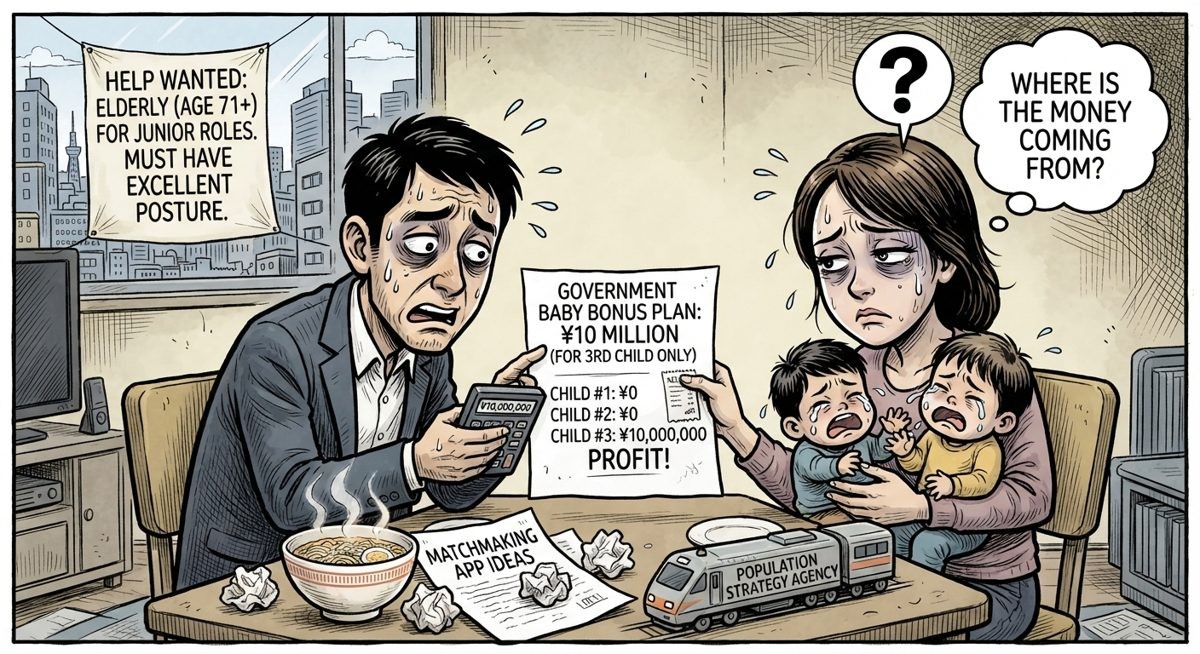
Japan has finally found the price of a baby, and it is about ¥10 million. On Friday, the ruling Liberal Democratic Party's population strategy panel drafted a plan offering benefits worth roughly $63,000 for every third and subsequent child, turning the family minivan into a small business with a car seat.
Note the fine print: the first two children are still free, in the sense that you pay for them. Only from child number three does the government start paying you back. It is the world's first loyalty card where the stamps scream at 3 am.
"I want to issue a message convincing people that the government is serious about the idea of letting the entire society support child-rearing," said Hakubun Shimomura, who heads the party's population strategy headquarters. Translation: it takes a village, and the village has been sent an invoice.
The package does not stop at cash. It proposes a new Population Strategy Agency, because nothing gets people in the mood like a cross-ministerial coordinating body. It wants free childcare extended to children under three. It calls for public-private partnerships to support matchmaking apps, which means somewhere in Tokyo a civil servant is about to design a swipe-right button with the seriousness of a bullet train.
Then comes the part that shows who is really in charge. Because the workforce keeps shrinking, the draft suggests raising the official definition of "elderly" from age 65 and reviewing the 15-to-64 working-age bracket. So the plan to fix the shortage of young people is to declare older people younger. Grandpa is 71, but under the new rules he is a promising junior employee with excellent posture.
It even proposes "short-term regular employees," a job title that sounds like a riddle and probably comes with a long-term irregular boss.
How will Japan pay ¥10 million per child? The draft offers a broad call for "bold tax cuts," which is the fiscal version of answering "where's the money?" with "look, a bird." Critics on social media are already arguing that help should go to young people trying to afford a first child, not to families confident enough to attempt a third. That is fair. The current deal is like a restaurant offering free dessert only to people who have already eaten two dinners.
The proposal goes to Prime Minister Sanae Takaichi soon, ahead of a national population strategy due by the end of the year. Until then, couples with two kids can be found looking at each other across the dinner table, doing math nobody taught them in school.
Japan spent years paying people to have children and watched birth rates stay politely unimpressed. Now it has raised the offer to ¥10 million. If that fails, the next draft may simply skip the middleman and pay the baby directly. Given the new retirement rules, the baby can start work at 65 and finish around 90.
Japan's ¥10 Million Baby Plan: Questions From Exhausted Parents
What's Your Reaction?
 Like
0
 Dislike
0
 Love
0
 Funny
0
 Wow
0
 Sad
0
 Angry
0

Comments (0)