

SpaceX Lenders Ban Elon Musk From Launching Their Collateral Into Space, Because No Repo Man Has Ever Towed Anything From Orbit
SpaceX's lenders tried to stop Elon Musk from firing $40 billion in AI-chip collateral into orbit, making this the first loan in history with a clause that says, in effect, please keep our money on the planet.

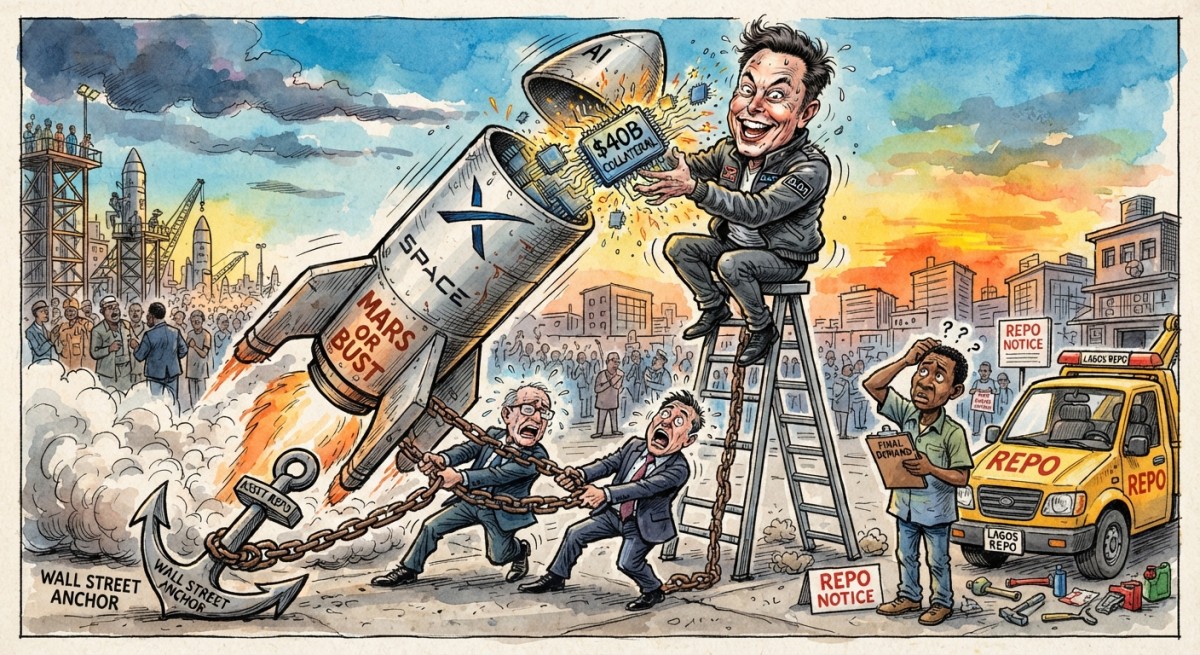
Wall Street has finally found the one thing it fears more than a recession: a loan that achieves escape velocity. Lenders behind SpaceX's $43 billion "Project Saturn" debt package, which is secured by its advanced AI chips, tried to bar Elon Musk from firing the collateral into space. It is the first time a bank has had to write "please keep our money on this planet" into a contract, and judging by the client, it will not be the last.
The worry is simple. If SpaceX defaults, the lenders want to repossess the chips and sell them. This is hard to do when the chips are lapping the Earth every 90 minutes. Repo men are tough, but they are not that tough. The industry toolkit is a tow truck, a clipboard and a bad attitude, and none of the three reaches low Earth orbit.
Musk has outlined plans for data centers cooled by the vacuum of space, which is the most Elon Musk answer imaginable to a hot computer. Most of us open a window. He opens the sky.
SpaceX insists these particular chips will live in US data centers majority-owned, controlled and operated by SpaceX, according to a Moody's rating report. The lenders nodded politely, the way you nod at a teenager who says he is "just going to a friend's house" while carrying a rocket. It is uncertain whether the Earth-only provision made it into the final documents, so somewhere a lawyer is either very relieved or quietly updating his résumé.
The numbers are majestic. SpaceX sold more than $30 billion of the debt on Thursday, led by a $25 billion investment-grade bond backed by its five-year lease payments for the Nvidia chips, at a total yield of about 8.3 percent. Pimco took $4 billion. BlackRock, Goldman Sachs Asset Management and KKR made "anchor commitments," and never has the word anchor worked harder in a deal everyone suspects might float away.
Moody's rated the bonds A3, one notch above SpaceX's own rating, which means the chips now have better credit than the company renting them. Somewhere a GPU is getting preapproved for a mortgage. The agencies credited "hell-or-high-water" clauses that stop SpaceX from walking away from the lease. The lawyers covered hell. They covered high water. Nobody, until this week, had thought to cover low Earth orbit.
The bonds were issued by a special purpose vehicle built to keep the debt off SpaceX's balance sheet. SpaceX, of course, already owns plenty of special purpose vehicles. They are called rockets, and that is precisely the problem.
There is an old banking rule: never lend to a man who can park your collateral where the sheriff can't drive. For centuries that meant offshore. Now it means off-shore, off-continent and off-world.
So the money is raised and the chips are grounded, at least on paper. The lenders can sleep soundly, provided they never look up. Because if a very expensive shooting star ever streaks across the night sky, that is not a wish. That is a missed payment.
SpaceX's Space-Bound Collateral: Your Questions Answered
What's Your Reaction?
 Like
0
 Dislike
0
 Love
0
 Funny
0
 Wow
0
 Sad
0
 Angry
0




Comments (0)