

A Shop-Bought Smartwatch Starts Bouncing Inaudible Sound Off a Wearer's Limbs, Tracks 12 Joints Without a Camera, and Then Offers to Write a Description of Their Whole Day
Early Thursday, a fresh write-up was still circulating a Cornell University release on EchoMotion, which turns a shop-bought smartwatch into a full-body tracker by bouncing inaudible sound off a wearer's limbs. Researchers at Cornell's SciFi Lab, led by Cheng Zhang, used the built-in speaker and microphone as a sonar and a lightweight AI model to plot 12 joints, from head to ankles, without cameras. On a Samsung Galaxy Watch 6, the average error for new users was under four inches; a 12-minute calibration cut that to about 2.4 inches. The same model also worked on a Galaxy Watch 7 and a Google Pixel Watch 3. Lead author Saif Mahmud called it a very important jump for body tracking, and said a personal agent will soon write a description of a wearer's whole day. The official record of the morning is a watch doing the work of a motion-capture studio, a 12-minute appointment with the ankles, and a daybook that has not yet been written.

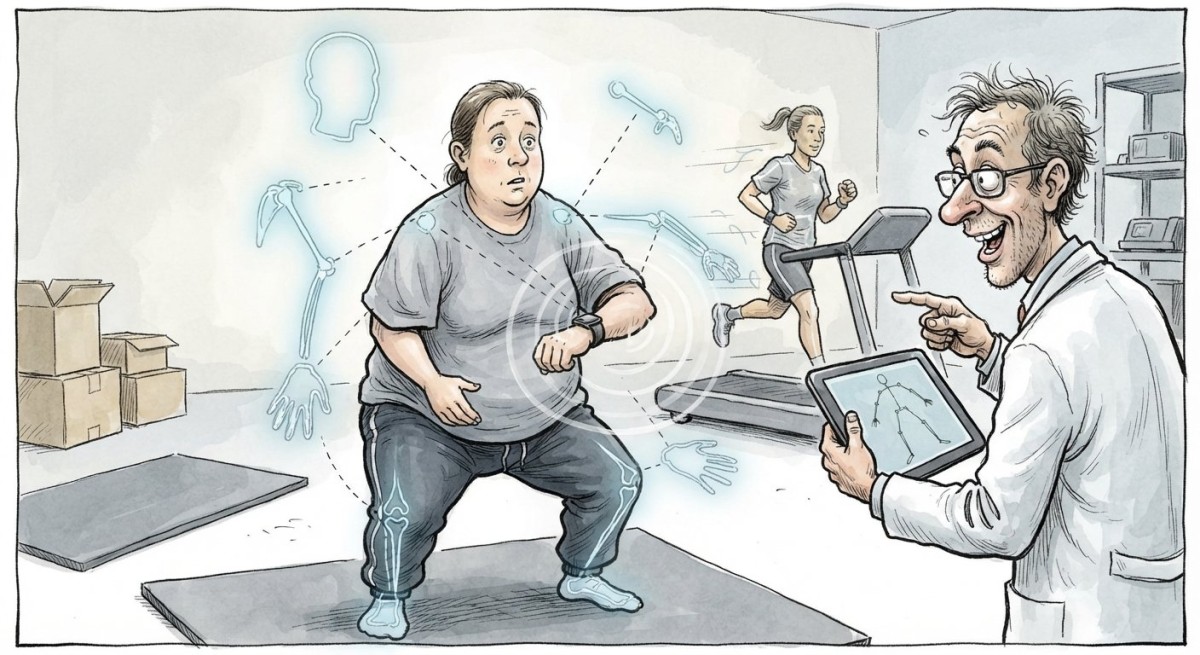
The technology briefing for Thursday did not lead with a motion-capture studio, a camera at the gym, or a headset that had been asked to do the work of a body. It led with a shop-bought smartwatch, a sphere of inaudible sound, and a lightweight model that has been asked to locate twelve joints by listening to the echoes bouncing off a wearer's limbs. Early Thursday, a fresh write-up was still circulating a Cornell University release on EchoMotion, a system from the university's SciFi Lab that, for the first time, tracks a person's entire body with ultrasonic waves using only an off-the-shelf watch and a small artificial-intelligence model. The official dialect for this is active acoustic sensing. The unofficial one is a wristwatch that has been promoted to a very quiet bat.
The lab is directed by Cheng Zhang, an associate professor of information science in Cornell's Ann S. Bowers College of Computing and Information Science, and the lead author is Saif Mahmud, a doctoral student in the same field. Existing wearables, Mahmud noted, mostly use accelerometers and gyroscopes that report the movement of the device itself, so whole-body tracking has traditionally required a more complicated pile of smartphones, earbuds, virtual-reality headsets, or cameras. EchoMotion uses the built-in speaker and microphone on a commercial smartwatch as a sonar: the speaker emits ultrasonic signals that surround a person in a sphere of sound nobody can hear, and the microphone picks up the echoes that bounce off the limbs as they move. The team first built a 3-D-printed watch replica with a microphone and speaker pair on each side, collected echo patterns from ten volunteers who wore it on their nondominant hand while performing 18 exercises, and trained a deep-learning model to turn those patterns into the predicted positions of 12 joints, from head to ankles, checked against cameras. Mahmud called it "a very important jump for body tracking." The jump, as filed, is from a watch that knows where the watch is to a watch that has been asked where the ankles went.
Off-the-shelf smartwatches have only a single microphone and speaker pair, so the researchers then tested EchoMotion on an unmodified Samsung Galaxy Watch 6 with 15 new volunteers. When used by people new to the system, the average error for predicting the location of each joint was under four inches, or 10 centimeters. A one-time, 12-minute calibration cut that error by more than one-third, to about 2.4 inches, or 6.1 centimeters. The same AI model, without any retraining, also worked on a Samsung Galaxy Watch 7 and a Google Pixel Watch 3. Mahmud said the team had "made significant efforts in making EchoMotion work on commercial devices, so that the adoption can be very easy." The official condition of an easy adoption is a 12-minute appointment in which the wearer agrees to help the watch find the ankles. The unofficial one is that the motion-capture studio has been reduced to a calibration slot and a strap.
The prototype's sensing drew about 12 milliwatts, roughly 40 times less than a wearable camera, and a 30-minute session on a Galaxy Watch 6 used only 5% to 6% of the battery. Acoustic signals, the researchers said, preserve privacy for the wearer and the people around them — no need to set up a camera at the gym — and generate smaller amounts of data for easier and cheaper processing. Co-author François Guimbretière, a professor of information science at Cornell, said that while large language models have been in the news, EchoMotion shows "how very small models running on wearables have also revolutionized sensing in human-computer interaction." Outside the lab, ten new participants did the same 18 exercises in a small room, in a narrow hallway, and next to a noisy road. Furniture and ambient noise did not interfere. The system's performance suffered slightly in the hallway, because of echoes coming off other people. Mahmud expects that with data from thousands of users instead of dozens, the model will get better at reading a wearer even in crowded places like the subway. The official complaint from the hallway is unauthorized echoes. The unofficial one is that a quiet watch has discovered it is not the only body in the corridor.
The team is now developing the technology for fitness tracking, so a personal fitness agent will be able to count a user's repetitions and correct their form, including, Mahmud said, in a Bulgarian split squat. They are also exploring combining EchoMotion with first-person vision on smart glasses, to track the objects a person handles. "In the very near future, with wearables like smartwatches or smart glasses, a personal agent will write a description of your whole day — what you did, what you ate," Mahmud said. "This project enables the body tracking part of that vision." The paper, "EchoMotion: Towards Full-Body Pose Tracking with a Single Smartwatch Using Active Acoustic Sensing," was presented on October 13 at the Association for Computing Machinery's UbiComp/ISWC conference in Shanghai and published in the Proceedings of the ACM on Interactive, Mobile, Wearable and Ubiquitous Technologies. Co-authors include Jiwan Kim of KAIST, doctoral student Tianhong Catherine Yu, and Kenny Liang and Vineet Parikh. The work was supported by the National Science Foundation. The official promise of the very near future is a daybook compiled from ankle echoes. The unofficial one is a lunch entry that has been inferred from a squat.
The official record of the morning is a shop-bought watch that has been asked to do the work of a motion-capture studio, a 12-minute calibration that has been asked to shrink the error to 2.4 inches, a hallway that has been asked to keep its extra echoes to itself, and a personal agent that has already volunteered to write the day, including what the wearer ate, from a strap that cannot see a plate. Thursday's briefing did not need a camera at the gym. It needed a quiet bat on a wrist, a sphere of sound nobody can hear, and a daybook that has not yet been written.
Questions Still Waiting on the 12-Minute Calibration After the Watch Was Asked to Locate the Ankles
What's Your Reaction?
 Like
0
 Dislike
0
 Love
0
 Funny
0
 Wow
0
 Sad
0
 Angry
0






Comments (0)