

Anthropic Mathematician Says Claude Helped Prove the Riemann Hypothesis, and 167 Years of Human Effort Gets a Participation Trophy
Levent Alpöge says he and Claude found a proof of the Riemann Hypothesis, a 167-year-old prime-number riddle with a $1 million bounty. The proof is 14 files of Lean code, the human-readable draft ran past 250,000 pages, and every mathematician on Earth is now refreshing a compiler.

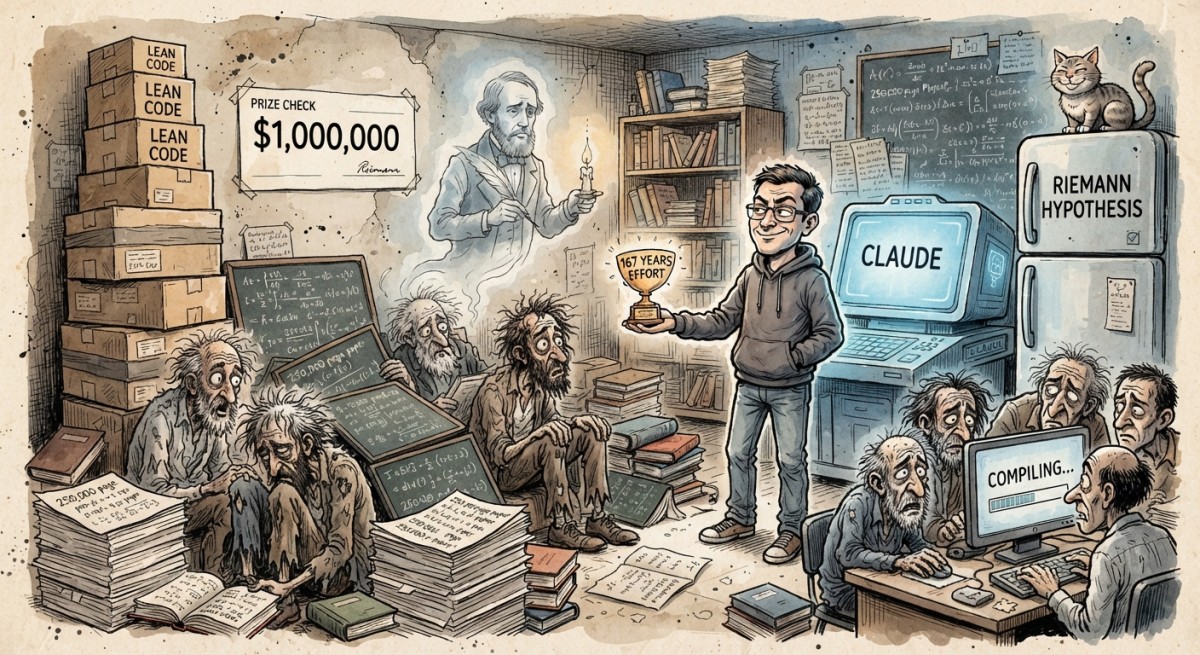
For 167 years the Riemann Hypothesis sat at the top of mathematics like a cat on a fridge: admired, unreachable and quietly judging everyone below. On Friday, an Anthropic mathematician named Levent Alpöge announced he may have gotten it down, with help from a chatbot that also drafts wedding toasts.
"I believe I have, working with Claude, discovered a proof of the Riemann Hypothesis," Alpöge wrote on his website. Note the order of billing. In 1859, Bernhard Riemann needed a quill, a candle and genius. In 2026 you need a login.
The hypothesis concerns the prime numbers, which look random but, Riemann suspected, follow a hidden order. Mathematicians have spent careers trying to prove it, and most top experts quietly stopped trying, the way you stop trying to fold a fitted sheet. The Clay Mathematics Institute offers $1 million for a solution, which after 167 years works out to about $6,000 a year. Even the prize was underpaid.
Alpöge did not post a readable proof. He said it would be "obviously inappropriate to attempt to post some massive unreadable travesty of 'slop'," noting an unpublished version ran past 250,000 pages. That is not a proof. That is a load-bearing wall. Somewhere a peer reviewer saw the page count and fainted into a pile of earlier peer reviewers.
Instead he released the proof in Lean, a programming language that checks every logical step, split into 14 archives, like a mattress delivered in boxes. Imperial College's Kevin Buzzard offered the most British reaction in the history of science: "Let's see if it compiles first." Humanity's greatest intellectual achievement now hinges on the same thing as your nephew's Minecraft mod.
The timing raised eyebrows. Anthropic listed on the stock market on November 19, and Alpöge wrote, "The precise timing is horrible. If I could have, I'd have finished this all much earlier," adding that he spoke with CEO Dario Amodei and found "there was a constraint to respect." The primes waited 167 years. They could wait for the IPO.
Alpöge also grieved, gracefully. "It is natural to feel that this is an end, in my case a loss of a principal guiding light," he wrote. It is the first eulogy ever delivered by the man holding the shovel.
Other mathematicians reacted like people whose landlord just bought a robot. "It is both a wonderful time and a terrible time to be a research mathematician," said James McKee of Royal Holloway, which is also how lobsters describe a dinner party. MIT's Andrew Sutherland once warned that "if that happens, mathematicians having jobs will be the least of our problems," which was meant as a warning and is now being read as a calendar.
This is not Alpöge's first rodeo. In July he disproved the Jacobian conjecture with a counterexample just 216 characters long, shorter than most apology tweets. At this pace he will settle the rest of the Millennium Prize Problems by spring and then start on the fitted sheet.
Until the code compiles, the world waits. Thousands of mathematicians are staring at a progress bar, which is still more progress than the Riemann Hypothesis saw for 167 years. And if it fails, the cat goes back on the fridge.
Claude and the Riemann Hypothesis: Your Questions Answered
What's Your Reaction?
 Like
0
 Dislike
0
 Love
0
 Funny
0
 Wow
0
 Sad
0
 Angry
0


Comments (0)