

Beijing Puts 28 Roombas on Its Rivers, and the Ducks Have Never Felt More Judged
Beijing has deployed 28 driverless boats to scoop leaves and mow weeds on eight city rivers, proving that even the water now has a robot vacuum and a stricter cleaning schedule than you do.

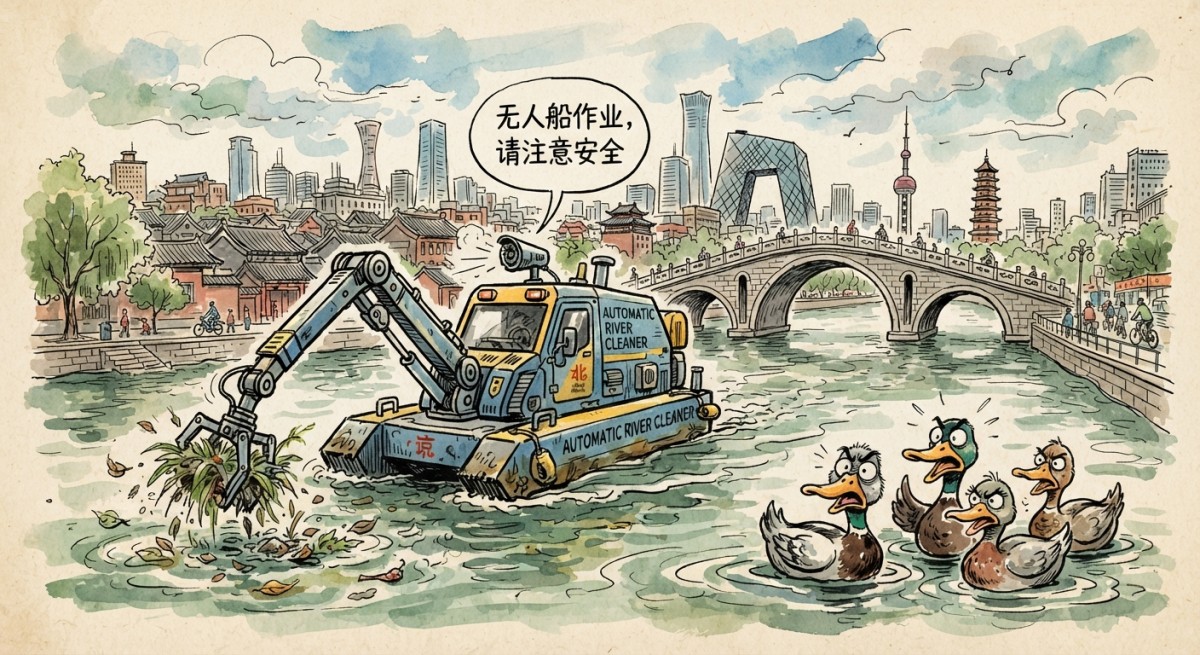
Beijing has put 28 robot boats on its rivers, which means the city's waterways now have better housekeeping than most of its residents. The fleet, ten cleaning boats and eighteen mowing boats, patrols eight central waterways, including the North and South Moats, the Tonghui River and the Kunyu River. Officials compare them to sweeping robots, making this the first time a Roomba has been promoted to admiral.
The boats follow preset routes and dodge obstacles on their own, a skill no human driver in any capital city has ever mastered. One stretches out a collecting arm roughly ten meters long and swallows floating leaves into its belly. It is, in short, a duck with a budget.
On November 18, as a strong wind blew leaves across the water near Gaobeidian Lake, a boat announced itself to passersby: "Unmanned boat at work, please pay attention to safety." It was the most polite thing a machine has said since the toaster stopped talking back, and the first job announcement in history delivered by the employee, about itself, with nobody on board.
The efficiency numbers are humbling. Officials say the boats are more than 2.5 times as efficient as the old manual method, and after a heavy rain they clear in 8 to 10 hours what used to take humans about 24. The humans, to be fair, needed lunch, sleep and regular proof that they had not fallen in.
"In the past, each boat needed two people; now one safety officer on shore can manage several boats at once," said Liu Fa, deputy director of Beijing's urban river and lake management office. Two people per boat became one person per several boats, which is the same math every middle manager uses to explain why you now do three jobs.
The schedule is the best part. To avoid disturbing residents who stroll and fish, some boats mow water weeds from 11 p.m. to 2 a.m. and scoop debris from 5 to 7 a.m. Somewhere in Beijing, a fisherman wakes up, finds the river spotless and the weeds trimmed, and assumes the river has a secret admirer.
The mowing matters because summer water weeds can grow 20 centimeters in a single day, faster than any startup valuation and almost as hard to cut down. The mower blades were widened, raising cutting width by 38 percent, an upgrade every suburban lawn owner is now quietly requesting for Christmas.
As of October, the fleet had logged about 1,500 hours and 3,580 kilometers, covering more than 10 million square meters of water. Officials say the program takes 44 workers off the water every day, and the workers presumably celebrated from the dry, warm shore.
Next, Beijing plans to add water-quality monitoring, video recognition and terrain survey gear, and send the boats to bigger rivers like the Chaobai and the North Canal. Soon the boats will watch the water, measure the water, map the water and film the water, which is more attention than the water has received since the Ming dynasty.
So the future has arrived, quietly, at night, with a ten-meter arm. It needs no raise, no nap and no second person on board. It only needs you to pay attention to safety, which it will kindly remind you of while it eats the leaves.
Beijing's Robot River Boats: Your Burning Questions
What's Your Reaction?
 Like
0
 Dislike
0
 Love
0
 Funny
0
 Wow
0
 Sad
0
 Angry
0






Comments (0)