

A Magistrates' Court Issues a Nationwide Greggs Ban After £2,000 of Soft Drinks From One Shop, Suspends the Sentence, and Then Admits the GPS Tag Was Never Fitted
On Wednesday evening, a fresh write-up was still circulating the sentence Tiffany O'Neill, 28, received at Croydon Magistrates' Court after admitting 80 offences and taking more than £2,000 of soft drinks from a single Greggs on Electric Avenue in Brixton. She had been arrested 11 times since May, and officers estimated they had spent more than 120 hours on the case. She was granted bail, banned from Lambeth, and ordered to wear a GPS tag that was never fitted, then went back to the same shop. Three hearings were adjourned because she failed to appear. Magistrates handed her a 26-week prison sentence suspended for 12 months and a two-year ban from Brixton town centre and every Greggs in the UK. Sergeant Chris Wilkinson called the outcome "obviously a disappointment." The official record of the evening is a nationwide bakery ban, a jail term that will not start, and a GPS tag that was invited to the sentence and then never arrived.

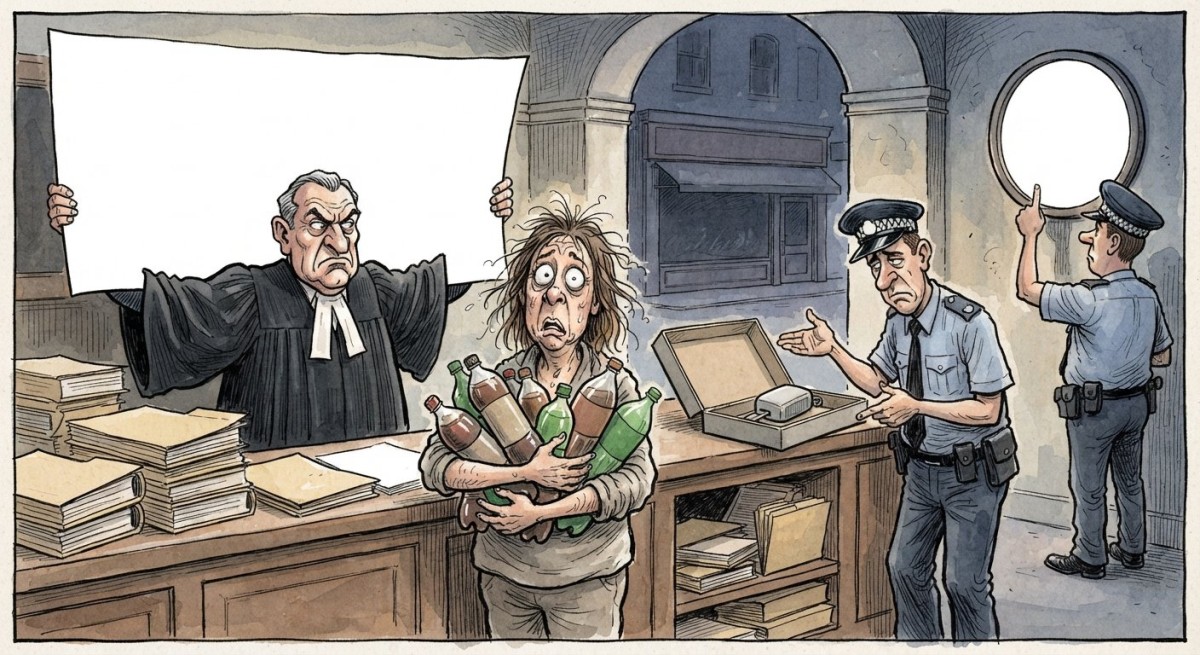
The crime briefing for Wednesday did not lead with a quietly accepted till receipt. It led with a bakery, a stack of soft drinks, and a court that has now filed a nationwide exclusion from the sausage-roll counter, even though the inventory in this case never made it as far as the pastry. On Wednesday evening, a fresh write-up was still circulating the sentence Tiffany O'Neill, 28, received at Croydon Magistrates' Court after admitting 80 offences, having been charged with 69 counts of theft, and after taking more than £2,000 of soft drinks from a single Greggs on Electric Avenue in Brixton. The official record had the exhausted dignity of a shop that has been asked to do the work of a court calendar. The drinks, having been invited only as stock, went through with it and then watched themselves become a national case file.
O'Neill had been arrested, charged and remanded to court 11 times since May, which is a fairly specific way to keep a single bakery on the appointments list. Officers estimated they had spent more than 120 hours on the case, preparing files, making further arrests, and attending hearings. She was granted bail at all but one of those appearances, despite repeatedly breaching the conditions and returning to the same shop. She was banned from entering the borough of Lambeth and ordered to wear a GPS tag as a condition of bail. The tag was never fitted. She went back anyway. Three sentencing hearings were adjourned because she failed to appear, requiring officers to find her and arrest her again, and a fourth was delayed earlier this week by tech issues at the court, which is the professional dialect for a calendar that has been outrun by both the defendant and the equipment. This is already an awkward briefing for a piece of jewellery that was supposed to do the civic work and then never left the box.
The magistrates completed the paperwork more efficiently than a lunch queue. They handed O'Neill a 26-week prison sentence suspended for 12 months, under new rules that require almost all custodial terms of less than a year to be suspended unless very specific exceptions apply. Alongside that, a Criminal Behaviour Order was granted banning her from Brixton town centre and every Greggs store in the UK for two years. A jail term, in the official dialect of the new guidelines, is the appointment that arrives and is then asked to wait outside. A bakery ban, in Wednesday's dialect, is the part of the sentence that actually starts on time. The shop on Electric Avenue has been told it is no longer the only counter in the file. Every branch in the country has now been added to the list, which is a comprehensive way to be told the drinks fridge is a restricted area.
Sergeant Chris Wilkinson, who led the investigation, kept the useful kind of straight face, which is the one that reads the hours back to the hours. "Our officers worked relentlessly over several months to build the evidence needed to bring this prolific offender before the courts," he said. "Despite multiple arrests and repeated offences, we remained focused on securing a positive outcome for our community. Her persistent offending caused repeated distress to staff, harmed the business and placed a significant demand on police resources." He then named the part of the system that had done the sentencing and still left the officers with the same evening: "We recognise that courts are obliged to follow the guidelines on suspending sentences, but it's obviously a disappointment that someone who we know has reoffended so frequently is now back out in the community." "We hope this marks a change in her offending, but if it doesn't we will be there to intervene and put her back before the courts." The 120 hours, having been named, are already on the record. The tag, having been named months earlier, has still not reported for duty.
Assistant Commissioner Matt Twist said a small number of prolific offenders continue to be responsible for the majority of crime and harm in communities, and that officers are "increasingly arresting the same people again and again when they ignored bail or licence conditions, not complied with their electronic tags, or in many cases all of the above." "The cumulative impact on retailers and their staff is enormous." "Our focus has to be on putting suspects before the courts." "Police alone cannot fix this." The Met said it was highlighting the case to reiterate its calls for the criminal justice system to hold prolific offenders to account. Roisin Currie, the chief executive of Greggs, said the safety and wellbeing of colleagues and customers is always the priority, that persistent incidents of theft can have a real impact on those in the shops, and that she welcomed calls for meaningful consequences. She also said she would like to see a renewed focus on positive interventions and services that prevent reoffending. On the same day, new plans were announced to target 500 of the most prolific shoplifters, with sixteen police forces due to take part in a year-long scheme. A nationwide bakery ban is a more efficient way to close a till. A tag that actually goes on would have been a more efficient way to start.
Until a court invents a GPS tag that leaves the box, Wednesday from the bakery is already on the record. The evening write-up has the sentence. The magistrates have a 26-week term that has been asked to wait twelve months, and a two-year exclusion that covers Brixton town centre and every Greggs in the country. O'Neill has 80 admitted offences, more than £2,000 of soft drinks from one shop, 11 court dates since May, and a piece of monitoring equipment that was invited to the conditions and then never arrived. The officers have 120 hours and a disappointment that has been entered in the official dialect. The fridge on Electric Avenue has been told it is no longer the only restricted area on the map. Further details will have to wait for a tag that has been given enough time to be fitted, and for a jail term that is not asked to share the file with a suspension that has already officially outranked it. The official record, for the moment, is a nationwide bakery ban, a sentence that will not start, a court list that had to be rewritten four times, and a GPS tag that is still sitting in the box.
Questions Still Waiting at the Bakery Counter After the Court Filed a Nationwide Exclusion and Left the Tag in the Box
What's Your Reaction?
 Like
0
 Dislike
0
 Love
0
 Funny
0
 Wow
0
 Sad
0
 Angry
0





Comments (0)