

BMI Hands 1.3 Million People a Diagnosis the Tape Measure Has Now Recalled, Leaves 2.4 Million Hidden in the Overweight Tray, and Then Admits It Cannot Tell Whether Anybody Is Actually Ill
On Wednesday afternoon, a fresh write-up was still circulating a King's College London-led study, published in Nature, which found that the body mass index has been doing the official paperwork of obesity without looking at anyone's waist. Researchers analysed 844,108 adults in the United Kingdom, China, the United States and Spain, including more than 430,000 people from the UK Biobank, and reported that adding waist measurements to the usual height-and-weight sum showed BMI misclassifying obesity in both directions. Up to 8.6 percent of people in the study had so-called hidden obesity: they had been filed as merely overweight, while the tape measure found obesity-level body fat. In the UK alone, the team said, that could translate to 2.4 million people with dangerous levels of body fat that BMI misses. Up to 3.1 percent had been classed as obese when measurements showed no excess fat, an estimated 1.3 million people who may have no excess fat and no excess risk.

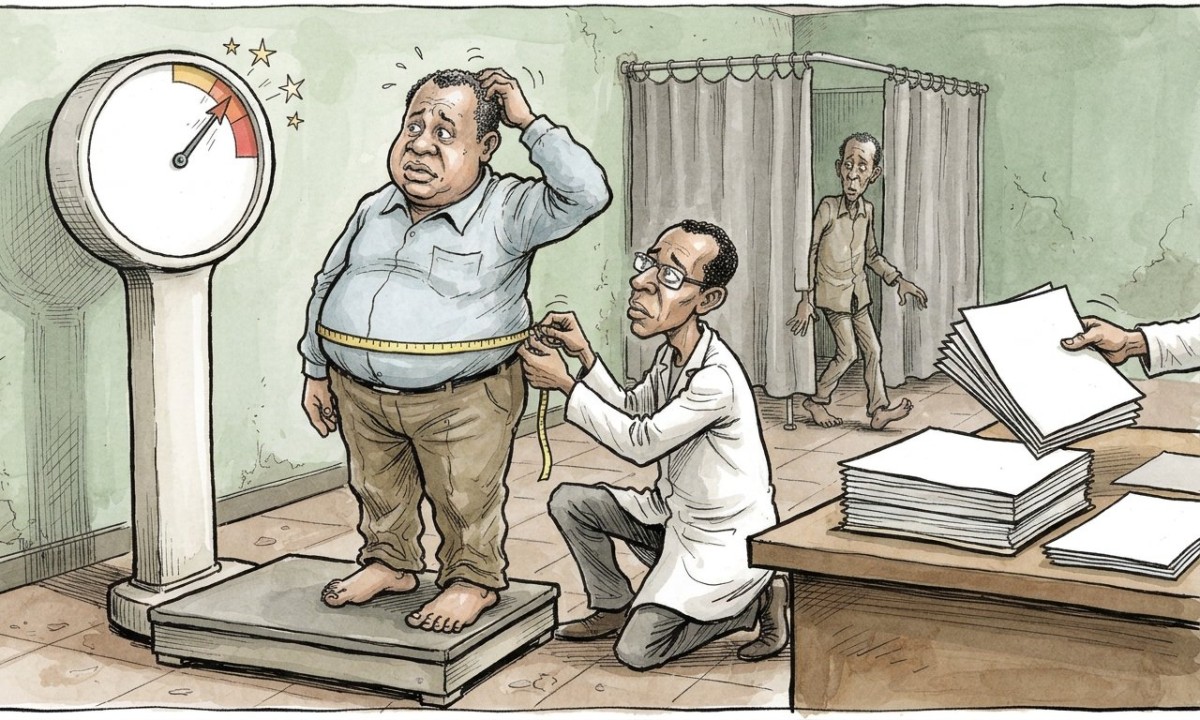
The health briefing for Wednesday did not lead with a quietly updated chart. It led with a scale, a tape measure, and 1.3 million people who had been carrying a diagnosis that has now been asked to come back to the desk. On Wednesday afternoon, a fresh write-up was still circulating a King's College London-led study, published in Nature, which found that the body mass index has been doing the official paperwork of obesity without looking at anyone's waist. Researchers analysed 844,108 adults in the United Kingdom, China, the United States and Spain, including more than 430,000 people from the UK Biobank, and reported that adding waist measurements to the usual height-and-weight sum showed BMI misclassifying the condition in both directions. The official record had the exhausted dignity of a reception desk that has been asked to re-file an entire afternoon. The scale, having been invited only as a starting point, went through with it and then watched itself get outranked.
Up to 8.6 percent of people in the study had so-called hidden obesity: they had been classed as overweight on the BMI scale, while measurements revealed obesity-level body fat. In the UK alone, the team said, that could translate to 2.4 million people with dangerous levels of body fat that BMI misses, which is a fairly specific way to be told you were standing in the wrong line. Up to 3.1 percent had been classed as obese when measurements showed no excess fat, an estimated 1.3 million people who may have no excess fat and no excess risk to their health. This is the professional dialect for a correction issued at national scale. A number that divides weight by height squared is supposed to be a convenient screen. A tape measure, in this account, has been asked to do the part the convenience had skipped, and has now sent a stack of folders back to reception.
Professor Francesco Rubino, chair of metabolic and bariatric surgery at King's College London and the study's senior author, completed the briefing more efficiently than a weigh-in. "BMI doesn't tell you anything about body fat content," he said. "It doesn't tell you whether a person's organ is working or not. It doesn't tell you if somebody, as an individual, is ill or healthy. It's just a measure of the overall risk of ill health." This is already an awkward testimonial for a figure that has spent years sitting at the diagnosis desk. He then named the part of the system that has been doing the civic work anyway. "Nevertheless, these BMI thresholds are being used to determine who receives treatment, or even who gets coverage for treatment, despite of the fact it doesn't accurately measure the individual health." The index, having been unable to tell muscle from fat or a waist from a shoulder, had still been deciding who gets in the door. The tape measure, having been named as the missing witness, is already doing preparatory work. The scale, having been named as the audience for it, has not yet had to give the chair back.
The framework the team tested does not throw the scale out. It simply refuses to let it work alone. The approach, first proposed by a Lancet Commission in January 2025, keeps BMI, then adds measures such as waist circumference, waist-to-hip ratio or waist-to-height ratio to confirm whether someone actually has excess body fat, and then asks a second, blunter question: is that fat impairing organ function, or are the organs still doing their jobs? If the organs are already affected, the diagnosis is clinical obesity, which the researchers call an active disease that should be treated as such. If there is extra fat but organ function remains intact, the diagnosis is preclinical obesity, a risk state rather than a finished illness. The study found that up to a third of all cases of obesity are clinical. Most people with preclinical obesity, 77 to 91 percent across the cohorts, did not progress to clinical obesity over ten years. "Preclinical obesity should therefore be neither treated automatically as active disease nor dismissed as harmless," Rubino said. "Some people may need preventive treatment, but its intensity should match their individual risk." Strength, in the official dialect of a health system, is the ability to match the appointment to the person in the chair. Strength, in Wednesday's dialect, is also the ability to admit that a single number has been doing too much of the talking.
Rubino said the new method "makes personalised, proportionate care possible, whereas a uniform BMI-based definition prevents it." Getting the scope of care right, he added, "matters enormously, both for the billion-plus people affected and for healthcare systems." Professor An Pan, the study's first author, of Huazhong University of Science and Technology, said rapid advances in treatment make a clinically meaningful diagnosis increasingly important, and that the differences between clinical and preclinical obesity, seen across countries and ethnic groups, support wider use of the framework. In England, about two-thirds of adults are estimated to be overweight or obese under the current measure, which is a very large tray in which to misfile a folder. Rubino noted that even these relatively small percentages, once they are let loose in large populations, "can correspond to millions of people being assigned to one or another category, and being assessed clinically in a way that doesn't correspond to their health status." In countries with large populations, he said, "you're talking about misdiagnosing tens of millions of people — this is not a trivial difference." "The inaccuracy of BMI at scale really applies to many, many, many people in every single country." The overweight tray, having been asked to compete with a tape measure, has, for the moment, lost on accuracy.
Until a scale invents a way to look at a waist without help, Wednesday from the weighing station is already on the record. The afternoon write-up has the study. Rubino has the confession that BMI cannot tell if somebody is ill, the warning that it is still deciding who gets treatment, and the invitation for the tape measure to share the desk. The UK has an estimated 1.3 million diagnoses that have been asked to come back, and 2.4 million people who had been sitting quietly in the overweight line. The organs have been given a vote. The waiting room has been warned that the form may need a second page. Further details will have to wait for clinics that have been given enough time to pick up a tape, and for a number that is not asked to issue a verdict before anyone has measured the middle. The official record, for the moment, is a recalled diagnosis, a hidden tray, a professor who has told a scale it cannot tell illness from health, and a tape measure that has been asked to finish the paperwork.
Questions Still Waiting at the Weighing Station After the Tape Measure Filed Its Correction
What's Your Reaction?
 Like
0
 Dislike
0
 Love
0
 Funny
0
 Wow
0
 Sad
0
 Angry
0

Comments (0)