

Physicists Name Their Time-Travel Ban MAGIC, Tell Time It May Only Go Forward, and Then Admit a Tiny Spacetime Ripple Can Grow Up Exponentially
On Wednesday morning, ScienceAlert reported that physicists Moustafa Ismail and David Mattingly of the University of New Hampshire have constructed a gravity model designed to stop time from looping back on itself, and have named the model Metric-Affine Gravity Imposing Chronology, or MAGIC. The work, published in Physical Review D, takes aim at a problem Einstein's general relativity has never quite agreed to solve: the equations allow closed timelike curves, paths through spacetime that can, at least on paper, deliver a traveler into their own past and, in the usual demonstration, into a conversation with a grandfather who has not yet had children. Stephen Hawking's 1992 chronology protection conjecture held that the laws of physics would simply refuse to permit those loops. Ismail and Mattingly asked whether gravity itself could be rewritten to enforce the ban. In their formulation, spacetime can be given a built-in direction of time, and under the right conditions every path a trav

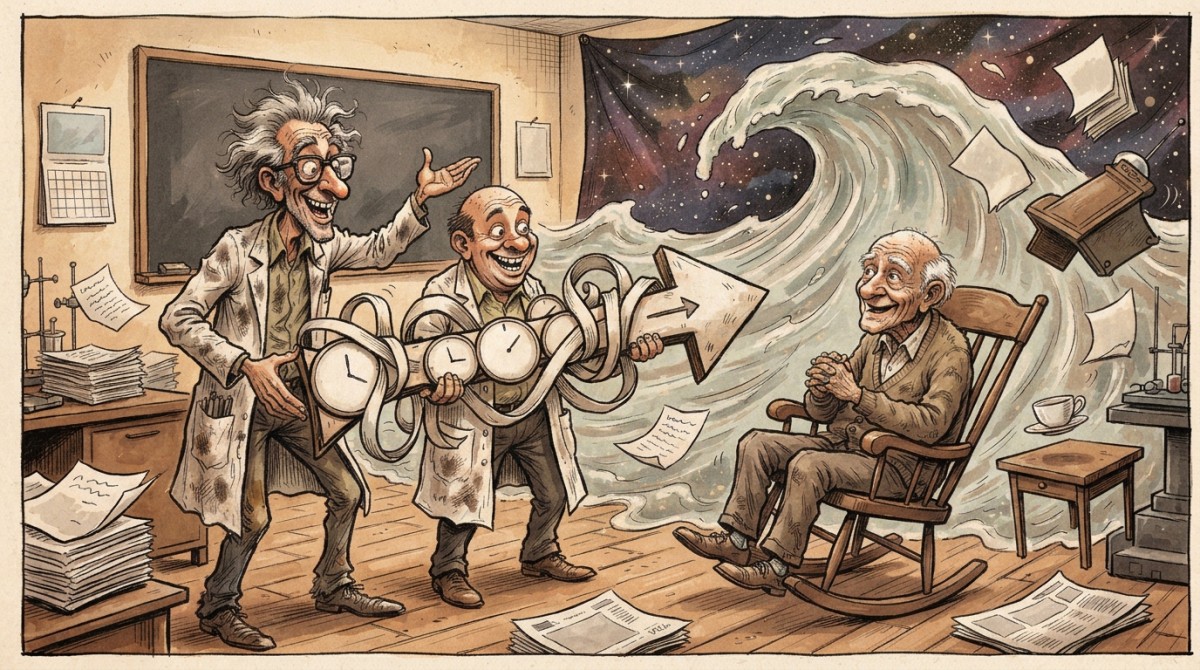
The science briefing for Wednesday morning did not lead with a new planet. It led with a time-travel ban, a model named MAGIC, and a warning that the universe, having been asked to behave, had immediately invented a new way to wobble. On Wednesday, ScienceAlert reported that physicists Moustafa Ismail and David Mattingly of the University of New Hampshire have constructed a gravity model designed to stop time from looping back on itself, and have given it the name Metric-Affine Gravity Imposing Chronology. That is MAGIC, which is already a more confident title than most unpublished universes ever receive. The work, published in Physical Review D, takes up a problem that general relativity has been leaving on the table for a century: the equations allow closed timelike curves, paths through spacetime that can, at least on paper, deliver a traveler into their own past. If the briefing is going to invent a spell, congratulations: the first trick is telling time it may only go forward, and the second is admitting that a tiny ripple might now want to grow up.
The usual demonstration of the problem is a family visit that should never have been booked. If a traveler were to find their own grandfather before he had children, and then somehow prevent that career from beginning, the traveler would not exist to make the trip, which is an awkward result for everyone still sitting in the parlor. Stephen Hawking, in his 1992 chronology protection conjecture, proposed that the laws of physics would simply refuse to allow closed timelike curves to appear, a ruling that has always sounded firm and has never quite been shown to have a bailiff. Hawking suspected that quantum effects would block the loops from forming. Nobody has conclusively identified the mechanism. Einstein's general relativity, still the best description of gravity on offer, continues to permit some decidedly peculiar arrangements of spacetime, and the loops remain legal in the mathematics even if they are frowned upon in the living room. The grandfather, in this telling, has been protected by a conjecture and a scolding. He has not, until this morning's write-up, been offered a named model and a one-way street.
Ismail and Mattingly wondered whether gravity itself might be talked into doing the enforcement. General relativity describes spacetime with a metric, which sets distances and intervals of time, and a mathematical connection, which describes how directions change as you move; in the standard theory the two are linked in a particular way. An alternative framework, metric-affine gravity, loosens that relationship and lets them operate more independently, which is the sort of sentence that sounds like a plumbing adjustment and is, in this case, an attempt to redesign the calendar. That is where the researchers found their wiggle room. They used the looser framework to build a model in which spacetime could have a built-in direction of time. Under the right conditions, time would always move forward along any path a traveler could take, making it impossible to loop back into their own past. The official record of the product launch is almost cheerfully brisk. The loops are out. The street is one way. The grandfather may resume his afternoon.
The same briefing then delivered the catch, which arrived on schedule and refused to sit quietly in the appendix. In general relativity, gravity can fluctuate in two ways, matching the two ways gravitational waves can stretch and squeeze space. MAGIC introduces a third, a scalar mode, and that mode, ScienceAlert reported, does not play particularly nicely with reality as we know it. On the cosmological background the researchers studied, it suffers what the paper calls a gradient instability. Rather than propagating as stable waves, disturbances can grow exponentially, and shorter wavelengths grow faster. In its current form, MAGIC cannot provide a stable description of the universe, which the report identified as the biggest obstacle to making the model a viable theory of gravity. A traditional repair job stops the leak and then checks that the house is still standing. This one stops the time loop and then notices that a tiny ripple has been given permission to become a much larger ripple, preferably in a hurry. The universe has been asked not to run in circles. It has offered, in reply, to inflate.
The longer list of caveats is the sound of a toy model being honest in public, which is rarer than a closed timelike curve and slightly less glamorous. MAGIC, the Wednesday report noted, only establishes the conditions for chronology protection locally. To guarantee that time cannot loop back on itself anywhere in the universe, the researchers have to make an additional assumption about the overall structure of spacetime that they have not shown follows from the model itself. They can make MAGIC prevent time loops. They have not yet shown that time-loop prevention is baked into MAGIC. The model is also designed to prevent the metric from breaking down in ways that would make spacetime impossible to describe properly, but the safeguard does not work in every circumstance; the researchers have not demonstrated that those breakdowns occur, and they have not ruled them out. The paper describes the construction as a toy model and a step in a research direction, not a finished solution. "Stabilizing the scalar without losing the timelike, closed projective mode is the natural next step toward a phenomenological completion," the authors write, which is the laboratory dialect for asking the wobble to remain a wobble and not apply for a promotion. The spell, for the moment, is a local suggestion with an outstanding trouble ticket.
Until physics invents a quieter way to announce that time has been asked to travel in only one direction, a New Hampshire model already named MAGIC is still teaching its extra wobble some manners, and a grandfather has been advised to stay in his chair, the honest takeaway is narrower and funnier. A theory can now promise to cancel the most famous paradox in the catalog and, in the same breath, warn that a tiny disturbance in the fabric of spacetime might grow exponentially while you are still explaining the rules. ScienceAlert has the Wednesday morning write-up. Physical Review D has the paper. No one has yet been sent into the past, which is the first good sign, and no one has yet been handed a stable universe in which that trip is impossible, which is the second. Further details, the field says, will have to wait for a scalar mode that can be stabilized without losing the one-way street, and for a calendar that does not inflate when it is told to behave. The parlor is still open. The briefing, for the moment, would like grandpa to remain exactly where he is.
Questions Still Sitting in the Waiting Room After Time Was Told It Could Only Go Forward
What's Your Reaction?
 Like
0
 Dislike
0
 Love
0
 Funny
0
 Wow
0
 Sad
0
 Angry
0



Comments (0)