

Scientists Prove Your Brain Takes Out the Trash Only If You Play It Tiny Bursts of Fuzzy Pink Noise on Cue
MIT and Boston University researchers found that 50-millisecond bursts of pink noise, timed to the peaks of sleep slow waves, pump more cerebrospinal fluid through the brain's overnight cleaning cycle. Lead author Joshua Levitt warns you cannot just loop a rain track and declare yourself detoxed. Science has officially invented the world's least glamorous nightclub: an MRI, an electrode cap, and a DJ that only drops static.

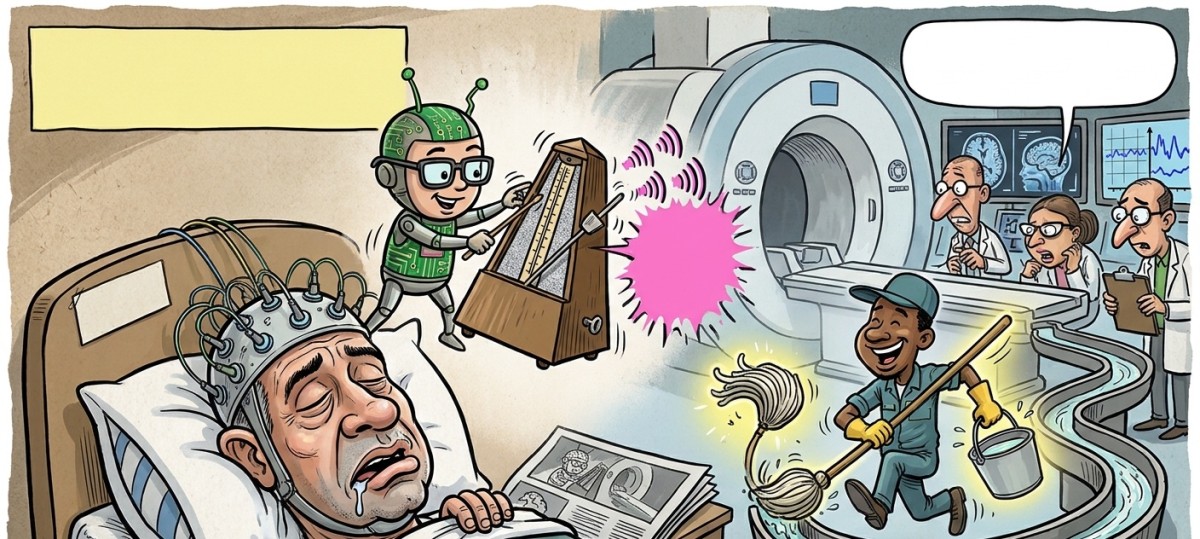
Your brain has a night crew. While you sleep, a plumbing system called the glymphatic circuit bathes the tissue in cerebrospinal fluid and ferries out the day's mental leftovers — the biochemical equivalent of shoving takeout containers into a bag and hoping morning-you does not notice. Aging and bad sleep can slow that rinse cycle. On Monday, November 9, Scientific American spotlighted a finding that makes the whole arrangement sound less like biology and more like a rental agreement with a very specific DJ.
Researchers at MIT and Boston University reported in Science Translational Medicine that short bursts of pink noise — fuzzy static with the bass turned up and the treble turned down — can boost those fluid waves if, and only if, the sound lands on the peaks of the brain's slow waves. Miss the beat and you get a nap soundtrack. Hit the beat and the scans show more cerebrospinal fluid moving through the system, which is science's polite way of saying the janitor finally got the keycard.
Lead author Joshua Levitt, a biomedical engineer who recently finished his Ph.D. at Boston University, put the marketing department on notice. "You can't just play pink noise all night and get the same effect," he said. The timing is the treatment. Continuous pink noise is what wellness influencers already sell. Closed-loop pink noise, delivered in 50-millisecond pops when an algorithm predicts a slow-wave crest, is what actually moved the fluid in the scanner. America has finally found a use for precise audio that is not a stadium entrance song.
The method required participants to sleep inside an MRI while wearing electrode caps, which is the spa day designed by a committee of engineers. An algorithm scrubbed MRI interference from the EEG in under 100 milliseconds, then predicted the next slow-wave peak so the burst could arrive on time. Brain scans showed stronger CSF flow when the noise matched the waves than during quiet control periods. Co-author Laura Lewis, a neuroscientist at MIT, notes the next hard question: whether the extra flow actually clears waste particles. Proving that in a living human is, she said, "very tough," so animal follow-ups are coming. Translation: the hose works louder; the trash bags still need a receipt.
University of Rochester glymphatic biologist Lauren Hablitz, who was not on the paper, called noninvasive sound "really powerful" compared with experimental drugs and surgeries aimed at the same plumbing. The team wants to try the approach in older adults and people with sleep disorders, which is how every promising sleep finding eventually migrates from the lab to a Kickstarter that claims to replace your entire personality with a speaker.
Until then, the honest takeaway is narrower and funnier. Your brain already runs a midnight wash. Researchers have shown they can goose the pump with tiny, carefully timed hisses of pink noise while you are strapped into a tube. They have also shown that looping a rain track until dawn is still just looping a rain track until dawn. The future of restorative sleep may involve electrodes, algorithms, and a sound that resembles a waterfall with a union card. The present still involves forgetting to charge your phone and calling it self-care. Science cleared the pipes. The playlist remains under review.
Questions Still Floating Through the Brain After Science Hired a Night Shift for Static
What's Your Reaction?
 Like
0
 Dislike
0
 Love
0
 Funny
0
 Wow
0
 Sad
0
 Angry
0



Comments (0)