

Claude Just Designed a Speakerphone, a Voice Hub, and a Handheld Virtual Pet, Then Made Engineers Build Them Like Homework
Anthropic says Claude Fable 5.2 can now design electronic hardware end to end — schematics, circuit boards, enclosures, firmware, parts lists — then hand the files to humans who solder like interns. Partner Diode Computers built a USB speakerphone, a home voice-assistant hub, and a battery-powered handheld virtual pet from Claude's designs. The boards worked without circuitry fixes. Silicon Valley has officially invented the world's most expensive shop teacher: a chatbot that grades your mute switch and tells you to tilt the board twenty-five degrees.

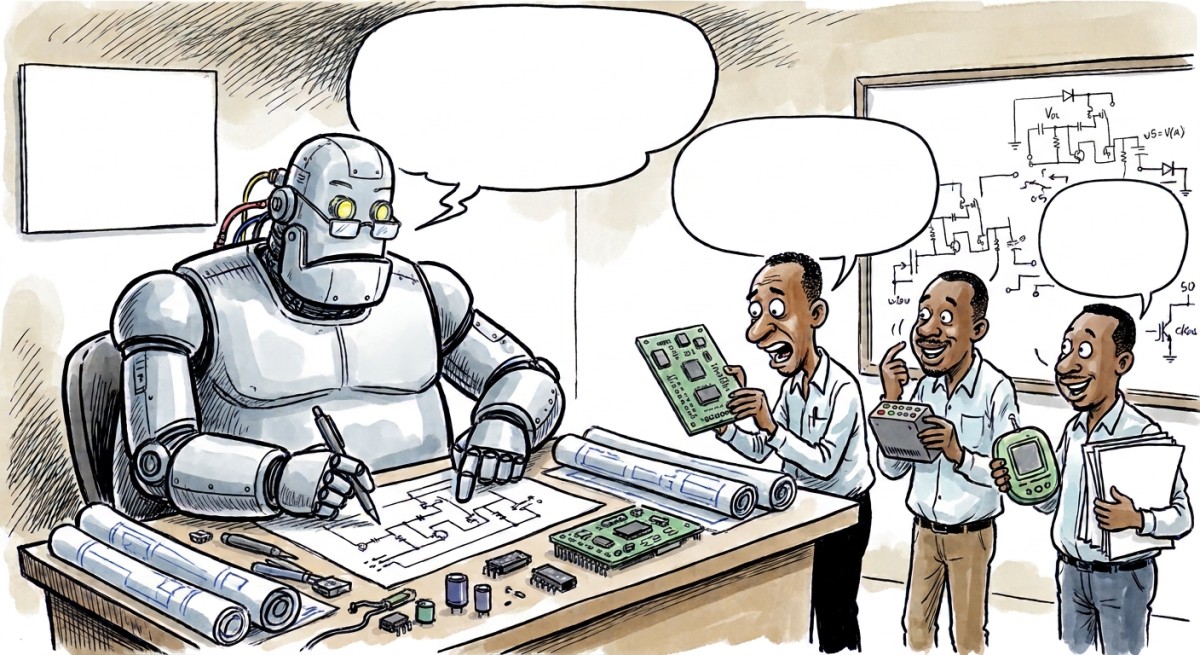
The modern American dream used to be inventing a gadget in a garage. On Sunday, November 9, Anthropic announced a more efficient path: invent the gadget inside a language model, then make a human walk it to the soldering iron. Claude Fable 5.2, the company said, can now design electronic hardware from a short prompt all the way through schematics, circuit-board layouts, 3D enclosures, firmware, and a shopping list of parts. Partner firm Diode Computers built three prototypes from those files. They worked. No circuitry fixes. Silicon Valley has discovered a new management style: the AI proposes, the engineer drips solder.
The assignment list sounded like a toy aisle that wandered into an engineering lab. Anthropic asked Claude for a USB-C speakerphone puck with microphones, a speaker, and Bluetooth; a home voice-assistant hub; and a battery-powered handheld virtual pet. With minimal prompting, Claude wrote specifications, drew schematics, placed components on printed circuit boards, routed the copper tracks between them, designed printable cases, coded firmware, and prepared parts lists. Diode manufactured the boards directly from Claude's design files. The team said they were surprised they did not need the usual rounds of manufacturing back-and-forth, which is corporate speak for "the chatbot finished the homework and the humans just had to staple it."
The comedy is in the details Claude treated like weather reports. When the speakerphone board would not drop straight into its case because the mute switch hit the back wall, Claude calculated a roughly 25-degree tilt, tested it in a 3D model, and wrote the install step into the assembly instructions. When copper tracks on the voice hub got "too tangled to trace visually," Claude decided to rip them out and start fresh, deleting and rerouting dozens of times. It wrote its own board router when the built-in tool felt too slow for a 100-pin connector. It checked manufacturer datasheets, widened solder-mask openings that failed design-for-manufacturing checks, and ignored a false alarm about two grounds that were supposed to connect. Somewhere in California, a career in "I move the vias by hand" just heard its own eulogy.
Earlier Claude models, Anthropic admitted, were the roommate who almost finishes the IKEA dresser. They placed supporting parts too far from their chips, oriented connectors wrong, and left boards 95 percent complete and completely unusable. Fable 5.2 scored 69 percent on Diode's internal PCB Gym layout benchmark, up from 25 percent for Fable 5, and nearly doubled its predecessor on a public CAD rebuild test. It routed high-speed and high-current tracks first, added zigzags so signals arrive on time, and kept the Bluetooth antenna neighborhood clear of stray copper so the puck could still gossip with your phone. The handheld virtual pet still runs after weeks. So does the speakerphone. The voice hub still listens. America has officially entered the era where your next desk toy may have been art-directed by a model that also dimmed its own LED ring so the board would not blow a current limit.
Anthropic is careful about the fine print, which is how you know the lawyers were awake. The three devices remain prototypes. They have not been through full electrical validation, antenna tuning, thermal testing, or certification, and they were not designed for mass production. Claude was not connected to test equipment or to the machines that fabricate and assemble boards, so humans still had to build and verify everything. Next, the company wants denser, faster, more complex boards, simulation checks, and learning from measurements on finished devices. OpenAI, Anthropic notes, has also written about models designing a handheld gadget. The arms race now includes who can invent a better plastic pet with fewer humans in the loop.
Until the factories plug the models in directly, the honest takeaway is narrower and funnier. An AI can now draft a working speakerphone, a listening hub, and a pocket pet, then email the bill of materials to people who still own flux. The boards boot. The cases fit if you remember the tilt. The virtual pet survives longer than most New Year's resolutions. Technology did not replace the engineer. It just promoted the engineer to general contractor for a chatbot with strong opinions about microphone port resonance. Your garage is still available. The shop teacher just got a context window.
Questions Still Shorting Out After an AI Became Your New Hardware Lead
What's Your Reaction?
 Like
0
 Dislike
0
 Love
0
 Funny
0
 Wow
0
 Sad
0
 Angry
0


Comments (0)