

Docker Takes the Shipping Containers Off Its Whale, Asks Developers to Trust It With the Robots Instead
Docker removed the containers from its famous whale, turned the whale itself into a container, and launched a rebrand whose central argument is that AI agents are delinquents and Docker is the only babysitter with references.

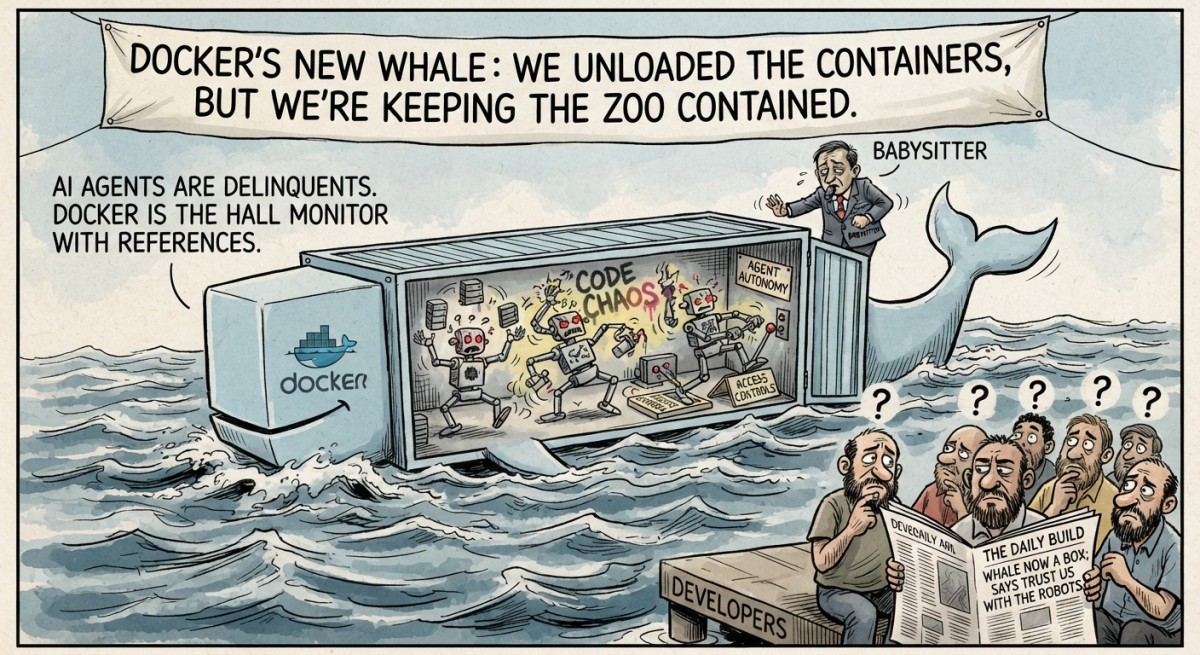
For more than a decade, Docker's whale, Moby, swam the internet with a stack of shipping containers on his back, like a mover who never once asked for a tip. This week Docker unloaded him. The new Moby is a boxy outline of a whale who is, in a twist no marine biologist requested, shaped like a container himself. The cargo has not been lost. The cargo has been promoted to whale.
The reason is AI agents, which is now the reason for everything, including several divorces. In a launch post titled "Meet the New Docker: Built to Run on Trust," the company explained the problem with admirable bluntness: "Containers isolate workloads. But agents aren't workloads. Agents are actors." Anyone who has worked with actors knows they also make their own decisions, wander off set and touch things they were specifically told not to touch.
Docker's answer is Docker Sandboxes, which gives AI coding agents an isolated place to run, and Docker AI Governance, which handles policies, access controls and oversight. In other words, Docker has built a playpen and hired a hall monitor. The robots were promised autonomy. They have been given autonomy inside a fenced yard, which is how every toddler, every house cat and most interns experience freedom.
The post then said the word "trust" with the energy of a man who has just been found somewhere he should not be. Trust Docker because of its track record. Trust Docker because it is neutral. And, in a line that will be framed above server racks everywhere: "Trust Docker because it's pretty darn clear you can't trust the agents to manage themselves." It may be the first corporate rebrand built on the premise that its newest customers are juvenile offenders.
Getting to the new whale was not easy. "We looked at a lot of whales, folks," the post confessed, before adding, "(I may or may not have been seeing whales in my sleep.)" The company worked with the brand transformation firm Motto, and the result was unveiled as "Something, dare I say, whale sized." Somewhere a branding agency invoiced for whale research, and somewhere an accountant approved it without asking a single follow-up question.
Docker insists it is not abandoning the old business. "The containers you know and love aren't going anywhere," the post promised, which is exactly what people say right before taking the containers off the logo. Developers responded in the traditional manner. "I don't like at all the new logo……" wrote one commenter under Linuxiac's report, a review so efficient it used six dots to avoid typing a seventh word.
The deeper lesson is that every tech company now has two jobs: build the AI, and build the cage for the AI. Docker has simply chosen to sell the cage, which, historically, is where the money is. Nobody ever got rich selling lions. They got rich selling the bars, the tickets and the keychains.
As for Moby, he swims on, lighter, squarer and carrying absolutely nothing. For years he hauled other people's software across the ocean without complaint. Now he is the box. That is not a demotion. It is simply what happens to every hard worker eventually: carry the containers long enough, and they turn you into one.
Docker's New Whale: Your Questions, Contained
What's Your Reaction?
 Like
0
 Dislike
0
 Love
0
 Funny
0
 Wow
0
 Sad
0
 Angry
0



Comments (0)