

Probe Reaches Mercury After Eight Years, Becoming the First Package Ever Delivered Late to the Messenger God
The European-Japanese BepiColombo probe finally entered orbit around Mercury after eight years, nine planetary flybys and one breakdown, a year behind schedule. It now plans to rest until April before doing any actual work, which makes it the most relatable spacecraft ever built.

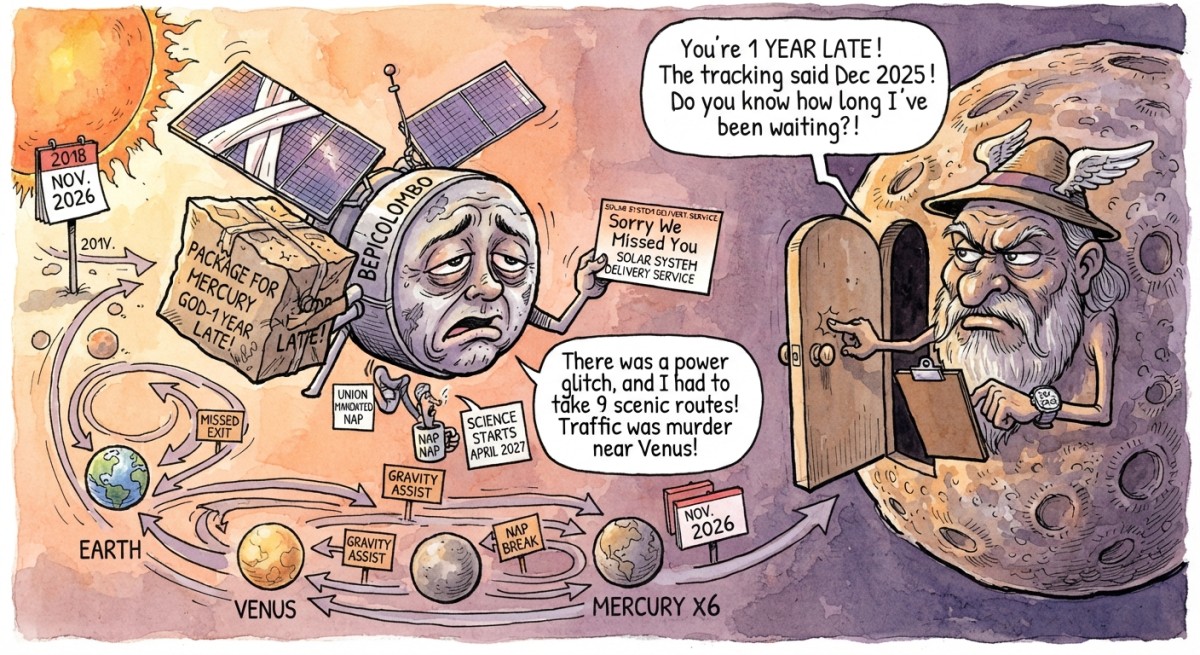
After eight years, one flyby of Earth, two of Venus and six of Mercury itself, the European-Japanese BepiColombo spacecraft entered orbit around Mercury on Nov. 21. No vehicle has ever circled its destination this many times before parking, and that includes every minivan at every mall on Dec. 23.
The probe launched on an Ariane 5 from French Guiana in October 2018, when the iPhone XS was brand new and "Old Town Road" did not exist yet. It was supposed to arrive in December 2025. Then a 2024 power problem crippled its thrusters and added a year, the most relatable thing a machine has done since the office printer.
Astrologers immediately blamed Mercury for the delay. It is the first time in history they were technically correct.
The trip took forever because the closest planet to the sun is absurdly hard to reach. "Energetically, it takes more energy to go to Mercury than to go to the outer Solar System," said Emma Bunce of the University of Leicester, one of the mission's leading scientists. In plain English, the hard part of visiting the sun's next-door neighbor is not getting there. It is stopping. Every Mercury mission is a teenager learning to drive downhill.
Anything falling toward the sun picks up terrifying speed, and Mercury's gravity is too weak to catch it, like a toddler trying to stop a runaway shopping cart. So BepiColombo spent years shedding speed by swinging past planets, a maneuver scientists call a gravity assist and everyone else calls missing the exit nine times.
The final orbit-insertion burn began at 18:24 GMT and lasted 37 minutes. That is 37 minutes of pure braking, or roughly the time it takes to merge onto the 405 on a Friday.
BepiColombo is really two spacecraft: ESA's Mercury Planetary Orbiter and JAXA's Mio, still bolted together like roommates who signed a lease in 2018 and can't afford to move out. They will separate around Dec. 9, the gentlest breakup in Solar System history. Nobody keeps the dog. Nobody gets the couch. Everybody gets a polar orbit.
Even then, nobody starts working. The European orbiter will spend until March 10, 2027 easing into its final orbit, and science does not begin until April 6, 2027. After eight years of commuting, the probe has walked into the office and scheduled its onboarding for spring.
ESA says the mission "will study all aspects of Mercury," from its magnetosphere to "its internal structure with its large iron core." Mercury went 4.5 billion years without anyone asking about its core. Now two orbiters want its magnetic field, its geology and its childhood.
The probe even did homework on the drive, pointing its X-ray camera at the Crab Nebula, the leftovers of a supernova seen from Earth in 1054. It is the first road trip in history where the passenger read the entire syllabus and the driver still got lost on purpose.
BepiColombo is only the second mission ever to orbit Mercury, after NASA's MESSENGER. So the planet named for the messenger of the gods has now had exactly two orbiting visitors, and both took the long way.
Still, credit where it's due. After eight years, nine flybys and one breakdown, the package arrived. Somewhere, the messenger of the gods is signing for it and asking why the tracking page said December 2025.
BepiColombo at Mercury: Your Late-Delivery Questions
What's Your Reaction?
 Like
0
 Dislike
0
 Love
0
 Funny
0
 Wow
0
 Sad
0
 Angry
0





Comments (0)