

Cambridge Dictionary Crowns "Human" Word of the Year, and Humans Celebrate by Asking a Chatbot What It Means
Cambridge Dictionary named "human" its 2026 Word of the Year, a 600-year-old word that finally went viral because the robots made everyone nervous. Being a person is now a premium upgrade, the mathematicians are worried, the toddlers are worried, and the toaster has asked for a recount.

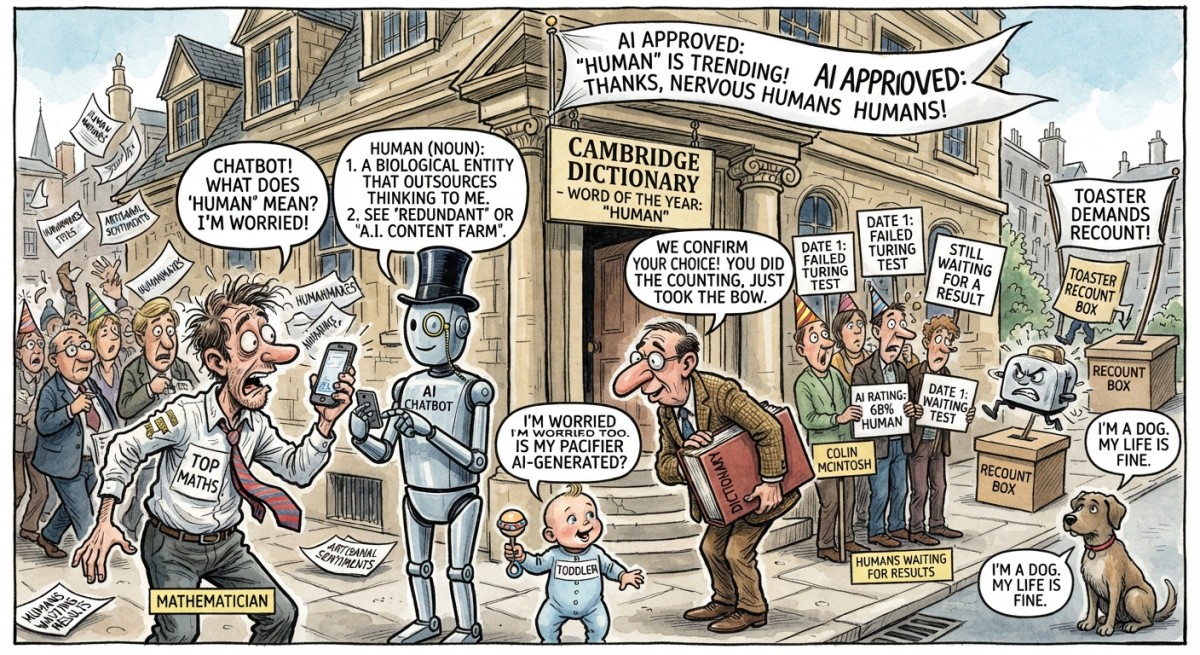
The Cambridge Dictionary has named "human" its Word of the Year for 2026, which is the language version of a restaurant awarding itself a Michelin star for having a door. The word has been in use since the 15th century. It took six hundred years, one robot invasion of every inbox, and a great deal of nervous typing to make it trend.
The dictionary defines human as "having the qualities, faults, and feelings that people have, as opposed to gods, animals, or machines." Note the order. Gods got there first, animals came second, and machines have been added at the end like a late guest who brought his own charger and asked for the Wi-Fi password.
"The growth of AI means it is now necessary to explicitly say 'human' for things that once could only be done by humans," chief editor Colin McIntosh told the BBC. He is right. Nobody in 1987 advertised a "human-written" birthday card. The card was written by a human because the dog refused and the toaster lacked ambition.
Now "human-written," "human-generated" and "human-made" are premium labels, sitting on the shelf beside "organic," "artisanal" and "hand-stitched by a man named Gareth who will not stop talking about it." Being a person has become a luxury feature. Soon airlines will sell it as an extra, right after legroom and before the sandwich.
"AI is changing how we talk about being human," McIntosh told the Associated Press. He added, "Fears about what humans may lose when we outsource our thinking have made us reconsider the extent to which we rely on AI: from top mathematicians to teachers of young children." So the mathematicians are worried, the toddlers are worried, and somewhere a middle manager is asking a chatbot to draft his feelings about it, in bullet points, by Friday.
The dictionary's own write-up notes that in a University of California, San Diego study, GPT-4.5 was judged to be "human" in 73 percent of cases after a 15-minute text conversation. That is a better score than most people get on a first date. The machine passed the test. Several humans at the same party are still waiting for their results.
The dictionary also flagged a fresh coinage, "humanmaxxing," credited to entrepreneur Christian Angermayer: chasing machine-like perfection through fitness tracking, supplements and "experimental interventions." So the plan is now official. Machines are learning to be human, humans are learning to be machines, and both will meet in the middle at a smoothie bar, comparing sleep scores and pretending to enjoy kale.
Most years these prizes go to fresh slang, a word a teenager said once in a car park and an adult ruined by Tuesday. Choosing "human" is a bold return to basics, like a chef winning a cooking award for water. At this rate, next year belongs to "breathing," and the year after that to "hands," assuming we can still find the paperwork for them.
The Word of the Year, in other words, is the thing we already are. Congratulations to eight billion winners who entered without filling in a form. The dog remains unmoved. The toaster has asked for a recount.
Questions Only a Human Would Ask
What's Your Reaction?
 Like
0
 Dislike
0
 Love
0
 Funny
0
 Wow
0
 Sad
0
 Angry
0




Comments (0)