

Ireland Rules That Knees Over 60 Have Seen Enough, Will Now Be X-Rayed Like Airport Luggage
Ireland's HSE has stopped GPs sending over-60s for publicly funded hip and knee MRI scans, cutting about 21,600 scans a year and diagnosing an entire generation of joints from their birth certificates.

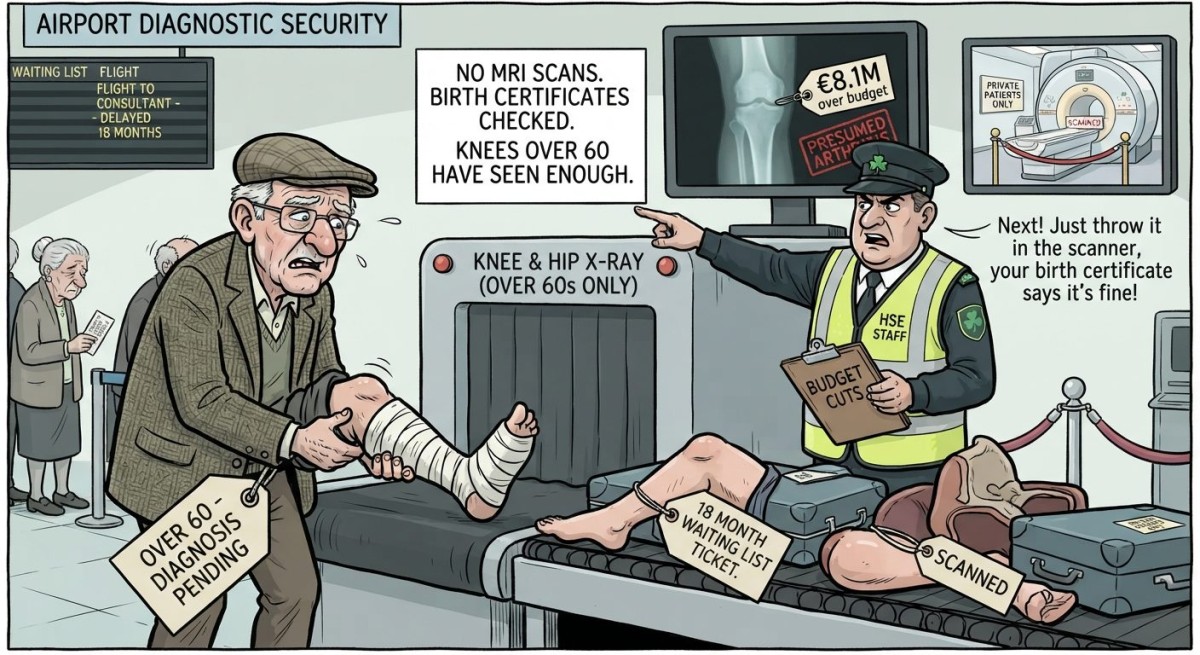
Ireland's health service has examined the knees of everyone over 60 and reached a diagnosis without the inconvenience of looking at them. From now on, GPs can no longer send those patients for publicly funded hip and knee MRI scans. The knee has been seen. The knee has been thanked. The knee has been asked to wait outside.
The HSE is removing hip and knee MRI from the GP Access to Community Diagnostics Scheme for patients aged 60 and over, a move that cuts roughly 21,600 scans a year. In plain English, 21,600 Irish joints were booked for a glamour close-up and have been downgraded to a passport photo.
The official explanation is a masterpiece of the form. The change aims "to align clinical practice with evidence-based guidance and to support the appropriate use of radiology resources." Translated from Health Service into Pub, that means: "We looked at the bill." The HSE adds that "MRI is not routinely indicated in the assessment of osteoarthritis of the hip and knee in older adults," making it the first medical system to diagnose a condition by checking a birth certificate.
For most patients in this age group, the HSE says, diagnosis "can be made through clinical assessment and, where required, plain X-ray imaging." The plain X-ray is the economy class of medicine: it sees the bones, ignores the soft tissue, and gets you there eventually, possibly with your knee in the overhead locker.
Money, naturally, has nothing to do with it. The HSE was merely €8.1 million over its medical imaging budget by the end of September, an internal report was merely "working to estimate the savings," and Cabinet had merely signed off a €780 million top-up for the executive. When an organisation needs an extra €780 million, the knees are always the first to go. Ask any footballer.
Doctors noticed. Prof Tadhg Crowley of the Irish Medical Organisation warned: "This is going to extend waiting lists, there is no doubt about that." He added that such decisions are "sort of secretly brought out through internal memos," which is how Irish people traditionally learn everything, from budget cuts to who's getting the house.
Crowley also pointed out that "when someone has a pain in their knee, there's always a worry that there's something else going on and that may not show up on an X-ray." The HSE's position is that anything which doesn't show up on the X-ray has the good manners not to exist.
Labour's Marie Sherlock called it "a really blunt cut," which is also what patients may eventually hear from orthopaedics. She warned of "lengthy waiting lists of 18 months or more just to get a diagnostic before they are seen by a consultant." Eighteen months is long enough for a sore knee to become a sore hip, at which point the HSE can decline to scan that too and save twice.
Picture the new patient journey. A 61-year-old feels a twinge, visits the GP, learns the scanner has an age limit like a nightclub in reverse, gets an X-ray, joins a list and finally meets a consultant at 63, by which time the knee has developed a mature, evidence-based arthritis that nobody needed a magnet to predict.
Patients with health insurance can still pay their way into the tube, so the policy at least clarifies Ireland's two classes of knee: the scanned and the presumed.
The HSE insists the change "does not prevent patients from accessing MRI where clinically indicated." Quite right. The over-60 knee simply does what it was told in the first place: it waits outside. It just has 21,600 more knees for company now, and every one of them is holding a numbered ticket.
Ireland's Over-60 Knee Scan Cut: Your Questions Answered
What's Your Reaction?
 Like
0
 Dislike
0
 Love
0
 Funny
0
 Wow
0
 Sad
0
 Angry
0



Comments (0)