

Study Finds Vaping Makes Your Windpipe Grow Skin, Which Is Your Lungs' Way of Changing the Locks
Two studies say the mango-ice cloud you exhale in the office bathroom has been renovating your airway without a permit: UC Riverside's lab-grown windpipes sprouted extra mucus and skin-like cells within weeks, and young vapers lost a full espresso of breath in a year. Blueberry was unavailable for comment.

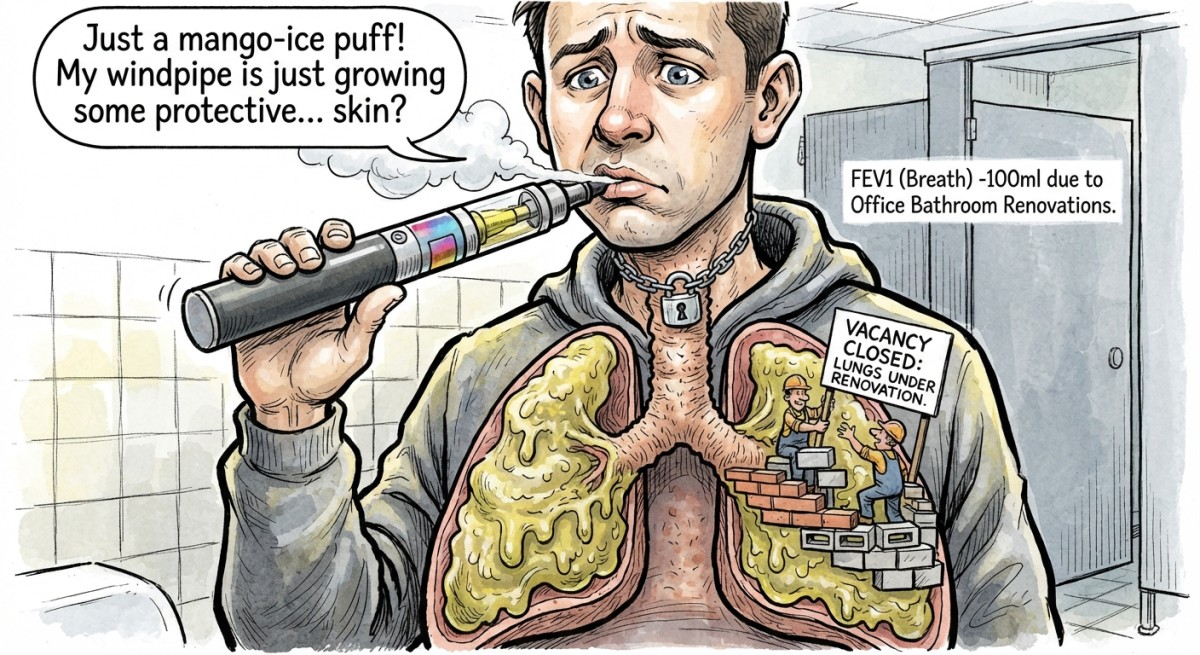
For years, vaping sold itself as the healthy alternative to smoking, the way falling off the 10th floor is the healthy alternative to falling off the 40th. This week, science finally checked the elevator buttons.
Researchers at the University of California, Riverside grew human airway tissue in a lab, then blew e-cigarette aerosol on it, which is the most Californian thing a windpipe has ever endured. The tissue got one or five puffs a day for up to three weeks. It did not get a buzz. It got a mucus problem and an identity crisis.
Within the first week, the airway started cranking out extra mucus, a condition called goblet cell hyperplasia, which sounds like a Harry Potter spell and behaves like a sinus infection with ambition. Then came squamous metaplasia, in which the delicate lining of the windpipe turns skin-like. Your lungs, in other words, saw the cotton-candy fog coming down the hallway and started installing drywall.
"These findings are particularly concerning because squamous metaplasia can be a precursor to squamous cell carcinoma, a type of lung cancer," said Prue Talbot, the study's senior author. Scientists have a rare gift for yelling "run" in a voice that sounds like "please consider jogging."
Even the one-puff-a-day group showed the skin-like changes by week three. One puff. That isn't a habit. That's a free sample at the mall kiosk, and it still filed paperwork with your trachea.
First author Rattapol Phandthong said the method "will help determine whether different electronic cigarette products cause varying degrees of airway damage." Finally, Yelp for lungs. Watermelon Ice: two stars, moderate remodeling, would not inhale again.
Meanwhile, a separate pilot study in the journal Tobacco Control tested 22 young vapers aged 21 to 35, then tested them again about a year later. Their FEV1, the amount of air you can blast out in one second, fell from 3.85 liters to 3.75. That's 100 milliliters, roughly one espresso of breath, gone. Nobody knows where it went. Probably the office bathroom.
The heaviest users, vaping 30 or more times a day, were linked to a 240-milliliter drop, which is less a decline than a corporate downsizing. At 30 hits a day you are not vaping. You are the fog machine at a regional wedding.
The researchers stressed that the study was small, used only two time points and had no tobacco-free comparison group, which is scientist for "we know, we know, please don't email us." Still, they said it gives "the first indicator of the potential of prolonged e-cigarette use to have persistent and clinically important cumulative effects on FEV1 and pose a COPD risk." When a paper fits "persistent," "cumulative" and "COPD" into one sentence, it is not making a suggestion. It is staging an intervention.
The internet greeted the news with its usual scientific rigor: memes, SpongeBob and the bold observation that water is wet. Fair enough. But water being wet has never sent anyone a 240-milliliter invoice.
So here is the takeaway. Vaping did not give anyone cancer this week. It just gave their windpipe a reason to grow skin. And when your own lungs start changing the locks, it might be time to stop knocking.
Vaping and Your Lungs: Questions Nobody Wanted to Exhale
What's Your Reaction?
 Like
0
 Dislike
0
 Love
0
 Funny
0
 Wow
0
 Sad
0
 Angry
0






Comments (0)