

Voyager 1 Gets One Full Light-Day From Earth on a 23-Watt Bulb, Now Needs Two Days to Answer a Text, and Still Has Not Asked If We Are There Yet
On November 18, 2026, Voyager 1 became the first human-made object one light-day from Earth, about 16.1 billion miles out, where NASA's commands now take a full day to arrive and a full day to hear back. It runs on a transmitter with the power of a 23-watt light bulb, has a full-time staff of three, and is still more reliable than your group chat.

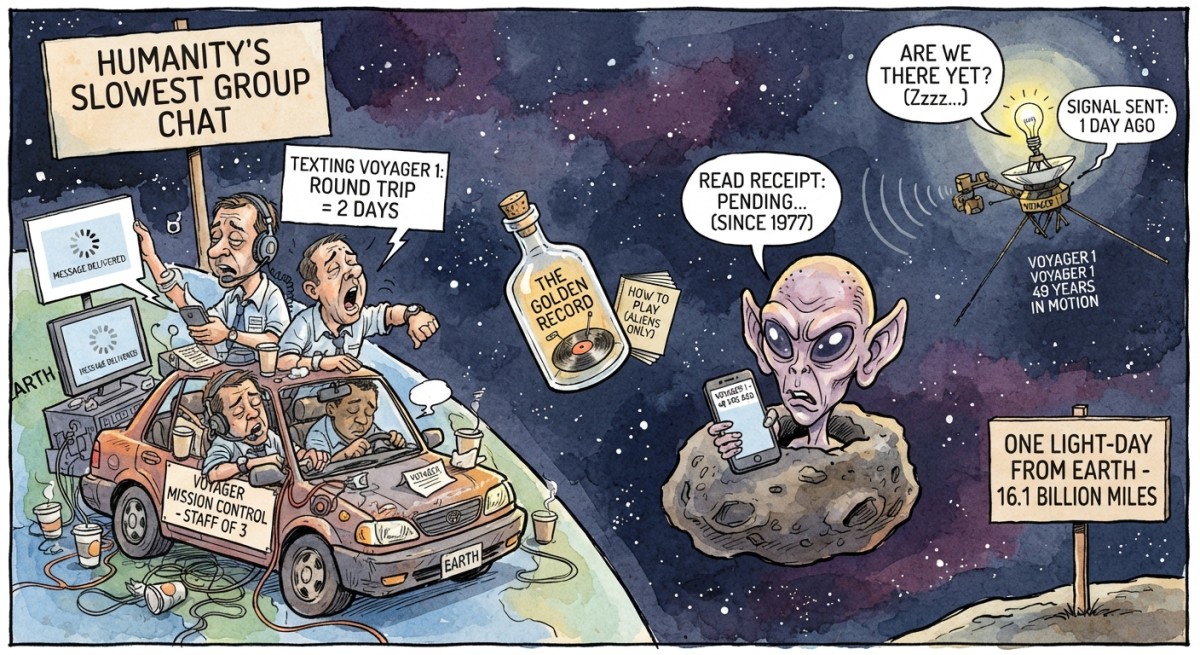
On Wednesday at 5:16:07 a.m. EST, Voyager 1 became the first human-made object to get one light-day away from Earth. Humanity has finally built something that leaves the group chat and actually means it.
That is about 16.1 billion miles, the distance light covers in 24 hours. A command sent from NASA's Deep Space Network now takes a full day to arrive, and the reply takes another day to come home. Engineers have achieved the communication schedule of a son at college.
The probe launched on Sept. 5, 1977, atop a Titan 3E-Centaur rocket, and it took 49 years, two months and 11 days to get here. It flew past Jupiter, past Saturn, out of the heliosphere, and never once asked if we were there yet. It is the only child in history to make that road trip in silence.
It phones home through a 12-foot antenna and a transmitter with roughly the power of a 23-watt light bulb. Your fridge light has a bigger budget. Your fridge light has also never left the kitchen.
NASA's Jet Propulsion Laboratory said the milestone will not produce any physical change in the spacecraft. No confetti. No horn. No odometer rolling over to all nines. Voyager simply kept going at nearly 38,000 mph, the cosmic equivalent of driving past your own surprise party.
Alan Cummings, the Caltech scientist who was the last person to touch the spacecraft before launch, called it "not a scientific milestone." Then, softening: "It is an engineering milestone, though." That is the nicest thing anyone has ever said about turning 49 and still being in motion.
Kareem Badaruddin, the interstellar mission manager, is one of just three full-time team members keeping the Voyagers healthy and on course. Three. A half-century-old spacecraft 16 billion miles out, and its entire staff could carpool in a Corolla. "I'm just the guy carrying the baton for now," he said. The baton is a day away at the speed of light and does not accept returns.
"It has never happened before. It may never happen again," Badaruddin added, a sentence usually reserved for wedding toasts and Cleveland sports parades, except this time it is true.
Things are delicate. Voyager 1 is down to two working science instruments, its power shrinks every year, and last month it went silent for two days before engineers reestablished contact. Two days of silence used to be a crisis. Now it is just the round trip.
Aboard is the Golden Record: a gold-plated copper disk with 115 images, greetings in 55 languages, whale songs, thunder and about 90 minutes of music, packed with a cartridge, a needle and instructions for playing it. We sent aliens a vinyl record and a manual. We have given our own grandparents worse tech support.
Carl Sagan called it "the launching of this bottle into the cosmic ocean." Nearly half a century later, the bottle is still drifting, the ocean is still enormous, and nobody has written back.
Its twin, Voyager 2, is on pace to reach one light-day in November 2035. It launched 16 days earlier and is still nine years behind, which is how every sibling rivalry ends.
Voyager 1 is headed toward a star called Gliese 445 and will pass within about 1.7 light-years of it in 40,000 years. So send your congratulations now. It gets them tomorrow, replies Friday, and arrives sometime after the heat death of your phone contract.
Somewhere out there, past every planet and every excuse, a 23-watt bulb is still on. Nobody has ever been this far from home and still left the light on.
Voyager 1 One Light-Day FAQ
What's Your Reaction?
 Like
0
 Dislike
0
 Love
0
 Funny
0
 Wow
0
 Sad
0
 Angry
0





Comments (0)