

Indian Candidate Loses Village Election by 751 Votes, and 50 Street Lights Immediately Concede Too
In Rajasthan's Tonk district, about 50 street lights installed during a BJP candidate's campaign started coming down roughly three hours after she lost by 751 votes, giving the villages the first electricity bill ever paid in pure darkness.

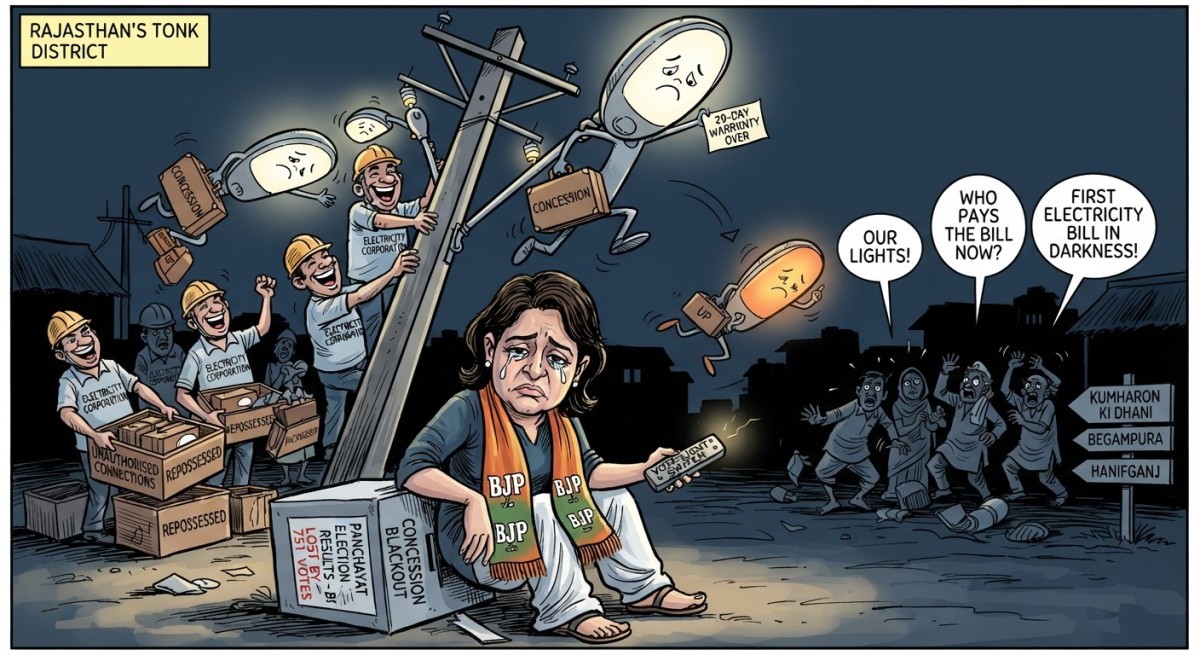
In Rajasthan's Tonk district, democracy has finally achieved what philosophers only dreamed of: an election result you can see from space, mainly because the lights went out. Priyanka Sharma, the BJP candidate for a Peeplu Panchayat Samiti seat and wife of Alok Sharma, personal assistant to Niwai MLA Ramsahay Verma, lost on Friday by 751 votes. About three hours later, an electricity crew arrived and began taking down the street lights. Most candidates give a concession speech. This one, villagers allege, gave a concession blackout.
The lights had a short, glorious career. "After seeing the colonies in darkness during the campaign, Priyanka had around 50 road lights installed in the villages and hamlets on 24 October," ward panch Kajod Prajapat told Dainik Bhaskar. So the campaign promise was literally "I will bring light," and the post-election policy was literally "never mind." Most politicians take four years to break a promise. This one was dismantled before dinner.
About 50 LED bulbs went up across hamlets including Kumharon Ki Dhani, Begampura, Hanifganj and Bijalpura, which is a lot of illumination for a job that, as it turns out, came with a 29-day warranty. Villagers praised the lights. The lights, sensing they were in a swing district, waited for the count.
The electricity corporation insists politics had nothing to do with it. Its team, officials said, simply noticed that the lights were wired to the poles through unauthorised connections. "The illegally installed lights will be removed," said Assistant Engineer Govardhan Choudhary, with the calm of a man who has never needed to find a goat at night. When villagers protested, he went further: "We did not remove the road lights at anyone's request. They must have been installed illegally by an unidentified person." An unidentified person. Fifty lights. During a campaign. With a candidate's name all over the neighborhood. Sherlock Holmes would need a nap.
Choudhary added, "People often install them during elections, but this is wrong." This is the single most honest sentence in Indian electoral history: yes, candidates often hang free lights on public poles before votes, and yes, the power company has noticed, usually around the time the votes are counted.
Villagers asked the obvious question: if the connections were illegal on October 24, why did nobody notice until the evening of the defeat? It is a fair point. Apparently the electricity corporation's inspectors can only see in the dark once somebody loses.
MLA Ramsahay Verma denied any political motive, saying candidates had put up the lights before Diwali and they came down once the matter of electricity bills arose. This is the most relatable explanation in politics: nothing ends a romance faster than someone asking who is paying.
The crew managed to unscrew lights from about 10 poles in Kumharon Ki Dhani before residents objected. The rest, roughly 40 poles, were spared after the newly elected sarpanches reportedly agreed to pay the electricity bills. So the winners inherited the lights, the loser inherited the moral high ground, and the voters inherited a lesson in civics: in Tonk, you do not just elect a representative. You elect the person who pays for the bulbs.
The utility has opened an inquiry to find out who installed the lights. Investigators are urged to look somewhere well lit.
Everything Tonk Wanted to Know About Voting by Candlelight
What's Your Reaction?
 Like
0
 Dislike
0
 Love
0
 Funny
0
 Wow
0
 Sad
0
 Angry
0




Comments (0)