

Miami (Ohio) Fills the Video Board With Extra Field-Goal Posts, the Referee Flags the Screen for Unsportsmanlike Conduct, and the Kick Still Clangs Off the Only Upright That Counts
On Wednesday morning, write-ups of Tuesday night's Battle of the Bricks were still circulating a clip from Yager Stadium in Oxford, Ohio, where Miami (Ohio) was flagged for unsportsmanlike conduct after its video board displayed depictions of field-goal uprights during an Ohio kick. Ohio led 17-7 and lined up a 34-yard field goal just before halftime, with kicker Brack Peacock trying to extend the lead. Before the snap, the home video board showed multiple shots of the yellow goal posts, apparently to confuse the kicker about which uprights were attached to the ground. Peacock missed, and Wednesday's local coverage said the ball clanged off one of the uprights, but a flag was already on the field. The referee announced: "On the previous play, there were depictions of the field goal uprights on the scoreboard. That is a foul for unsportsmanlike conduct against Miami. Half the distance to the goal, automatic first down." Ohio accepted the penalty and, with six seconds left, tried a fake

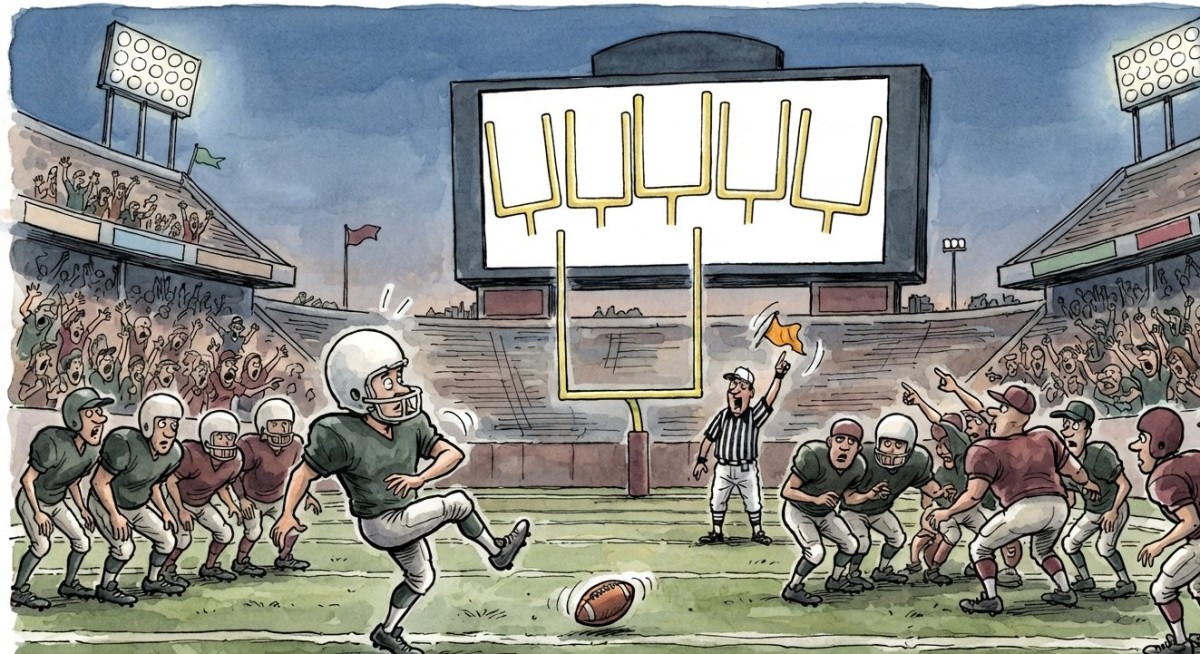
The sports briefing for Wednesday did not lead with a missed kick. It led with a video board, a second set of field-goal posts that were not attached to the ground, and a referee who had to flag a screen. On Wednesday morning, write-ups of Tuesday night's Battle of the Bricks were still circulating a clip from Yager Stadium in Oxford, Ohio, where Miami (Ohio) was flagged for unsportsmanlike conduct after its video board displayed depictions of field-goal uprights during an Ohio kick. The official record had the exhausted dignity of a scoreboard that has been asked to host a target it does not own. The real posts, having been invited to share the frame, went through with it and then watched the flag land on the picture.
Ohio led 17-7 and lined up a 34-yard field goal just before halftime, with kicker Brack Peacock trying to extend the lead before the locker room. Before the snap, the home video board showed multiple shots of the yellow goal posts, apparently to confuse the kicker about which uprights had been bolted to the grass and which had been invented for the occasion. This is the professional dialect for a distraction that declined to stay in the lighting booth. A field-goal post is supposed to arrive as a pair and then keep still. A video board, in this account, offered several more and then waited to see which ones the kick would believe. Peacock missed, and Wednesday's local coverage said the ball clanged off one of the uprights, which is the testimony of a kick that has been asked to choose from a menu and has selected, reasonably, the only item that was actually there. The photographs and broadcast footage published with the Wednesday write-ups show a stadium screen dressed as a second set of posts. A kicker is not supposed to require a building permit to find the target. The board, for one snap, did not take notes.
The referee completed the briefing more efficiently than a rulebook. "On the previous play, there were depictions of the field goal uprights on the scoreboard," he announced. "That is a foul for unsportsmanlike conduct against Miami. Half the distance to the goal, automatic first down." Unsportsmanlike conduct, historically a human offence, has now been extended to a rectangle of lights, which is how a rule keeps up with the furniture. The NCAA had been waiting for this appointment since 2021, when video-board and lighting-system operators were added to the list of people who may not create a distraction that obstructs play. Rule 1-1-6 forbids persons subject to the rules, including those operators, from creating any noise or distraction that prohibits a team from hearing its signals or obstructs play. A companion clause, Rule 1-4-2-d, is even shorter: no equipment may be used to confuse opponents. A video board is equipment. Extra uprights, when they exist only as pictures behind the real ones, are a confusion. The official, having found both the pictures and the rule, applied the one to the other and threw the flag at the screen.
The trick, it should be said, did not invent itself on Tuesday night. Oklahoma State tried a cousin of it against Texas in 2020, lining the board with yellow vertical lines rather than extra shots of the posts. Texas head coach Tom Herman was not amused, the conference was contacted, and months later the rulebook was updated to include the operator among the people who can be flagged. The screen at Yager Stadium, having declined to read the amendment, went ahead with a more literal version of the original idea and received the original penalty. The NFL, for its part, tightened what may be shown on video boards during field-goal and extra-point attempts earlier this season, after a former analytics staffer pointed out how often a rear-angle shot of the posts had been appearing behind visiting kickers. College football, watching the same furniture, has now produced its own citation. The posts that were painted on the screen did not become real. The flag, having been asked to find a defendant, did.
Ohio accepted the penalty and, with six seconds left, declined to kick the same play twice. The Bobcats tried a fake field goal instead. Magnus Haines's pass to Evan Herrmann on first-and-goal fell incomplete, the half ended 17-7, and the extra posts, having done their work and then been written up for it, were not asked back for a second attempt. The rest of the afternoon then filed a correction that had nothing to do with the screen. Miami, which had already come back from 17-0 to 17-7, scored 27 unanswered points in the second half and won the Battle of the Bricks 34-17, moving to 6-4. Ohio did not score again. The penalty, in the official accounting, was not costly. The clip, in the Wednesday accounting, was the thing people were still watching. A comeback is a respectable way to win a rivalry. A flagged video board is a more efficient way to be remembered.
Until a stadium invents a display that can tell a kicker how many uprights he is allowed to see, Tuesday night from Yager Stadium is already on the record. Wednesday's write-ups have the clip. The referee has the announcement, the flag, and a foul that named the scoreboard. The rulebook has the 2021 amendment that had been sitting there for just this appointment. The kicker has a miss that, in the local account, still found the only upright with a building permit. The Bobcats have a fake that did not finish the joke. The RedHawks have a 34-17 win, a 6-4 record, and a screen that tried to help and was cited for the effort. Further details will have to wait for a video board that has been given enough time to look like itself again, and for a kick that is not asked to share the frame with a copy of its own target. The official record, for the moment, is extra posts, a flagged screen, a clang, and the only upright that counted.
Questions Still Looking for the Real Uprights After Yager Stadium Invented a Few Extra
What's Your Reaction?
 Like
0
 Dislike
0
 Love
0
 Funny
0
 Wow
0
 Sad
0
 Angry
0
Comments (0)