

New Zealand's Third-Warmest Winter Wakes Auckland's Bees Early, Then Lets Them Hold a Parking Space and a Queen Street Sign
Auckland is having an unusually large bee swarming season after what beekeepers call a milder than usual winter and a soft start to spring, a weather plot twist Earth Sciences NZ can file under the country's third-warmest winter on record. The Auckland Beekeepers Association is now taking five to ten swarm-removal calls a day, up from under five in past years, and has already logged at least 100 call-outs. In October, a swarm plastered the back of a parked car in Birkenhead for two hours while a woman napped inside, which is one way to keep a space. A month earlier, bees took over a sign on Queen Street and made pedestrians reroute, the insect version of a road closure with better branding. Officials say the bees are at their most placid when swarming. The city is still treating street furniture like a waiting room.

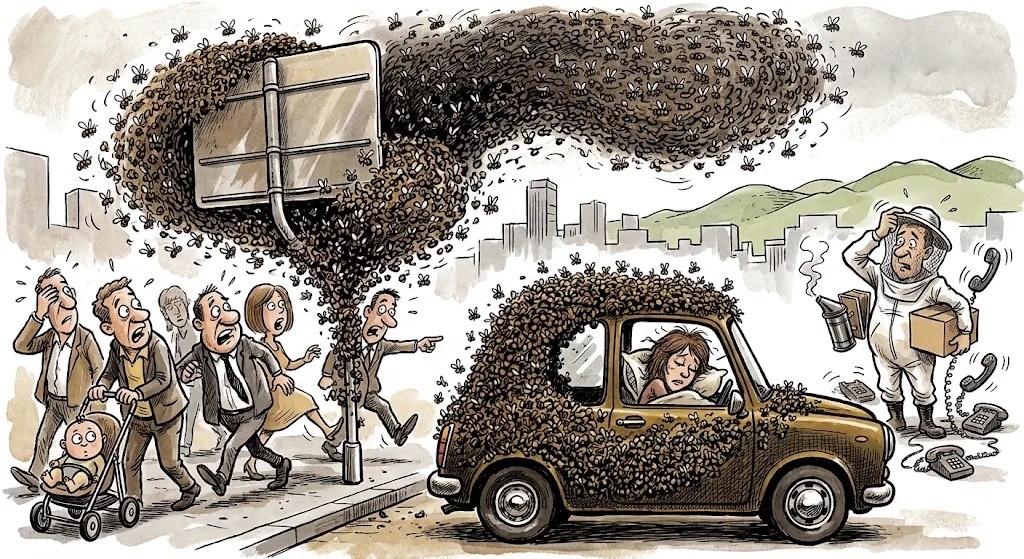
The modern way to announce spring in Auckland is apparently to cover a parked car in bees and let the beekeepers take the calls. New Zealand has just logged its third-warmest winter on record, according to Earth Sciences NZ, and the Auckland Beekeepers Association says a milder winter and a soft start to spring have sent honeybees house-hunting weeks earlier than usual, and in larger numbers. The association is now fielding five to ten swarm-removal calls a day, up from under five in past years. The running total is at least 100 call-outs. If your city has a waitlist for insect relocations, congratulations: the weather has upgraded your street furniture to temporary housing.
The official explanation is almost disappointingly practical, which is how you know the entomologists were awake. During spring and early summer, part of a colony that has outgrown its hive leaves in search of a new home or extra food, parks somewhere convenient, and sends scout bees out to find a proper address. This is called swarming, and it is as natural as a lease ending, except the tenants arrive as a single loud cloud. Bryan Lang, the association's swarm control coordinator, put the beekeeper's version plainly: you do not want them to swarm, because you lose two-thirds of your bees right when they should be bringing honey in, and it is not great for the neighbors either. The neighbors, for the record, did not book this.
The rest of the map treated it like a roll call. In October, a swarm plastered the back of a parked car in Birkenhead for two hours, according to witnesses, while a woman inside was napping. Lang said he was surprised she did not hear them, because they are pretty loud, which is the kindest possible review of both the bees and the nap. A month earlier, a swarm took over a sign at a busy intersection on Queen Street, Auckland's main commercial thoroughfare, and forced pedestrians to reroute, the civic equivalent of a detour caused by a committee that does not read email. Association president Ken Brown notes that when bees swarm in the countryside, no one really notices. "Townies," he said, are not so familiar. The city has now been introduced.
Brown's weather brief is the part that belongs on a forecast. He believes the milder winter and the start of spring produced larger broods of eggs, larvae, and pupae. If the colonies do not succumb to varroa mite, a tiny parasite that attaches to honeybees and their young, the survivors are much stronger and ready to swarm sooner. Earth Sciences NZ's winter summary gives the country a number to hang that on: a nationwide average of 9.7 degrees Celsius, 1.1 degrees above the 1991-2020 winter average, the third-warmest winter since the agency's temperature series began in 1909. Brown says beekeeping is more unpredictable now because the extremes and the patterns keep shifting. Every year is slightly different, he said, and recently it has been even more different. That is the scientific way of saying the calendar has stopped taking notes.
There is a comedy in the vocabulary. A swarm sounds like a crisis and is, according to the people who collect them, a colony at its most placid, focused on relocation and not looking for a fight. Brown said people who do not know bees might feel intimidated by thousands of venomous insects flying around. The recommended response is still to call a beekeeper, not to swat the movers. Prof Phil Lester, an entomologist and ecologist at Victoria University, said collectors have been busy in other parts of the country as well, including Wellington. Unmanaged swarms can carry varroa to other honeybees or native bees, which is the unfunny footnote. The funnier one is Lester's verdict on the season itself: the early buildup is probably a good indication that it is a good bee year. The bees got a head start. The city got the forwarding address.
Until Auckland invents a winter that stays cold enough to keep the hives on their original lease, the honest takeaway is narrower and funnier. A mild season can now put five to ten swarm calls on a beekeeper's desk before lunch, decorate a Birkenhead bumper for two hours, close a walking lane on Queen Street, and still be, technically, just spring arriving early with better branding. The woman in the car slept through her visitors. The sign did not. The association is still answering the phone. Weather news has officially entered the era where the most memorable tenant of the morning has no lease, no forwarding form, and a better sense of timing than the forecast. Your street is still available. The opening credits just grew a swarm.
Questions Still Buzzing After the Weather Gave Bees a Head Start
What's Your Reaction?
 Like
0
 Dislike
0
 Love
0
 Funny
0
 Wow
0
 Sad
0
 Angry
0



Comments (0)